Citing this page does not grant permission to republish it. Copyright & reuse.
Wherever the records find them, the Aguris, or Ugra Kshatriyas, are above all a community of Burdwan. In 1872, 85 per cent of those counted in Bengal lived in Burdwan district.[1] Their documented history runs through the Burdwan Raj: its cash-paid army in the eighteenth century, its estate and tenures in the nineteenth, and the land, trade and politics of the district in the twentieth.
This page follows that history in order, from the question of origins to land reform. Each statement is labelled by the kind of evidence behind it.
Documented: a dated record, or a scholar’s reading of records, interviews or fieldwork.
Reported: a scholar’s statement taken from local histories or reports whose own sources have not yet been traced.
Tradition: an account handed down in a family or the community, including descent from a named founder.
Interpretation: an explanation of the evidence, including this website’s own working view, which others may dispute.
Mukundaram’s Chandimangal, composed in the later sixteenth century, contains a couplet on the Aghari or Aguri. Scholars quote it in different wordings,[1][2] and the standard edition rests on a manuscript dated 1700. Read the discussion.
Documented
The rise of the Burdwan Raj
A family of Punjabi Khatris gains office at Burdwan in 1657 or 1679–80 and is confirmed as zamindars in 1695–96. Under Kirtichand (1702–40) the estate becomes “a virtual Hindu kingdom”.[3]
Documented
The Company takes Burdwan
Burdwan is ceded to the East India Company. In December a Company detachment defeats the Raja’s army and its Birbhum allies near Burdwan.[4][3]Read about the Raj’s army.
Documented · end date reported
The cash army wound down
Pay for the Raja’s cash-paid troops falls from Rs 33,000 a month in 1761 to Rs 8,660 in 1767; the corps is abolished in 1787.[4] Dutta’s sources give 1809 as the end.[1]
Documented
Patni tenures
After the Permanent Settlement of 1793 the Raja begins granting perpetual patni tenures, legalised in 1819. By 1826 the Collector credits them with “a new class of landed gentry”.[4]
Census
The first count
The census records 70,606 Aguris in Bengal, 59,887 of them in Burdwan district.[1]
Literary
The name in print
Lal Behari Day’s novel Govinda Samanta, later Bengal Peasant Life, calls its peasant family Ugra Kshatriya or Aguri.[5]
Risley, Vidyanidhi and Bhattacharya record the Jana and Suta branches and the claim to be the Ugra of Manu.[7][8][9]Read about Jana and Suta.
Community history
Rajput O Ugrakshatriya
Haricharan Bandhu’s Bengali history argues for Rajput descent. Prabasi reviews it in 1915, and a revised edition appears in 1940.[1][10][11]
Census
Ugra Kshatriya in the census
After the Samiti’s revival in 1927, the caste agrees to return itself in the census as Ugra Kshatriya rather than Aguri.[1]
Freedom movement
Quit India in Burdwan
Dasarathi Tah leads Quit India actions around Raina and Jamalpur; at Kalna, the arrest of the lawyer Ananda Prasad Mondal sets off attacks on the jail and the court.[12]Read about Aguris in the freedom struggle.
Agrarian politics
Land reform
Hare Krishna Konar becomes minister for land and land revenue in West Bengal’s United Front government.[13]Read his biography.
No surviving document records how or when the Aguris formed, and firmly dated references begin late. The Chandimangal couplet is firmly attested only from about 1700; Bharatchandra places Aguris in Bardhaman in the 1750s; and the 1872 census finds them concentrated in the district the Burdwan Raj ruled.[2][1] McLane reads the Chandimangal line as proof that Aguris lived there before the Khatri rulers arrived (p. 157).[3] With its wording and date both disputed, this website does not treat that reading as settled.
Interpretation · this website’s working view
Soldiers of the Raj’s cash-paid army
This website’s working view is that the Aguris descend from the naqdi or Nagadee troops, the army the Burdwan Raj paid in cash, and became landholders as the East India Company wound that army down. The army is documented in Company records (see below); its link with the Aguris is reported. Dutta, citing a 1982 local history by Ajit Halder and the 1940 settlement report, calls Ugra Kshatriyas “the bulk of the nagdees”, and records the community’s own account that it took to farming after losing military employment in the 1760s (p. 299).[1]The Origins article sets out the argument and its limits.
Textual identification · not a genealogy
The Ugra of Manu
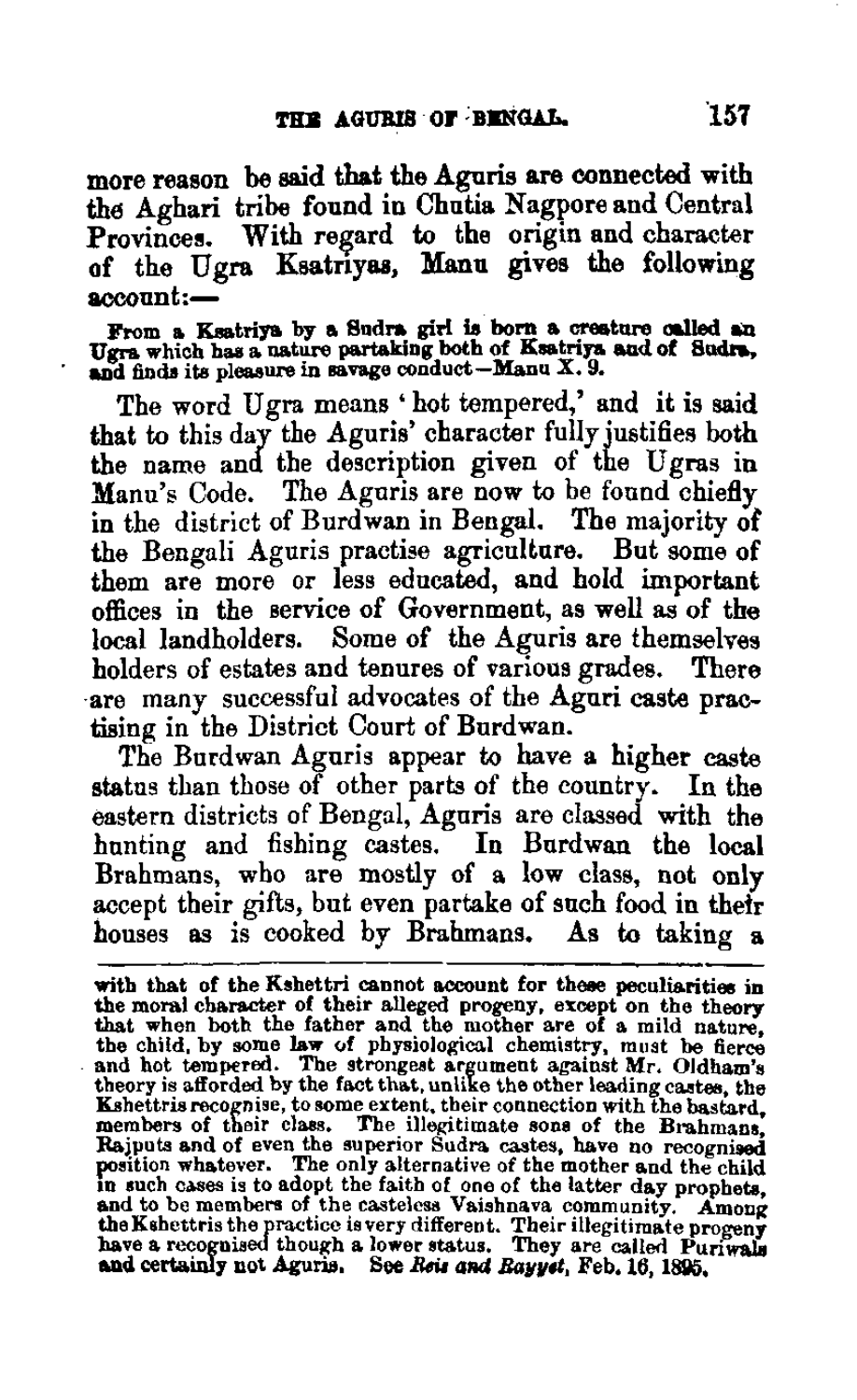
Risley recorded a popular belief, and Bhattacharya a claim, that the Aguris are the Ugra of the Manusmriti (X.9), born of a Kshatriya father and a Shudra mother.[7][9] The identification explains the name Ugra Kshatriya (see below); it is not a family history.
Colonial theory · rejected
Unions of Khatris and Sadgops
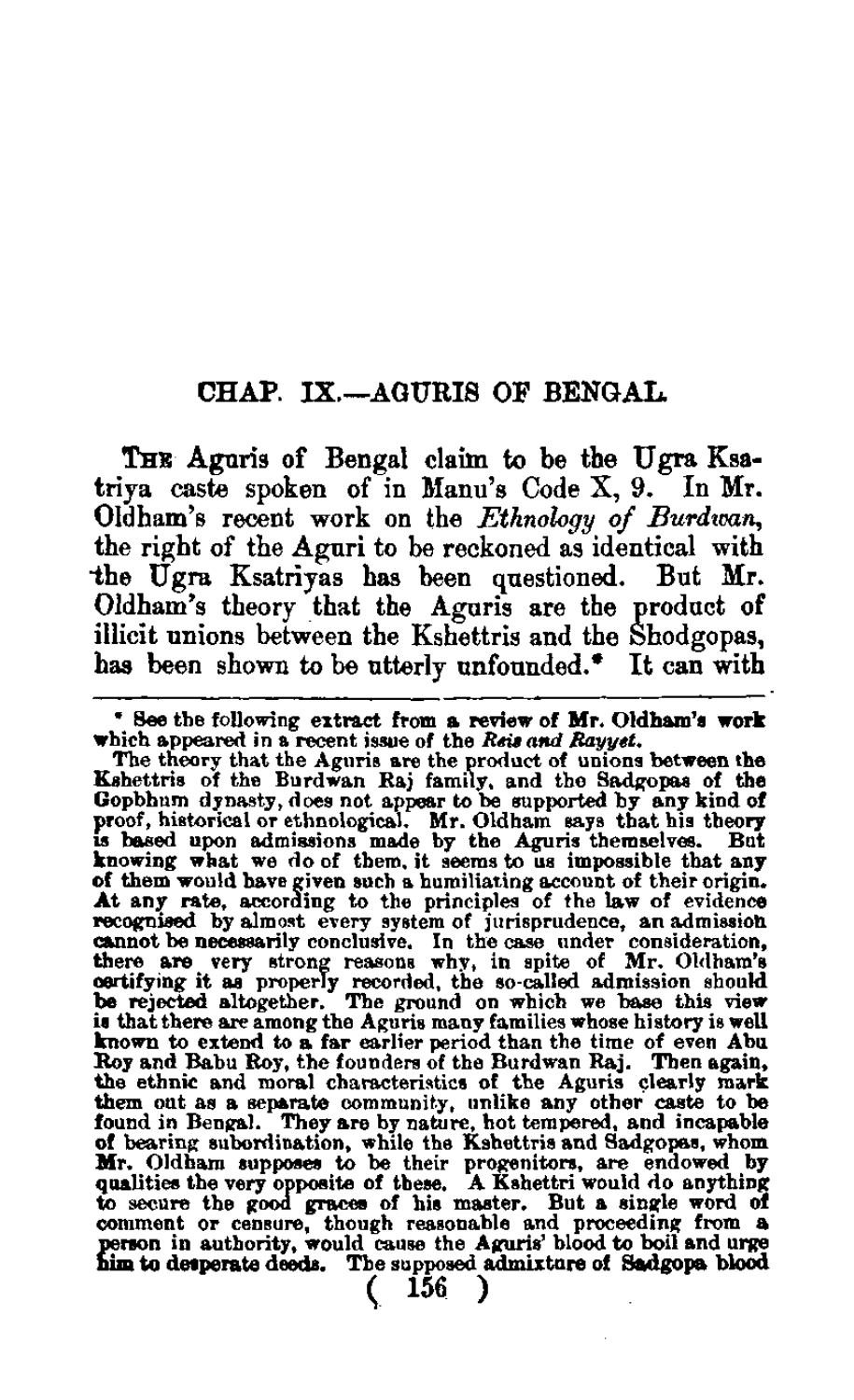
W. B. Oldham (1891) derived the Aguris from unions between Khatris of the Raj family and Sadgops, citing what he called the Aguris’ own admissions; Peterson’s gazetteer repeated it in 1910 (p. 22).[16] A review quoted by Bhattacharya found no “proof, historical or ethnological” for it (pp. 156–157), and McLane calls Oldham “obviously misled” (p. 157).[9][3]
Tradition · no supporting record
Migration from Agra with Man Singh
A tradition, repeated by Bhaumik (p. 48), brings the Aguris from Agra or Rajasthan with the army of Raja Man Singh, Mughal governor of Bengal from 1595.[2] Haricharan Bandhu attributed it to Panchanan Tarkaratna and rejected it as conjecture.[11] Burdwan lay on Man Singh’s line of march (McLane, pp. 128–129), but no record ties any Aguri family to his army.[3]
Community history · Haricharan Bandhu
Rajput soldiers and royal land grants
In the 1940 edition of Rajput O Ugrakshatriya, Bandhu argued that Rajput warriors became land-grant holders in Rarh, deriving Agari or Aguri from agrahari through his reading of the Mallasarul copperplate.[11] The book belongs to the campaign for Kshatriya recognition (see below). Dutta allows a possible link with Pala-era military groups, as a possibility only (pp. 302–303).[1]
A useful distinctionAn early written mention tells us that a name was in use by that point. It does not tell us when a community first formed, or prove a single origin for all its families.
The Burdwan Raj and its cash-paid army
Documented When Sobha Singh rose in 1696, Raja Krishnaram Rai met the rebels “with a small band of followers” and was killed (Chakravarti, p. 5).[4] Half a century later, after Kirtichand’s long reign (1702–40), the estate covered about five thousand square miles. McLane calls its growth a product of “nawabi patronage rather than military adventurism”, though where resistance was met, as at Chandrakona and Gopbhum, “the Burdwan zamindari army, and if necessary the nawab’s army” completed the takeover (pp. 125, 159).[3]
Documented Alongside servants paid in land, the Raj kept troops paid in cash from its treasury: the naqdi, nagdee or Nagadee, from nagad, cash. McLane calls it “the raja of Burdwan’s naqdi or cash-paid army” (p. 117).[3] In 1777 the Raja’s diwan told the Company that the troops had been kept to guard against family disputes and the inroads of robbers. He listed what successive Residents had allowed for them each month: Rs 33,000 in 1761, Rs 22,000 in 1763, Rs 16,000 in 1766 and Rs 8,660 in 1767. In 1767 the force numbered 1,487 men, 296 of them horsemen, posted at the Raja’s house, with the Raja’s mother at Amboah, and at outposts such as Chandrakona and Billabgarh. That year 648 were dismissed and 839 kept (Chakravarti, pp. 163–165).[4] The land-paid establishment was a separate and larger body. In 1766 it numbered 32,031 servants, including 4,793 guards of forts and passes and 19,846 village paiks, peons and kotwals (Chakravarti, p. 162; McLane, p. 118).[4][3]
Documented The army’s one recorded battle was against the Company. Mir Qasim ceded Burdwan to the East India Company in September 1760. That July the Raja’s “unpaid discontented forces” had fired on Company sepoys (McLane, p. 183). On the night of 29 December 1760 the Burdwan forces, under their general Misri Khan, joined those of the Raja of Birbhum against a Company detachment under Martin White, at the pass of the Banka river between Burdwan and Sangotgola. White put the allied force at about ten thousand men. It lost some 500 killed and was defeated (Chakravarti, pp. 22–24; McLane, pp. 184–185).[4][3]
Documented The Company cut the force in stages. Johnstone, the first Resident, pared the military payroll in 1763 from almost Rs 4 lakh a year to Rs 2.64 lakh, and the 1767 cuts left 839 men (McLane, p. 192).[3] In 1787 the household troops were placed under a Company officer and the “Nugdean Corps” was abolished, with part of the sebundy, or irregular troops, left under Raja Tejchand (Chakravarti, p. 177). McLane describes the same step as halving the zamindari troops to 1,000 (p. 263).[4][3] Dutta’s sources say the arrangement ended in 1809 (p. 300).[1]
Reported None of these Company records names the caste of the soldiers. The identification of the Aguris with the cash army comes from twentieth-century sources cited by Dutta. Halder and the settlement report call the Ugra Kshatriyas “the bulk of the nagdees” and put about 10,000 nagdee infantry in the field in 1760 (pp. 299–300).[1] The eighteenth-century papers behind those statements have not yet been traced. Bhattacharya’s 1896 placing of the Aguris among “The Military Castes” is a classification, not a service record (see below).
Land, enterprise and family histories
From soldiers to landholders
Reported Halder, as cited by Dutta, places many former nagdee soldiers of the Aguri community in a new stratum of powerful peasants in early colonial Burdwan, each holding 30 to 100 acres (p. 307).[1]
Documented The Burdwan estate’s tenures gave such families room to rise. After the Permanent Settlement of 1793 the Raja began, in 1802, to grant patni tenures: perpetual rights to collect rent under the zamindari, sold to the highest bidders and legalised by Regulation VIII of 1819. In 1826 the Collector of Burdwan wrote that hereditary occupancy had “given birth to a new class of landed gentry” (Chakravarti, pp. 123–127, 154).[4] Dutta and Bhaumik describe Aguri landholders and substantial peasants consolidating their position through patni interests (Dutta, p. 307; Bhaumik, p. 198).[1][2]
Documented By 1891 Risley found that “many of them hold estates and tenures of various grades, and the bulk of the caste are fairly prosperous cultivators” (p. 13).[7] McLane calls them “a successful caste of jotdars and small traders” with “a special relationship with the Burdwan raj”, and judges that they “seem to have been an important element” in the Raj’s hold over its estate (p. 158). He also lists Aguris, with Kaibartas and Sadgops, among the dominant peasants who ran most villages in western Bengal, without dating when they gained that position (pp. 54–55).[3]
Prosperity was never universal. Dutta acknowledges poor Aguri cultivators and examines the power prosperous families held over poorer neighbours (pp. 306–307).[1]
Trade, mills and mines
Interpretation Dutta, a historian at the University of Burdwan, explains Aguri influence through the overlap of cultivation, grain trading, lending and rice milling: profits went into land and tenures, and railways and wider markets created new opportunities (pp. 306–311). His study of Burdwan’s rice trade from 1880 to 1947 traces the markets and millers those businesses depended on.[1][17]
Documented · Dutta Dutta names the Hazras of Anguna, the Roy Chowdhurys of Chaitanyapur, the Tahs of Palitpur and the Panjas of Sathinandi among prosperous Aguri families investing in land (p. 308). The Hazras, in the trans-Damodar region, developed interests in both rice milling and coal mining in Burdwan (p. 309). Banwarilal Panja’s family of Sathinandi traded agricultural produce on commission and invested the proceeds in land in Burdwan and Bankura (p. 308). Satya Kinkar Sahana’s family of Bankura expanded from cultivation and lending into warehousing, mining and rice milling (pp. 309–310), and Nagendranath and Janaki Nath Samanta appear among the pioneers of Burdwan’s rice-milling industry (p. 309).[1] Dutta draws on settlement reports, district histories, newspapers and interviews. The individual mills, mines and dates behind these examples have not yet been traced in the underlying records, and the list is not a roll of every significant family.
A village view: Kshiragram
Documented · ethnography Masahiko Togawa’s study of the Jogadya temple at Kshiragram, in the Mangalkot block, An Abode of the Goddess (2006), rests on fieldwork in 1994–95. Of the 655 households in his caste table, 217 were Ugra Kshatriya: 84 Jana Aguri and 133 Suta Aguri. Bagdi households numbered 178 and Brahman households 85. Ugra Kshatriyas held the greater part of the village’s agricultural land, and nine lineages distinguished by their titles each sent a representative to the temple ritual. In the order the priests call them, they are Datta, Samant, Malla, Sani, Ray, Josh, Chota-Ray, Chota-Samant and Chaudhuri; the Datta and Samant lineages are Jana Aguri and the other seven Suta Aguri (pp. 49–50, 94). The book also gives 729 households from the 1991 Census, so the two totals should not be combined (pp. 25, 49).[18]
The lineages’ ties to the Raj ran through ritual. Five Durga Pujas, each in an Ugra Kshatriya para, were timed to the Durga Puja of the Raj’s temple (pp. 130, 145–146); the Datta and Samant lineages held service land from the Maharaja for duties at the temple’s Baishakh festival (pp. 59–61); and after zamindari ended, the lineages took over many sacrifices once offered in the Maharaja’s name (p. 112).[18]Read about the temple rituals.
Tradition · genealogical claim A lineage chart kept by the main Raychaudhuri family of Chaitanyapur, which Dutta lists among prosperous Aguri households, traces the family to a raja, gives its original title as De of pargana Dhenya, and records moves to Eruyar in 1154 BS (about 1746–47), Kshiragram in 1182 BS and Chaitanyapur in 1202 BS (about 1794–95). It credits the Bardhaman Maharaja with the titles Chaudhuri and Ray Chaudhuri (Togawa, pp. 147–150). The royal ancestry has not been independently traced.[18][1]
Fieldwork elsewhere shows the same mixture of prominence and shared village life. Salini Saha’s research at Musharu identifies Ugra Kshatriyas as the dominant farming community, living alongside Sadgops, Goalas, Namasudras and Bagdis and taking part in shared village worship (p. 7).[19]
A village view: Raina in the Dakshin Damodar
Documented · ethnography Arild Engelsen Ruud did fieldwork in 1992–93 in two villages of Raina I block, which he calls by the invented names Udaynala and Gopinathpur. In Gopinathpur the Aguris, “also known as Uggra-Kshatriya”, were the dominant caste: in 1993 they numbered 214 of 1,112 villagers (19.2 per cent) and owned 29.1 per cent of the land. Bagdis were the largest group, at a third of the population, and their quarter adjoined the Aguri quarter at the centre of the village (pp. 16–17). Around 1960, eight of the fourteen Aguri households held 20 bighas or more (pp. 53, 116). Aguri families often had relatives in government service or business, caste literature was among the reading of the older generation, and the higher-status groups “included a number of land-poor families” (pp. 84–85, 89, 115).[20]
Jana and Suta
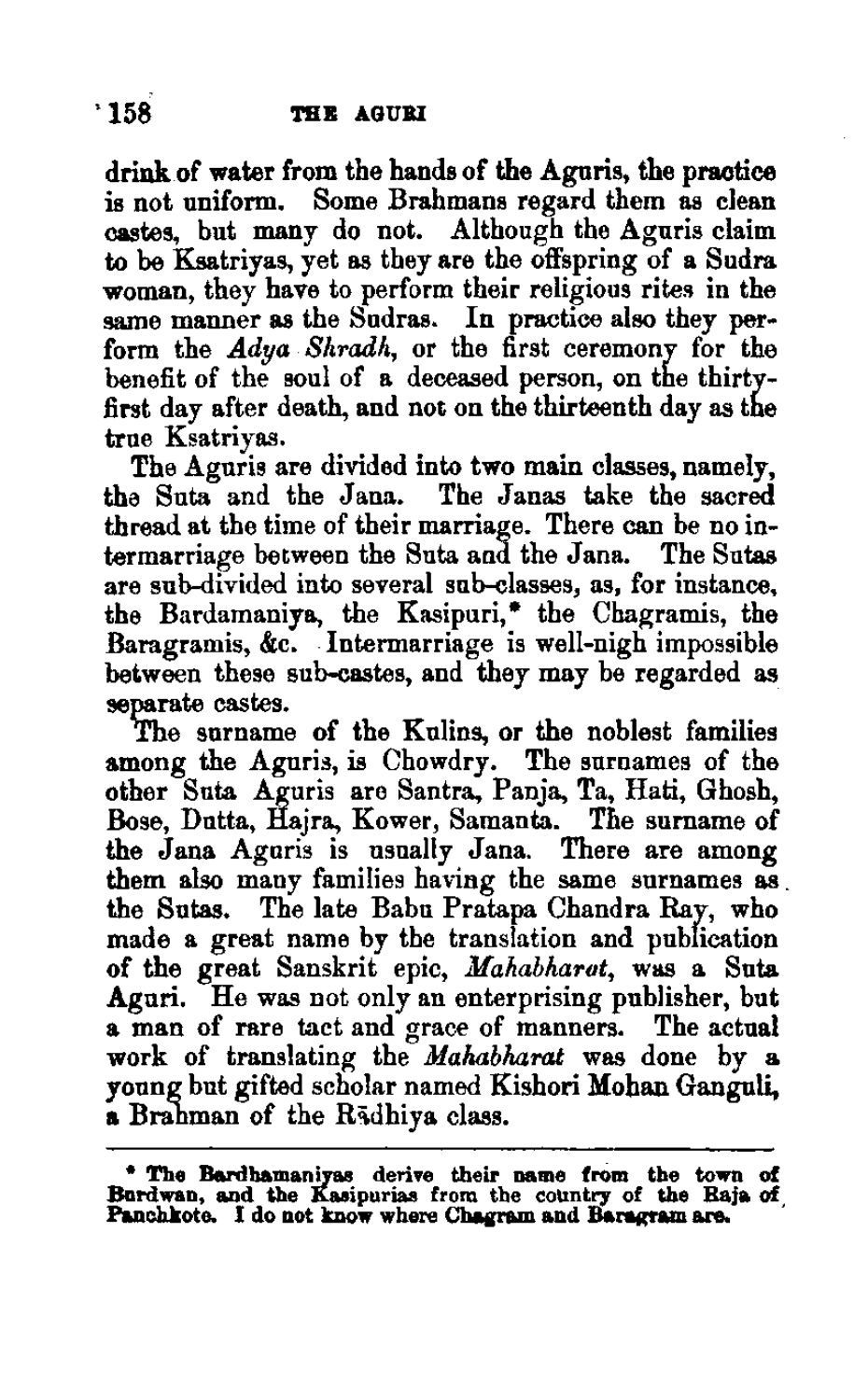
Documented By the late nineteenth century the Aguris were divided into two main branches, Jana and Suta, which did not intermarry. Risley (1891) lists them among seven sub-castes and notes that both claimed a mythical ancestor, Dakshin Rai, while taunting each other with illegitimacy. Only Janas wore the sacred thread, which they assumed at marriage, and “those, however, who work as cultivators and drive the plough with their own hands usually discard the thread” (p. 12).[7] Vidyanidhi (1896) adds that the Janas justified the thread from the Brihaddharma Purana while the Sutas followed Manu and lived as Shudras, that the branches did not intermarry or ordinarily dine together, and that Hazra and Chaudhuri families were mostly Kulin (pp. 187–188).[8] Bhattacharya (1896) divides the Sutas further into Bardhamaniya, Kasipuri, Chagrami and Baragrami sub-classes that “may be regarded as separate castes”, and notes that Jana families were usually, but not always, surnamed Jana (p. 158).[9]
Interpretation · tradition What separated the branches is not settled. Risley’s remark ties the thread to not ploughing, which suggests a line of status as much as of descent. Bhaumik describes the Janas as agriculturalists who claimed Kulin rank and the Sutas as “more or less professionals”, later in white-collar work (p. 49).[2] Community tradition, as recorded by this project, holds that the Janas were the landed families and the Sutas the less propertied section, the first to move into salaried and professional work in the early twentieth century. Village evidence is mixed. At Kshiragram in 1994–95, Suta households outnumbered Jana ones by 133 to 84, while the two Jana lineages held the senior places in temple ritual (Togawa, pp. 49–50, 186).[18] Reformers worked to bring the branches together, and marriages between them are recorded from the 1920s (Dutta, pp. 312–313).[1] Titles and surnames are discussed on the Surnames page.
Organisation, reform and the Ugra Kshatriya name
Documented Aguri is the older name in the records; Ugra Kshatriya is the name the community chose. Lal Behari Day’s novel Govinda Samanta (1874), later Bengal Peasant Life, already calls its peasant family Ugra Kshatriya or Aguri (p. 31 in the 1916 reprint).[5] The Ugra Kshatriya Samiti, founded in 1888 and said to be Burdwan’s first caste association, began the monthly Ugrakshatriya-Pratinidhi in 1891.[1][6] After a lull from about 1913 it was reorganised in 1927, started the quarterly Ugra Kshatriya Patrika in 1929 and held conferences until 1950. They campaigned for education, improved farming, widow remarriage, an end to dowry and closer ties between Jana and Suta, and urged members to vote for Ugra Kshatriya candidates (Dutta, pp. 311–313).[1]More on the reform movement.
Documented The name was part of a claim to rank. The 1901 census placed the Aguris with the Baidyas and Kayasthas in Group II, the castes ranked below Brahmans and above clean Shudras. Before the 1931 census the caste objected to “Aguri” as a vulgar term and agreed to return itself as Ugra Kshatriya (Dutta, p. 317).[1] Dutta describes qualified local recognition in Burdwan, with food, water and priestly-service conventions that varied from place to place (pp. 317–319). Bhaumik lists the Aguris among castes that had begun to wear the sacred thread around the 1911 census (p. 247), though the Jana custom was already recorded in 1891.[1][2] These claims and responses changed with period and locality; they do not describe a single fixed hierarchy.
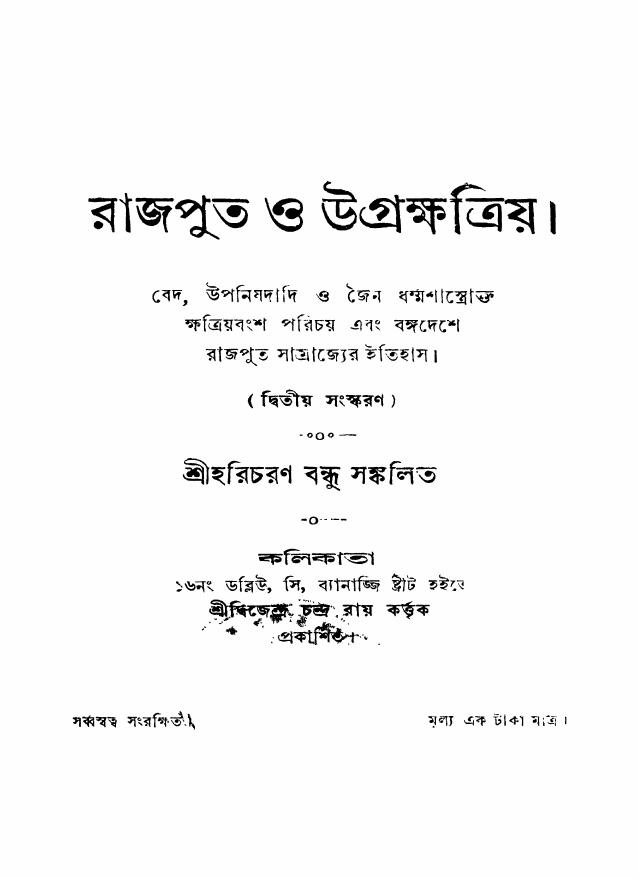
Second-edition title leaf. Digital Library of India scan, from the Bangiya Sahitya Parishad collection.
Haricharan Bandhu · 1913 and 1940
রাজপুত ও উগ্রক্ষত্রিয় Rajputs and Ugra Kshatriyas
Haricharan Bandhu’s Rajput O Ugrakshatriya was the fullest Bengali statement of the community’s case. Dutta discusses its first edition, of 1913, among works advancing a Rajput connection (p. 315).[1] A review in Prabasi (Magh 1321, 1915, pp. 470–471) described its treatment of origins and customs and asked why its foreword was in English.[10] For the second edition of 1940 Bandhu replaced a chapter with a discussion of Pala and Sena inscriptions, and his publisher, Dwijendra Chandra Ray, appealed for unity within the community.[11]
The book is a primary source for how the community argued its history. Its proposed Rajput ancestry is the author’s case, not an established finding.
Documented · Dutta Dutta names six Ugra Kshatriyas who took part in the freedom movement and who “remain alive in the memory of people at the local level”: Jadabendranath Panja, Dasarathi Tah, Ananda Prasad Mondal, Benoy Chowdhury, Harekrishna Konar and Shib Shankar Chowdhury. Many of them, he adds, later “dedicated themselves to the cause of communism” (p. 314).[1] Their routes differed: Gandhian Congress campaigns, the revolutionary underground and the Andaman prison, and the Quit India rising of 1942 in the Damodar country.
Aguri participants in the freedom movement named by Dutta (p. 314), with their political affiliations. Details come from the sources cited in the text below and in the People section; “not traced” means no further record has yet been found.
Left the Burdwan bar for Non-Cooperation in 1920; Mahishbathan salt satyagraha; led the Burdwan District Congress for about twenty years; jailed 1932–34 and 1942
State minister for Cottage and Small-scale Industries; president of the West Bengal Pradesh Congress Committee, 1958–61
Jugantar from 1928; Communist Party of India from 1938; later CPI(M)
Led Burdwan’s satyagrahi group in 1930; revolutionary activism and imprisonment
Defeated Burdwan’s former Maharaja in 1952; Left Front minister for land reform, including Operation Barga
Ananda Prasad Mondal
Lawyer (B.L.); party not recorded
His arrest at Kalna in September 1942 set off attacks on the jail, the munsif’s court, the post office and the railway station
Not traced
Shib Shankar Chowdhury
Not recorded
Named by Dutta among local leaders of the movement
Not traced
Congress and the Gandhian campaigns
Documented Jadabendra Nath Panja, son of the Burdwan schoolteacher Nrisinghamurari Panja, took a law degree in 1911 and gave up his practice at the Burdwan District Court in 1920 to join the Non-Cooperation Movement (Dutta, p. 310).[1] He later took part in the Mahishbathan salt satyagraha in the 24 Parganas, led the undivided Burdwan District Congress for some twenty years, and was imprisoned in 1932–34 and again in 1942.[21][22] Dasarathi Tah joined the Congress in 1930 and took part in the salt satyagraha.[23]
Revolutionaries and the Andaman prison
Documented Benoy Choudhury recalled joining the Jugantar revolutionary party in 1928 and attending Bhupendranath Datta’s classes for revolutionaries; in 1930 he led Burdwan’s satyagrahi group.[24] Hare Krishna Konar was first jailed at fifteen during the civil disobedience campaign of 1930, when, according to Biman Basu, he came to know Benoy Choudhury. Arrested again in 1932 over plans attributed to the Jugantar group, he was transported to the Cellular Jail in the Andaman Islands, where he turned to Marxism.[13] There he took part in the hunger strike of May–June 1933, in which three prisoners died after force-feeding, and in the mass hunger strike of 1937 that led to the prisoners’ return to mainland jails.[25] Both men joined the Communist Party of India in 1938.[26][13]
Quit India in the Damodar country, 1942
Documented Sukanta Pramanik’s study of the 1942 movement in Burdwan gives Dasarathi Tah a leading part. On 26 August Tah issued a leaflet, printed at Raina Bazar, calling students to the struggle; on 1 September he organised a hartal at Jamalpur and Kalna; and on 19 September he led the raid on Jamalpur’s police station and post office, disguised in a lungi, a false beard and a cap. Most of the raiders came from the Raina police-station area (pp. 223–224).[12] In Kalna town that September, the arrest of the lawyer Ananda Prasad Mondal brought out a crowd of about 250. They attacked the jail gate demanding his release, then damaged the munsif’s court, burned post-office records, cut telegraph wires and set fire to the railway station (p. 224).[12]
Reported A 2026 newspaper feature adds that Tah’s men took over the Raina and Jamalpur police stations and pulled up the Bankura–Damodar Railway line, that the government offered a reward of Rs 10,000 for him dead or alive, and that he planned a parallel government on the model of Midnapore’s Tamralipta Jatiya Sarkar. The weekly Damodar, which he had founded in 1936, carried anti-British writing; his wife, the freedom fighter Roma Tah, kept it running while he was in hiding.[21][27]
After independence
Documented The paths divided after 1947. Konar and Benoy Choudhury led the communist peasant movement in Burdwan and later directed land reform as ministers (see Land reform and public life).[13][26] Tah represented Raina for the Kisan Mazdoor Praja and Praja Socialist parties before moving back to the Congress in 1969.[23][20] Panja, who stayed with the Congress, became a state minister and president of the West Bengal Pradesh Congress Committee from 1958 to 1961.[22]
The six names come from Dutta’s chapter, which draws on Sanjib Bandhu’s community history and on local memory; the individual careers come from party remembrances, newspaper features and regional historical research, each cited above. This is not a complete roll of Aguri participants, and community membership is not inferred from surnames. Full biographies are in the People section.
Land reform and public life
Documented In the twentieth century Burdwan became a centre of peasant organising and, from 1967, of land-ceiling enforcement. As minister for land and land revenue, Hare Krishna Konar pressed the drive to vest ceiling-surplus land held clandestinely or benami, which D. Bandyopadhyay describes as a participant.[13][28] Ruud’s fieldwork shows how rural communist politics in Burdwan drew on alliances between middle peasants and the poor (pp. 108, 111–112).[20] The same district produced Aguri landholding families and Aguri peasant leaders such as Hare Krishna Konar and Benoy Choudhury, so community and class need to be studied separately.
Documented · ethnography Village politics shows where Aguri dominance stopped. In Ruud’s Gopinathpur, Aguri landowners fought a block officer’s decision in about 1957–58 to put the first public hand-pump in the Bagdi quarter, and lost. An Aguri of the Mandal family, with only about 32 bighas, then allied with two Bagdi leaders, brought Bagdis into village institutions and the panchayat, and led village affairs from about 1958 to 1977; two of the family’s next generation joined the CPI(M) in the 1960s (pp. 36–41, 84).[20]
Aguris also entered state and national politics: Ajit Kumar Panja moved from the West Bengal Assembly to the Lok Sabha in 1984 and later held Union ministerial office.[14][15] The People section has sourced biographies.
Reading the colonial accounts
Much of what is known about the Aguris before 1900 comes from colonial ethnographers and Bengali handbook writers. Risley’s entry mixes observations about land and social organisation with a scriptural theory of origin and hostile claims about temperament.[7] This website uses such records to study how the community was described, and rejects the idea that an inherited identity determines anyone’s character.
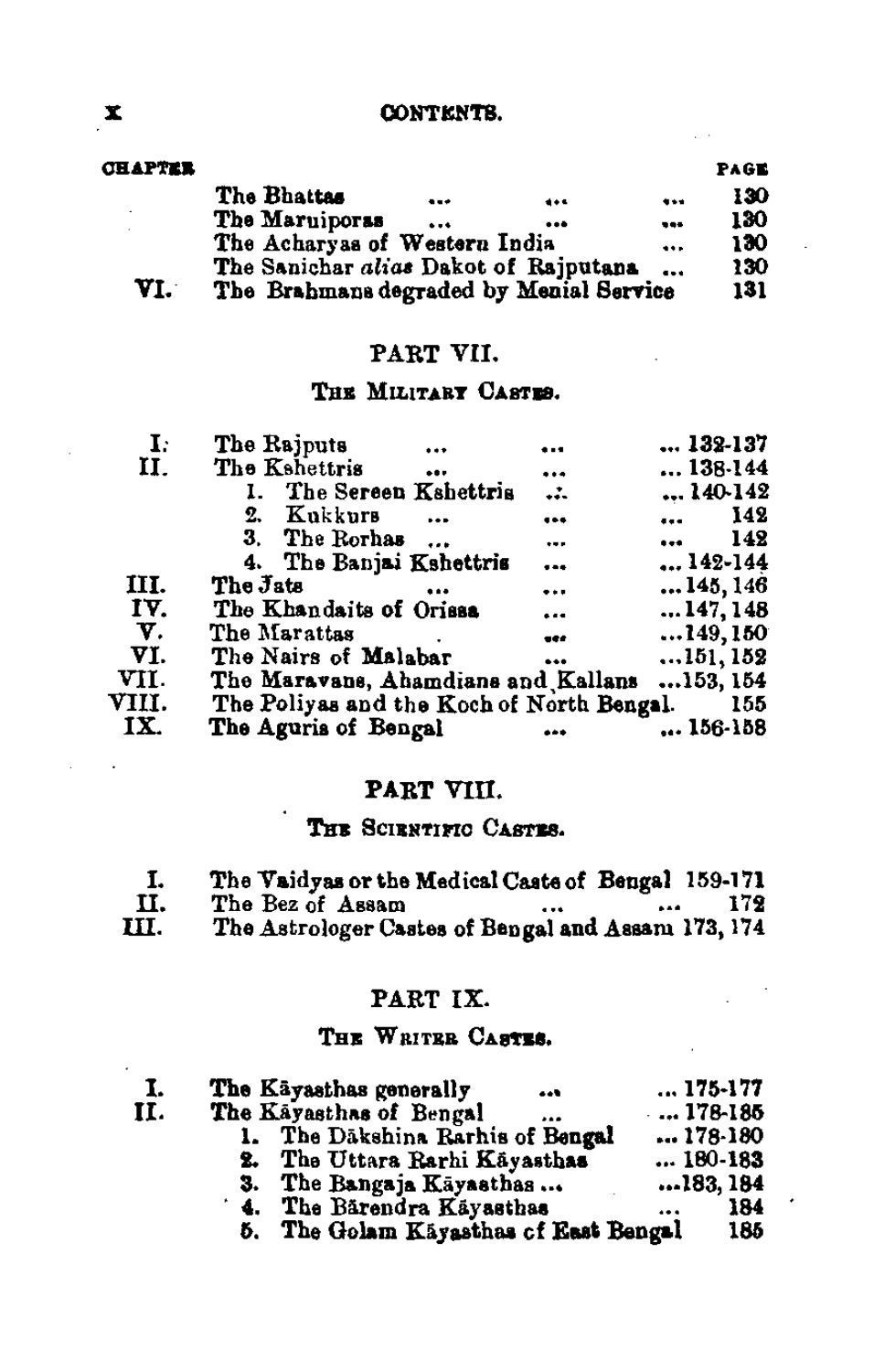
Contents, p. x, in the 1896 edition. Scan from the Gokhale Institute of Politics and Economics library.
Jogendra Nath Bhattacharya · 1896
The Aguris in Hindu Castes and Sects
Published in Calcutta by Thacker, Spink & Co., Bhattacharya’s Hindu Castes and Sects includes “The Aguris of Bengal” (pp. 156–158) in Part VII, “The Military Castes”. That is the author’s classification. It is not a record of army recruitment, a British military designation or an Aguri regiment.[9]
His account of livelihoods is more concrete. Most Aguris farmed, while others served the government and local landholders, held estates and tenures, or practised successfully as advocates in Burdwan’s District Court (p. 157). On p. 158 he names the Mahabharata publisher Pratapa Chandra Ray as a Suta Aguri, the source for our Pratap Chandra Ray profile. His remarks on ritual rank and inherited character belong to the caste assumptions of his time.[9]
Explore questions about Nagadee origins, Burdwan estate records, kul panjikas, oral histories and inequality today. See research questions and methods →
John R. McLane, Land and Local Kingship in Eighteenth-Century Bengal (1993). Read directly from the full Cambridge PDF (October 2026): pp. 54–55, 117–118, 125–138, 157–160, 183–185, 192, 263 and 271. McLane uses the Chandimangal, dated 1589 and quoted through Dimock and Inden’s translation, to treat the Aguris as older than the Khatris in Burdwan; this website records that reading and its limits on the Origins page. McLane does not connect the Aguris with the Raj’s naqdi (cash-paid) army or any other troops. Source details
Lal Behari Day, Bengal Peasant Life (1916 reprint), preface and pp. 10, 31, 59, 82, 149, 204–207, 278–280. Pages 31, 59 and 82 read as page images on 21 September 2026. The preface and pp. 10, 149, 204–207 and 278–280 were read on 8 October 2026 in the item’s OCR text, using its running heads for page numbers; their page images have not been checked. Literary representation, not a verified pedigree or ethnography. Wording has not been collated against the 1874 edition. Source details
Ugrakshatriya-Pratinidhi, Volume I (1298 Bangabda). Owner-supplied PDF. Complete electricity essay (printed pp. 12–23) and first editorial’s opening-page extract translated against the scans; selected reading notes also available. Bengali OCR remains unreviewed. The contents leaves (scans 2–3) were re-read against the images on 8 October 2026 for the titles and authors cited on the Culture page. Source details
Jogendra Nath Bhattacharya, Hindu Castes and Sects (1896), contents p. x and pp. 156–158. Evidence of Bhattacharya’s classification and account, not official army recruitment or a regiment. His caste hierarchy, scriptural genealogy and character stereotypes are historical claims, not present-day facts. The chapter prints the translator’s name as “Kishori Mohan Ganguli”; the profile uses Kisari Mohan Ganguli, as credited in the Mahabharata edition’s publisher’s preface. Source details
হরিচরণ বন্ধু, রাজপুত ও উগ্রক্ষত্রিয় — Rajput O Ugrakshatriya, second edition (1940). English reading translation of the dedication, prefaces, all nine chapters and surviving conclusion available as a 98-page PDF, with original errata sheets and a translator’s note. Printed pages 142–143 are missing from the digitised original. Uncertain readings are marked; this is not a fully verified scholarly edition. Separate preface readings include Bengali transcriptions and source images. Source details
J. C. K. Peterson, Bengal District Gazetteers: Burdwan (1910). Read from the digitised copy in October 2026. The p. 22 passage was checked against the page image; the pages cited on the Origins page (pp. 27, 28, 31 and 32) were read in its text layer. A colonial assertion reported here as a disputed claim, not as established history. The Manasa and Dharmaraj passages (pp. 56–57) were read in its text layer on 9 October 2026. Source details
Hare Krishna Konar — Wikipedia. Article read 6 October 2026; Cellular Jail section read 8 October 2026. Several claims in the article (languages, foreign party memberships) lack adequate sourcing and are not used; its account of the 1937 hunger strike has no specific references. Source details