The heritage projectCulture
Culture, customs & community life
Sourced from the Aguri Heritage project.
https://aguri-heritage.in/culture
Original project material: all rights reserved. Other material retains its own rights. Copyright & reuse
Village life, worship, custom and reform, print and family memory in the records of the Aguri community.
Last updated:
Cite this page
Aguri Heritage. “Culture, customs & community life.” Last updated: . https://aguri-heritage.in/culture.
Citing this page does not grant permission to republish it. Copyright & reuse.
Most of what can be documented about Aguri culture belongs to the villages of Burdwan, where Aguri families farmed, worshipped and celebrated alongside Sadgops, Bagdis, Brahmans and many others. A few customs set them apart, and for half a century those customs were argued over in caste handbooks, census offices and the community’s own journals.
This page draws on three kinds of record: descriptions by colonial and Bengali writers between 1874 and 1896, the community’s own publications from 1891 to 1940, and village fieldwork from the 1990s and 2010s. Each statement is labelled by the kind of evidence behind it. Land, trade and family enterprise are covered on the History page.
- Documented: a dated record, or a scholar’s reading of records or fieldwork.
- Community account: what the community’s own writers and publications said about its customs.
- Literary: a novel’s portrayal, which shows how Aguris were seen rather than how a particular family lived.
- Interpretation: an explanation of the evidence, including this website’s own, which others may dispute.
Village and household life
Documented Risley in 1891 called the Aguris “a cultivating and trading caste, very numerous in Western Bengal” (p. 12).[1] Village fieldwork since then finds Aguri households within a shared village culture rather than apart from it. At Musharu, 23 kilometres from Katwa, Salini Saha found Ugra Kshatriyas to be the dominant farming community among Sadgops, Goalas, Namasudras and Bagdis. The larger houses of landowning families stood beside the fields, while agricultural labourers lived in straw-and-mud huts along the village path (p. 7).[2]
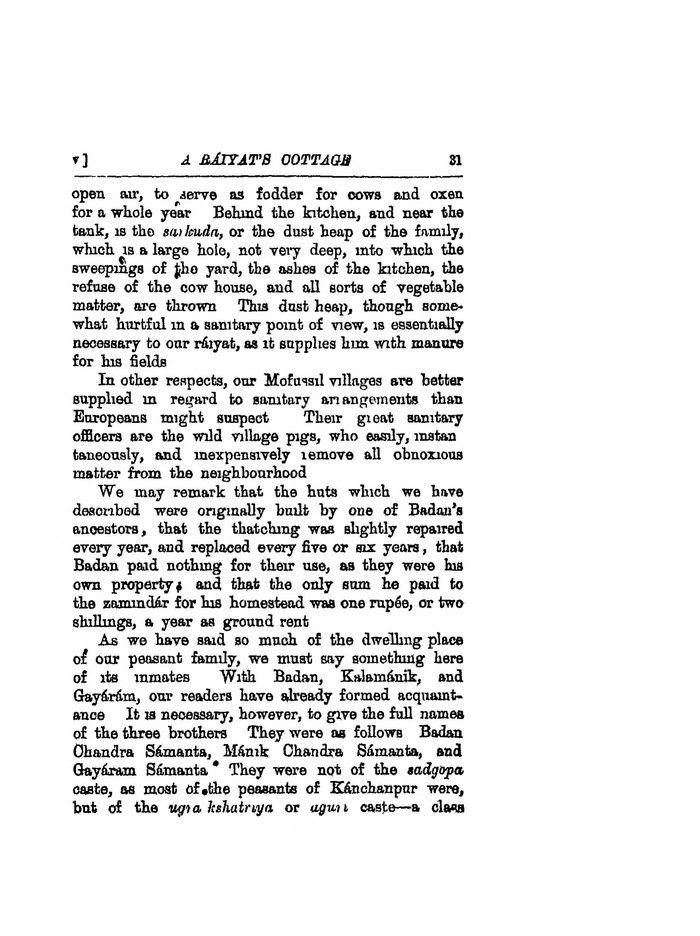
Lal Behari Day · 1874
Govinda Samanta
An Aguri household in fiction
Literary Lal Behari Day wrote Govinda Samanta for a prize offered in 1871 by Joy Kissen Mookerjea, a zamindar of Uttarpara, for the best novel illustrating “the Social and Domestic Life of the Rural Population and Working Classes of Bengal”. It won in 1874 and was reissued as Bengal Peasant Life (preface). Its family, the Samanta brothers of Kanchanpur, a village about six miles north-east of Burdwan town, were “not of the sadgopa caste, as most of the peasants of Kanchanpur were, but of the ugra kshatriya or aguri caste” (pp. 10, 31).[3]
Day follows the household through the farming year. At Navanna in November the family priest offers the first rice of the season to the gods and the ancestors, and portions go to the cattle, the jackals, the birds, the fish in the tank and the ants before the family eats. The feast that follows has rice, dal, greens and vegetables fried in mustard oil, two kinds of fish and paramanna, but no meat, “animal food being prohibited to the class of Hindus to which Badan belonged” (pp. 204–207). A daughter’s marriage is arranged through a matchmaker who serves the Aguri caste, for “every caste has its own ghatakas” (p. 82). Friendship crosses caste lines where dining does not: “An Aguri may have a goala (milkman), or a sadgopa … as his most intimate friend, although they may not enjoy each other’s company at dinner” (p. 149).[3]
The novel shows how an Aguri family was portrayed for English readers in the 1870s. Most of what it describes belonged to Burdwan’s peasants generally, and it is not a record of a real family. Its surnames are discussed on the Surnames page.
Worship and the village gods
Documented “In their religious and ceremonial observances Aguris differ little from the higher castes of Hindus in Bengal,” Risley wrote. Most were Vaishnavas or Shaktas, with comparatively few Shaivas, and their ceremonies were performed by Brahmans “who incur no degradation by serving them” (p. 13).[1] Bhattacharya added that Burdwan’s local Brahmans accepted Aguri gifts and ate food cooked by Brahmans in Aguri houses (p. 157).[4] Dutta reads these arrangements as local recognition of the caste’s standing (pp. 318–319); the History page discusses the claims to rank behind them.[5]
Community account The community’s own writers described a household religion of family deities, endowed shrines and hospitality. Haricharan Bandhu (1940) quotes the scholar Panchanan Tarkaratna: many Ugra Kshatriyas maintained charitable kitchens and guest houses and had installed images for worship, Shalagrama stones were present “in almost every household”, many had established Shiva shrines, and “almost everyone undertakes pilgrimage with particular eagerness” (p. 42). Bandhu adds that every lineage maintained the worship of a family deity, with rent-free land set aside for it (p. 41), and that the goddess Shakambhari was worshipped in almost every Ugra Kshatriya household of the Burdwan region (p. 40).[6] He offered the Shakambhari claim as evidence of Rajput descent, and no fieldwork has yet tested it.
Documented · ethnography Village deities belong to villages rather than to castes. Saha found that, while the climate gave Bardhaman’s farmers a common experience, their village deities gave each village its own identity (p. 6). Musharu’s goddess is Jhankeshwari, and the Jhanglai, the village’s cobras, are revered as her embodiments (p. 7). Several other villages of eastern Bardhaman also venerate snakes, more often through the goddess Manasa (pp. 11–12). Jhankeshwari’s annual worship in the monsoon month of Shravan, when snakes are bathed in milk and shown to visitors, has drawn growing public attention since 2021 (p. 14).[2]
Dharmaraj, god of drought and rain
Documented Dharma Thakur, also called Dharmaraj, is the village god of Rarh, the old name for western Bengal between Birbhum, the Bhagirathi, northern Midnapore and Manbhum. Surveying the cult for the 1951 Census, the folklorist Asutosh Bhattacharyya found it among “almost all sections of the Hindus” there (p. 351). Dharma has no image. He is a rough stone, or several, kept under a tree or in a village shrine. Villagers turn to him in drought, childless women for children and the sick for cures, and his annual worship falls on a full moon between Chaitra and Ashadh, the hot months before the rains. He receives goats and clay horses. His priests were traditionally Doms, joined by Brahmans where Brahmans were strong (pp. 351–354).[7] Peterson’s Burdwan gazetteer of 1910 likewise found his shrines “common all over West Bengal”, with “all castes, even Brahmans” making offerings through his priest (p. 57).[8]
Documented Aguri families shared in this worship. Asutosh Bhattacharyya’s clearest example is an Aguri household at Khudkuri, in the Khandaghosh police station of Burdwan district, which kept Dharma Thakur as its tutelary deity. A Brahman priest worshipped him every day with what Bhattacharyya called the “unorthodox offering” of a seer of boiled rice instead of sun-dried rice, and had “practically identified” the stone with the Shalagrama of Vishnu. In severe drought the Aguris carried the stone out of its mud hut into the midday sun as a “punishment”, believing that rain would follow at once (pp. 352–353, 359).[7] This is one household, as recorded in 1953. How many other Aguri families kept Dharma, then or now, has not been studied.
Documented · ethnography Dharma remains part of village religion in the Aguri heartland. In the villages around Bhatar and Mangalkot where Salini Saha did her doctoral fieldwork, Ugra Kshatriyas made up more than half of all farmers and agricultural labourers (pp. 13–14), and the regional historians she draws on give Dharmaraj and Manasa “a special status” among Bardhaman’s deities (pp. 87–88). At Bonkapasi in Mangalkot, villagers say their god Kal Rudra Shiva was found while ploughing and given land by a Maharaja of Bardhaman (p. 120). His worship has passed mostly to the upper castes, while lower-caste devotees, most of them agricultural labourers, worship Dharmapal as his “farmer version”. There, Dharmaraj belongs to the scheduled castes and is worshipped on Buddha Purnima, the full moon of Baishakh (pp. 168–169, 192, 198).[9] Bhaumik notes a similar blending at Jamalpur, whose Buroraj is “a mixture of both Dharmathakur and Siva” and whose Gajan is still held on the same full moon (p. 80).[10]
Interpretation Where Dharma came from has been argued over for more than a century. Haraprasad Shastri saw him as Buddha in disguise, a view that stayed popular; K. P. Chattopadhyaya traced him to the Vedic god Varuna; and Suniti Kumar Chatterji derived the name from an Austro-Asiatic word (p. 358). Asutosh Bhattacharyya rejected both the Buddhist and the Vedic explanations. He concluded that Dharma is “neither the Vedic nor pseudo-puranic sun-god” but rests on “a primitive sun-cult” of the region’s earliest inhabitants, taken into Hindu worship later under a Sanskritized name (pp. 358–360).[7] Later writers see layers rather than a single origin. Bhaumik calls Gajan “a mixture of three distinct forms of culture – aboriginal, Buddhist and Hindu” (p. 80),[10] and villagers at Bonkapasi told Saha that Dharma and Shiva worship together joined “Aryan and pre-Aryan modes of worship” (p. 197).[9] On this website’s reading, Dharmaraj is best understood as a pre-Vedic god of Rarh’s cultivators, concerned with drought, rain and fertility, whom Aguri families worshipped alongside their neighbours and, at Khudkuri, as a household god.
Manasa, the snake goddess
Documented Manasa, who protects her worshippers from snakebite, was a household goddess across Burdwan. Peterson’s gazetteer of 1910 says she “is worshipped by Hindus of all castes”, and that most families kept a shrine to her at home. A twig of the manasa plant was set up in the courtyard on Dasahara and worshipped on Nagpanchami. She was worshipped again on the last days of Shraban and Bhadra, with songs of her struggle with the merchant Chand Sadagar, and among the higher castes Brahmans performed the rites (p. 56).[8] A century later, Saha found household Manasa worship “a common ritual” in Bhatar, Kulchanda, Bonkapasi and Amarun. Unlike the village deities, Manasa belongs to no single village; as an old woman put it, she has “become a common goddess” (p. 90).[9] The pattern varied. At Kshiragram, Togawa recorded Manasa puja as the Bagdis’ biggest festival, with a Bagdi priest for her temple, while Durga Puja was the main festival of the Ugra Kshatriya neighbourhoods (p. 32).[11]
Interpretation Like Dharma, Manasa is generally thought to have entered Brahmanical Hinduism from below. Bhaumik writes that she had “her origin in lower circles” and had “formerly been worshipped only by the lower classes” (p. 74), that her name is “the Sanskritized form of a non-Aryan word”, and that the Buddhist snake goddess Janguli fed into her cult (p. 82). In the Manasamangal, her first worshippers are a ploughman, fishermen and a cowherd (p. 52).[10] Peterson quotes R. C. Dutt, who read the story of Chand Sadagar, the merchant forced at last to worship her, as the memory of an “aboriginal worship” entering Hindu society, set near the Damodar (pp. 56–57).[8] Saha cites the literary historian Sukumar Sen for the observation that Dharma Thakur and Manasa often share roles, mythic origins and patterns of worship (p. 88).[9] On this website’s reading, both deities reached Aguri households from the older, pre-Brahmanical religion of Rarh, by the same route that brought them to most castes of the region. Neither is a distinctively Aguri tradition, but both belong to Aguri religious life.
Kshiragram and the goddess Yogadya
Documented · ethnography The fullest account of Aguri ritual life comes from the temple of Yogadya at Kshiragram, in the Mangalkot block, where Masahiko Togawa did fieldwork in 1994–95. Ugra Kshatriyas were the village’s largest community, divided into Jana and Suta households, and nine lineages, each known by its title, sent a representative to the temple ritual (pp. 49–50).[12]
On the last day of every month a Malakar performs the guya-dak, the calling. He names the Dom chief and “Bharat Datta”, remembered as the chief of the Datta lineage, and then calls the Aguris of Eruyar, Nasigram, Kusumgram, Kurmun, Kaligram and Majigram (p. 86), villages that Togawa describes as dominated by Ugra Kshatriyas (p. 44).[12] Tarun Chakrabarti’s Bengali account in Anandabazar Patrika describes the same gua daka (গুয়া ডাকা), at which a Malakar welcomes participants with betel leaves and areca nuts before the Aguri villages are named.[13]
The lineages are marked again and again in the ritual year. At each stage of the Baishakh festival and the temple’s Durga Puja, the priest calls the nine titles in a fixed order, beginning with the Datta, and gives each representative a mark of ash or vermilion or a garland of shola (pp. 94, 134). The Datta and Samant representatives, both of Jana lineages, wear a sacred thread through the festival, carry the goddess’s pot and perform the peacock dance, mayurnac; in a ritual mock fight they “attack” the chief priest with bamboo staves before bowing to him (pp. 92, 99, 105). For the great buffalo sacrifice, Bagdi temple servants bring the animal, a representative of the Chaudhuri lineage holds its head at the block and a Karmakar strikes the blow (p. 141). Five Durga Pujas were held by Ugra Kshatriya lineages in their own paras, worshipping the goddess as a bundle of nine plants rather than an image, because the village already has its goddess (pp. 135, 144–146).[12]
Interpretation The ritual shares honour among many castes and fixes the Aguris’ place within it. Togawa suggests that the Datta lineage’s precedence may preserve its former standing as a regional chief (p. 186), a reading that competes with the view that Aguri prominence came through the Raj (see Research).[12] His study describes one village in the 1990s, not a custom followed by every Aguri household. Read about Kshiragram’s households and land.
Thread, marriage and mourning
The customs recorded in the 1890s were written down partly because they were taken as marks of rank. They are dated descriptions, not guidance for present-day marriage, ritual or membership, and practice varied by family and place.
Documented The thread. Only Jana Aguris wore the sacred thread, which they took at marriage; Risley noted that Janas who drove the plough with their own hands usually discarded it (p. 12).[1] Vidyanidhi (1896) adds that these rites were not those prescribed by the Vedas, and that the Sutas followed Shudra custom (pp. 187–188).[14] Bhaumik lists the Aguris among castes that had begun to wear the thread around the 1911 census (p. 247), though the Jana custom was already on record in 1891.[10] At Kshiragram the two Jana lineages still wore the thread for the goddess’s festival in the 1990s (Togawa, p. 92).[12] Read about Jana and Suta.
Documented Marriage. Risley found each subdivision split into Kulin and Maulik families, the Kulins bearing the titles Kesh, Pai, Shyam and Pal. A Kulin was not forbidden to marry a Maulik, but a series of such marriages would lower the whole family to Maulik rank. Marriage within a section, such as Kashyap, Sandilya or Bharadwaja, was forbidden. Daughters were married as infants, widows did not remarry, divorce was not recognised, and polygamy, though permitted, was rare (pp. 12–13).[1] Vidyanidhi names the Hazra and Chaudhuri families as mostly Kulin, but adds that Kulin rank could be gained through wealth and good works (pp. 187–188).[14] Bandhu (1940) grades both branches as Kulin, Satgrihastha and Maulik (p. 33).[6] From the later nineteenth century well-to-do Aguris, like Sadgops and Telis, adopted the dowry paid by the bride’s family in place of the bride-price paid by the groom’s (Dutta, p. 318).[5]
Documented Mourning. Risley recorded that Aguris performed the first shraddha on the thirtieth day after a death, not on the eleventh as Brahmans did (p. 13), and Bhattacharya put it on the thirty-first day rather than the thirteenth of “the true Ksatriyas” (p. 158).[1][4] Vidyanidhi, however, recorded that Janas kept twelve days of impurity, as Kshatriyas did, while accepting Shudra penances (pp. 187–188), and Bandhu counted twelve days’ mourning among the community’s Kshatriya customs (p. 32).[14][6] The accounts may describe different branches. Dutta treats the month-long period as one reason neighbours still classed prosperous Aguris as Shudras (pp. 314–315).[5]
Debating and reforming custom
Documented The community argued about its customs in print from the start. The first volume of the Ugrakshatriya-Pratinidhi (1891–92) carried an essay on “Ugrakshatriya society and the consent law”, a rebuttal and a reply to the rebuttal, in the year the Age of Consent Act raised the age of consent for girls from ten to twelve. It printed Haridas Sain on child marriage with a rebuttal by Pandit Akshaykumar Vidyavinod, Pandit Hrishikesh Byakaranasaraswati on widow remarriage, and editorials on social reform and on marriage payments, the latter titled “Taking a price at marriage, or the selling of sons and daughters” (contents, scans 2–3).[15] In its second year the journal explained that, as a Hindu journal, it would discuss conflicting scriptural positions “in the form of debate and response”: it ranked a widow’s celibacy above remarriage, while accepting that both had scriptural sanction (Vol. II, pp. 2–3).[16] These exchanges have not yet been translated.
Documented At its sixth session, in Shraban 1299 (July–August 1892), the Ugrakshatriya Samiti adopted five aims: education within the community, a community fund, the improvement of crafts, agriculture and health, unity within the caste, and a community journal. Each member was to give a rupee a year. The meeting also declared the account of the caste in the caste volumes compiled by H. H. Risley “entirely mistaken” and asked Haridas Sain to draft a rebuttal (Vol. II, pp. 104–105).[16] Sain had already written on the Bengal Government’s caste list in the first volume (contents, scan 3).[15]
Documented Dutta traces the later programme. The Samiti, active until about 1913 and revived in 1927, campaigned against dowry and for widow remarriage, scientific agriculture, indigenous goods and education, helped poorer families educate their children, and urged members to reform their way of life, “purifying their ritual practices” (pp. 311–313). A youth association, the Nikhil Bharat Ugra Kshatriya Yubak Sangha, was formed in Calcutta in 1938. Marriages between Jana and Suta families took place from the 1920s, and in April 1938 a widow remarriage, of Radhanath Kesh and Mahamaya, was held at Bankura (p. 313 and note 20, citing Bardhaman Barta, 2 May 1938).[5] Bhaumik also discusses efforts to bring the subdivisions together (p. 252).[10]
Interpretation Reform pulled two ways. It sought to end customs that reformers judged harmful, such as dowry and the bar on widow remarriage, and it promoted customs that signalled higher rank, such as the thread and Kulin marriage rules: the process Dutta calls Kshatriyaisation (pp. 314–318).[5] Printed resolutions show what leaders proposed, not what every family did.
Print, learning and the Bengali language
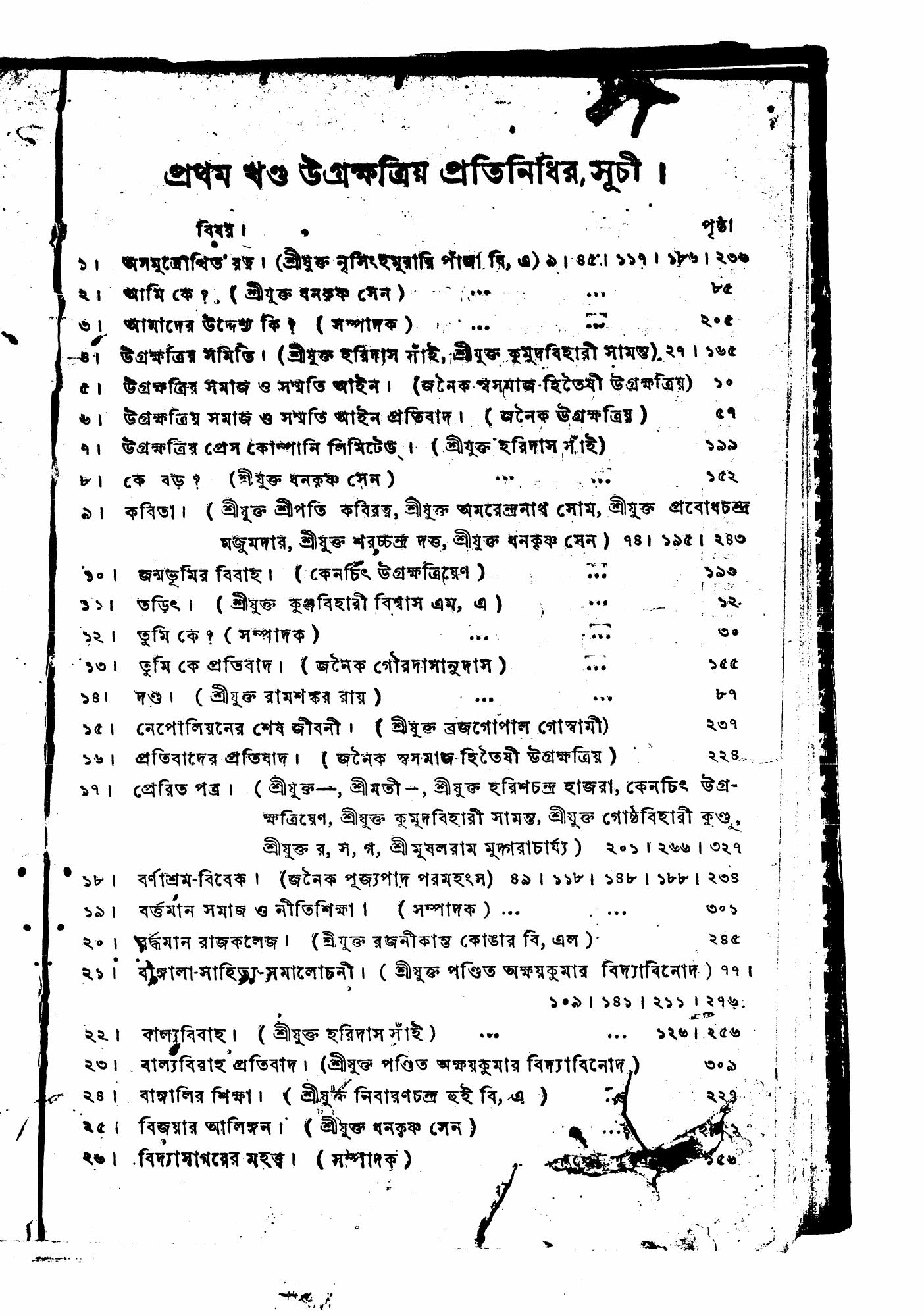
Monthly journal · Calcutta · 1891–92
উগ্রক্ষত্রিয়-প্রতিনিধি
Ugrakshatriya-Pratinidhi
The community’s first journal began in Baishakh 1298 (April 1891) from an office at 22 Ramkanta Mistri Lane, Calcutta (scan 1).[15] Its editor and proprietor, Srishchandra Ta, handed it to the Samiti in 1892 (Vol. II, p. 105). It cost two rupees a year, postage included, for some 480 pages (Vol. II, p. 5).[16]
It set itself three tasks: to collect the community’s history, to discuss its social affairs for the sake of reform, and to spread education. On the first it admitted failure, refusing to construct a history “through imagination or with the help of hearsay” (Vol. II, p. 3).[16] Its first volume ranged from poems, devotional songs and philosophy to Napoleon’s last years, the science of chess, Burdwan Raj College, Bengali and Western education, and Vidyasagar (contents, scans 2–3).[15] The Indian Mirror noted its “large number of papers bearing on social religious and literary subjects” (Vol. II, p. 4).[16]
Documented The first volume’s essay Tadit (“Electricity”), by Kunjabihari Biswas, M.A., opens by admitting that science is hard to write in Bengali because technical words are lacking. English terms appear within the Bengali prose, and readers are invited to suggest Bengali equivalents.[15]
Documented Print remained the community’s main forum. Sitikantha Smrititirtha and Haricharan Bandhu wrote treatises on its status (Dutta, p. 315), and from 1929 the revived Samiti issued a quarterly, Ugra Kshatriya Patrika, with articles on the community and on “contemporary socioreligious problems” (pp. 311–312).[5] Bandhu’s Rajput O Ugrakshatriya, revised in 1940, can be read on this website in Bengali and in English.
Education also led into professional and literary life. Bhattacharya names the Mahabharata publisher Pratap Chandra Ray as a Suta Aguri (p. 158).[4] Dutta names the mathematician Manohar Ray of Nasigram, the dermatologist Ganapati Panja of Majhigram and the writer Satya Kinkar Sahana of Bankura, whose books include Sakuntala Rahasya and Hindu Dharma (pp. 313–314).[5]
A reputation in print
Literary One saying about the Aguris has lasted: আগুরি গোয়ার, “the headstrong Aguri”, which Bandhu described in 1940 as still current (p. 63).[6] Day built a chapter of Govinda Samanta on the reputation behind it. When the zamindar has Govinda beaten with a shoe, the Aguri families of Kanchanpur, “not more than twenty-five” of them, gather at his house and resolve to harass the landlord, while the Sadgop peasants look on them as “a very thin-skinned class who made much ado about nothing”. Day calls the Aguris the bravest and most independent of western Bengal’s peasants, then adds that they were spirited “compared only with other Bengali raiyats” (pp. 278–280).[3] Swati Moitra notes that the novel presents this fierceness, and the other castes’ passivity, as natural qualities of caste (pp. 18–19).[17]
Documented Other writers put the same reputation to different uses. Risley repeated rumours of a quick temper and tied them to Manu’s description of the Ugra and to district crime records (p. 13).[1] A review in Reis and Rayyet in 1895, quoted by Bhattacharya, used it in the Aguris’ defence: a people “by nature, hot tempered, and incapable of bearing subordination” could not, it argued, descend from the Khatris and Sadgops that Oldham proposed (p. 156).[4] Bandhu used the saying to confirm an older verse’s picture of the Suta branch as “extremely irascible, proud and quarrelsome” (p. 63), while Tarkaratna, whom he also quoted, praised the community’s “spirit, helpfulness to others, protection of those seeking refuge” (p. 42).[6]
Interpretation The reputation records how officials, novelists and the community’s own writers argued about the Aguris. It is not evidence of any person’s character, and this website rejects the idea that inherited identity determines temperament. Some readers connect it with the community’s remembered military past; a proverb cannot settle that question either way (see the Origins article).
Genealogists, names and living memory
Community account Aguri families once had genealogists of their own. Vidyanidhi (1896) quotes verses from the Ugrakshatriya-bibaran of the genealogist, or kulacharya, Shashthidas Bhattacharya, naming eight renowned houses in eight parganas of Burdwan (pp. 187–188); the genealogist’s book itself has not been found.[14] Bandhu wrote that every Ugra Kshatriya, of whatever branch, identified himself as the descendant of a founding ancestor styled “Raja”, such as “Raja Nilabandhu” or “Raja Shakambhar Datta” (p. 33).[6] Some families keep lineage charts, such as the Raychaudhuri chart of Chaitanyapur described on the History page. They remain family traditions until they are checked against dated records.
A surname is a lead for family research, not proof of community identity, and writing for a community journal does not establish a writer’s ancestry. Lokeshwar Basu’s Bengali book Amader Padabir Itihas (“The History of Our Surnames”) explains that many surnames occur across community boundaries, so a name is best studied together with places, dated records and family accounts.[18] See the Surnames page.
Not yet documented. No published study describes Aguri weddings, food, songs, dress or household worship as they are practised today. No Aguri genealogist’s book has been located, the Samiti’s later journal and records have not been read, and most of the journal volumes held by this project remain untranslated. The Dharma Thakur of the Aguri family at Khudkuri, recorded in 1953, has not been revisited, and no study describes how Aguri households worship Manasa or Dharma today. Family photographs, festival and puja accounts, recipes, lineage charts and village histories can help fill these gaps. Each contribution should name its place, date and contributor, and the permission under which it can be shared. No modern practice is presented on this website as uniquely Aguri without evidence.
Notes & sources
- H. H. Risley, The Tribes and Castes of Bengal, Vol. I (1891), pp. 12–13. Evidence of what a colonial author recorded in 1891. The text’s caste hierarchy, origin speculation and character stereotypes are not descriptions this project endorses. Source details
- Salini Saha, “Endangered cobras and conservation politics: Exploring multispecies encounters in agrarian landscapes of West Bengal” (2026). Original article read; pp. 5 and 7 checked as page images, and pp. 6, 11–12 and 14 in the extracted text. Describes a shared village culture, not practices exclusive to Aguris. The thesis is listed separately (Saha 2023). Source details
- Lal Behari Day, Bengal Peasant Life (1916 reprint), preface and pp. 10, 31, 59, 82, 149, 204–207, 278–280. Pages 31, 59 and 82 read as page images on 21 September 2026. The preface and pp. 10, 149, 204–207 and 278–280 were read on 8 October 2026 in the item’s OCR text, using its running heads for page numbers; their page images have not been checked. Literary representation, not a verified pedigree or ethnography. Wording has not been collated against the 1874 edition. Source details
- Jogendra Nath Bhattacharya, Hindu Castes and Sects (1896), contents p. x and pp. 156–158. Evidence of Bhattacharya’s classification and account, not official army recruitment or a regiment. His caste hierarchy, scriptural genealogy and character stereotypes are historical claims, not present-day facts. The chapter prints the translator’s name as “Kishori Mohan Ganguli”; the profile uses Kisari Mohan Ganguli, as credited in the Mahabharata edition’s publisher’s preface. Source details
- Achintya Kumar Dutta, “Prosperity, Dominance, and Social Mobility: Emergence of a Mobile Caste in Colonial Southwest Bengal” (2023), pp. 297–324. Complete chapter, including endnotes and references, read directly in the supplied book. Page references use its printed pagination. Origin hypotheses remain attributed to the author. Link opens the publisher’s book record. Source details
- হরিচরণ বন্ধু, রাজপুত ও উগ্রক্ষত্রিয় — Rajput O Ugrakshatriya, second edition (1940). English reading translation of the dedication, prefaces, all nine chapters and surviving conclusion available as a 98-page PDF, with original errata sheets and a translator’s note. Printed pages 142–143 are missing from the digitised original. Uncertain readings are marked; this is not a fully verified scholarly edition. Separate preface readings include Bengali transcriptions and source images. Source details
- Asutosh Bhattacharyya, “Dharma Worship in West Bengal”, in A. Mitra, The Tribes and Castes of West Bengal (1953), pp. 351–360. Read on 9 October 2026 from the North Bengal University repository scan (PDF pp. 359–368) by machine OCR; p. 352 was checked against the page image. The Khudkuri account describes one household around 1950. The argument about origins is the author’s interpretation, including his disputed derivation of the name Dharma from Dom. Source details
- J. C. K. Peterson, Bengal District Gazetteers: Burdwan (1910). Read from the digitised copy in October 2026. The p. 22 passage was checked against the page image; the pages cited on the Origins page (pp. 27, 28, 31 and 32) were read in its text layer. A colonial assertion reported here as a disputed claim, not as established history. The Manasa and Dharmaraj passages (pp. 56–57) were read in its text layer on 9 October 2026. Source details
- Salini Saha, Fertility Worship and Monsoon among Agricultural Communities of Bardhaman (2023). Read on 9 October 2026 by machine OCR of the repository’s chapter files, which are page scans; the cited passages were read in context. The villages studied have mixed populations, and the thesis does not single out any practice as Aguri. The 2026 journal article drawn from it is listed separately (Saha 2026). Source details
- Sudarshana Bhaumik, The Changing World of Caste and Hierarchy in Bengal: Depiction from the Mangalkavyas c. 1700–1931 (2023). Every Aguri and Ugra Kshatriya passage in the supplied book was located by full-text search and read in context; the rest of the book has not been reviewed. The Rajasthan–Man Singh migration account is presented as an attributed tradition alongside Dutta’s uncertainty about origins. Link opens the publisher’s book record. Its passages on Manasa and Dharma Thakur were read in context on 9 October 2026. Source details
- Masahiko Togawa, A Sakta-pitha in Bengal: Kingship, Caste and Sacrificial Organization in a Village Society (1996). The Culture page directly cites Chapter I, p. 32 for Manasa puja as the Bagdis’ biggest festival at Kshiragram, with their own priest; this passage was checked against the thesis scan. Other accounts of lineages, temple land and rituals cite the published 2006 book (see Togawa 2006). The thesis remains a distinct source. Source details
- Masahiko Togawa, An Abode of the Goddess: Kingship, Caste and Sacrificial Organization in a Bengal Village (2006). Full book read. The study describes one village in 1994–95 and the author’s reconstruction of earlier practice; it is not a survey of all Aguri settlements. Source details
- তরুণ চক্রবর্তী, “শরতের দুর্গোৎসবেও জলমগ্ন থাকেন ক্ষীরগ্রামের দশভুজা” — Anandabazar Patrika (24 September 2023). Bengali article read directly. Its inconsistent royal chronology is not used as historical evidence. Source details
- Lalmohan Vidyanidhi, Sambandha Nirnaya, Samanya-kanda, second edition (1896). Aguri passage located in the archive.org text and read in context; the OCR is unreviewed. The genealogist’s source text has not been found. A later printing (1898) is also on archive.org. Source details
- Ugrakshatriya-Pratinidhi, Volume I (1298 Bangabda). Owner-supplied PDF. Complete electricity essay (printed pp. 12–23) and first editorial’s opening-page extract translated against the scans; selected reading notes also available. Bengali OCR remains unreviewed. The contents leaves (scans 2–3) were re-read against the images on 8 October 2026 for the titles and authors cited on the Culture page. Source details
- Ugrakshatriya-Pratinidhi, Volume II (1299 Bangabda). Owner-supplied PDF. Complete Pratinidhir Atmakatha (printed pp. 1–5) translated against the scans. Bengali OCR remains unreviewed; most of the volume is not translated. The Samiti report was read against the scan image on 8 October 2026; it has not been translated in full. Source details
- Swati Moitra, “Those Backward Hordes: Representing the Indian Peasant as a ‘Rebel’ in Early Indian Fiction in English” (2020). Passages on Day’s novel consulted online on 8 October 2026. Used for its reading of the novel, not as evidence of Aguri history. Source details
- লোকেশ্বর বসু, আমাদের পদবীর ইতিহাস — Amader Padabir Itihas. Online introduction read directly. The printed edition, date and page numbering have not been verified; no modern legal classification is taken from this text. Source details
Page views: