The heritage projectHistoryOrigins
From Nagadee to Jotedar: The Burdwan Raj and the Origins of the Aguris
Sourced from the Aguri Heritage project.
https://aguri-heritage.in/origins
Original project material: all rights reserved. Other material retains its own rights. Copyright & reuse
An argument about military service, landholding and identity in the history of the Aguris and the Burdwan Raj.
Last updated:
Cite this page
Aguri Heritage. “From Nagadee to Jotedar: The Burdwan Raj and the Origins of the Aguris.” Last updated: . https://aguri-heritage.in/origins.
Citing this page does not grant permission to republish it. Copyright & reuse.
The Aguris appear to descend from the Nagadee forces, the cash-paid army the Burdwan Raj raised and maintained during the 18th century as a reaction to certain external threats from other principalities and the Maratha Bargi raids. As the East India Company wound that army down between 1763 and 1809, its soldiers turned to the land and, within a century, became the dominant landholders of Burdwan.
The argument in brief
Five points tie the Aguris to the Burdwan Raj's army rather than to an ancient pedigree.
- A Burdwan community. In 1872–1921, 73–87 per cent of Bengal's Aguris lived in Burdwan district, the Raj's heartland, not across Bengal as settlers from a Mughal provincial army would.
- Descended from the Nagadees. After 1696 the Raj raised an army paid in cash, not land: hired soldiers without local holdings. Regional histories describe the Nagadees as largely Aguri.
- A Rajput link. A section of the Aguris took the sacred thread at marriage, as the Rajputs of UP and Bihar did.
- Soldiers turned landholders. As the army was wound down, military service became jotes, and jotes became jotedar dominance.
- The Chandimangal couplet proves nothing earlier. Its standard edition rests on a manuscript dated 1700, and its Aghari is only assumed to mean the Aguris.
Timeline
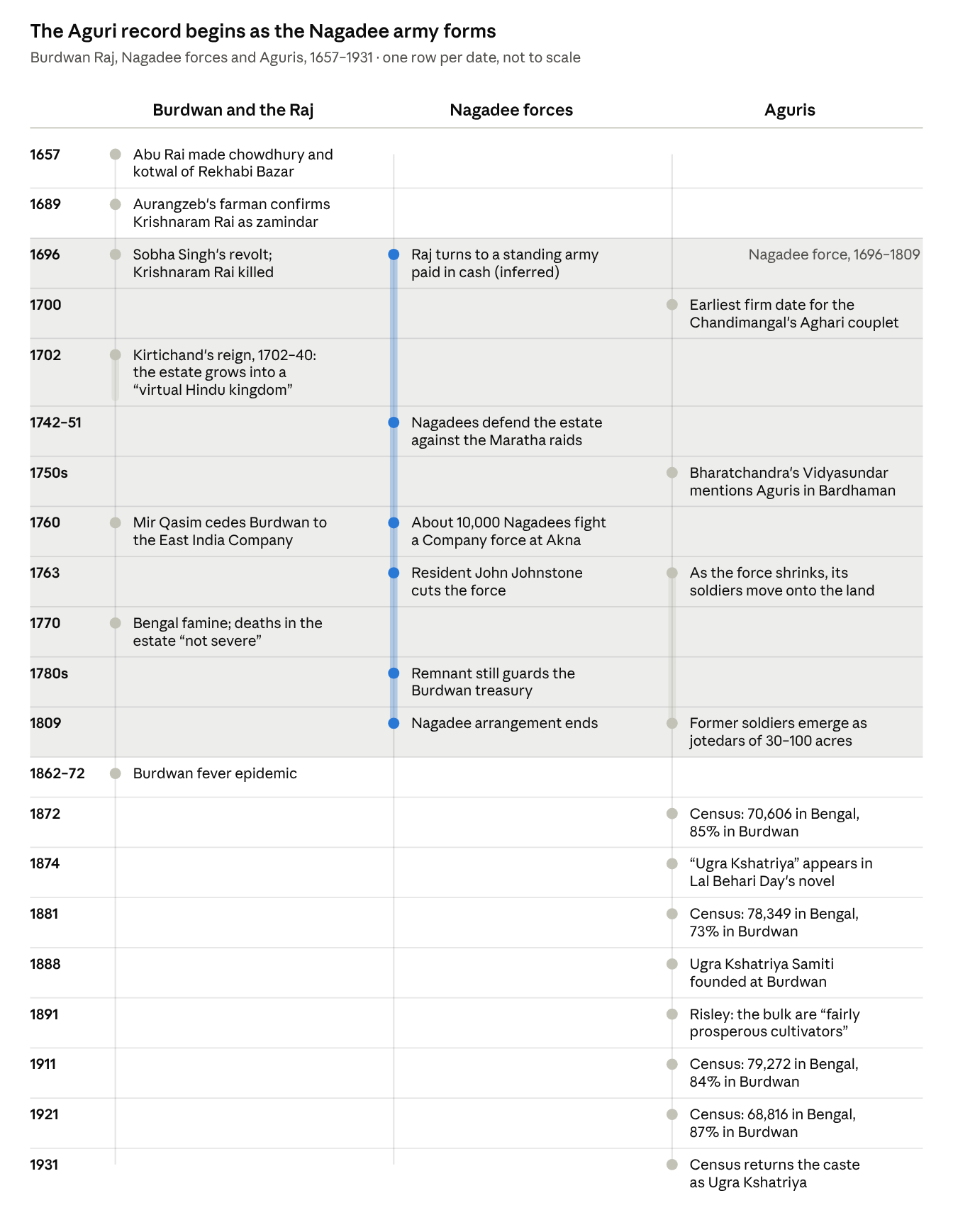
Read the timeline as text
Nagadee force, 1696–1809
| Date | Burdwan and the Raj | Nagadee forces | Aguris |
|---|---|---|---|
| 1657 | Abu Rai made chowdhury and kotwal of Rekhabi Bazar (other sources: 1679–80) | ||
| 1695–96 | Aurangzeb’s farman confirms Krishnaram Rai as zamindar (often dated 1689) | ||
| 1696 | Sobha Singh’s revolt; Krishnaram Rai killed | Raj turns to a standing army paid in cash (inferred) | |
| 1700 | Earliest firm date for the Chandimangal’s Aghari couplet | ||
| 1702 | Kirtichand’s reign, 1702–40: the estate grows into a “virtual Hindu kingdom” | ||
| 1742–51 | Nagadees defend the estate against the Maratha raids | ||
| 1750s | Bharatchandra’s Vidyasundar mentions Aguris in Bardhaman | ||
| 1760 | Mir Qasim cedes Burdwan to the East India Company | About 10,000 Burdwan, Birbhum and allied troops fight a Company force at Akna | |
| 1763 | Resident John Johnstone cuts the military payroll from almost Rs 4 lakh to Rs 2.64 lakh | As the force shrinks, its soldiers move onto the land | |
| 1770 | Bengal famine; deaths in the estate “not severe” | ||
| 1780s | Troops halved to about 1,000 (1787); they guard the kacharis and escort treasure | ||
| 1809 | Nagadee arrangement ends | Former soldiers emerge as jotedars of 30–100 acres | |
| 1862–72 | Burdwan fever epidemic | ||
| 1872 | Census: 70,606 in Bengal, 85% in Burdwan | ||
| 1874 | “Ugra Kshatriya” appears in Lal Behari Day’s novel | ||
| 1881 | Census: 78,349 in Bengal, 73% in Burdwan | ||
| 1888 | Ugra Kshatriya Samiti founded at Burdwan | ||
| 1891 | Risley: the bulk are “fairly prosperous cultivators” | ||
| 1911 | Census: 79,272 in Bengal, 84% in Burdwan | ||
| 1921 | Census: 68,816 in Bengal, 87% in Burdwan | ||
| 1931 | Census returns the caste as Ugra Kshatriya |
Every firmly dated Aguri record falls after the 1696 revolt that, on this article's reading, created the Nagadee force. The shaded band marks the force's life, to 1809.
1. The Burdwan Raj and the founding of the Nagadee forces
The Raj was built by the Kapoors, Punjabi Khatris from Lahore. Sangam Rai, a Khatri Kapur of Kotli mahalla in Lahore, settled at Baikunthapur near Burdwan as a trader and money-lender; family tradition says he came after a pilgrimage to Puri, a story McLane treats with scepticism as the conventional origin tale of west Bengal's raj families (McLane 1993, pp. 130–131). Abu Rai became chowdhury and kotwal of Rekhabi Bazar in Burdwan town in 1657, according to the gazetteer and the Raj's handbook; other sources give 1679–80 (McLane 1993, pp. 125, 134). Krishnaram Rai paid the emperor a nazrana of Rs 1 lakh for a farman confirming him as zamindar and chaudhuri of "parganas Burdwan, etc." McLane dates that farman to 1695–96 (p. 137); other accounts give 1689 (Wikipedia; Purba Bardhaman district). McLane's description of the farman mentions no licence to raise troops. Bhaumik explains why the Mughal authorities favoured the family: it was an up-country Khatri house "with no local military base and therefore deemed to be worthy of trust" (Bhaumik 2023, p. 178). The Raj had no army of its own to inherit.
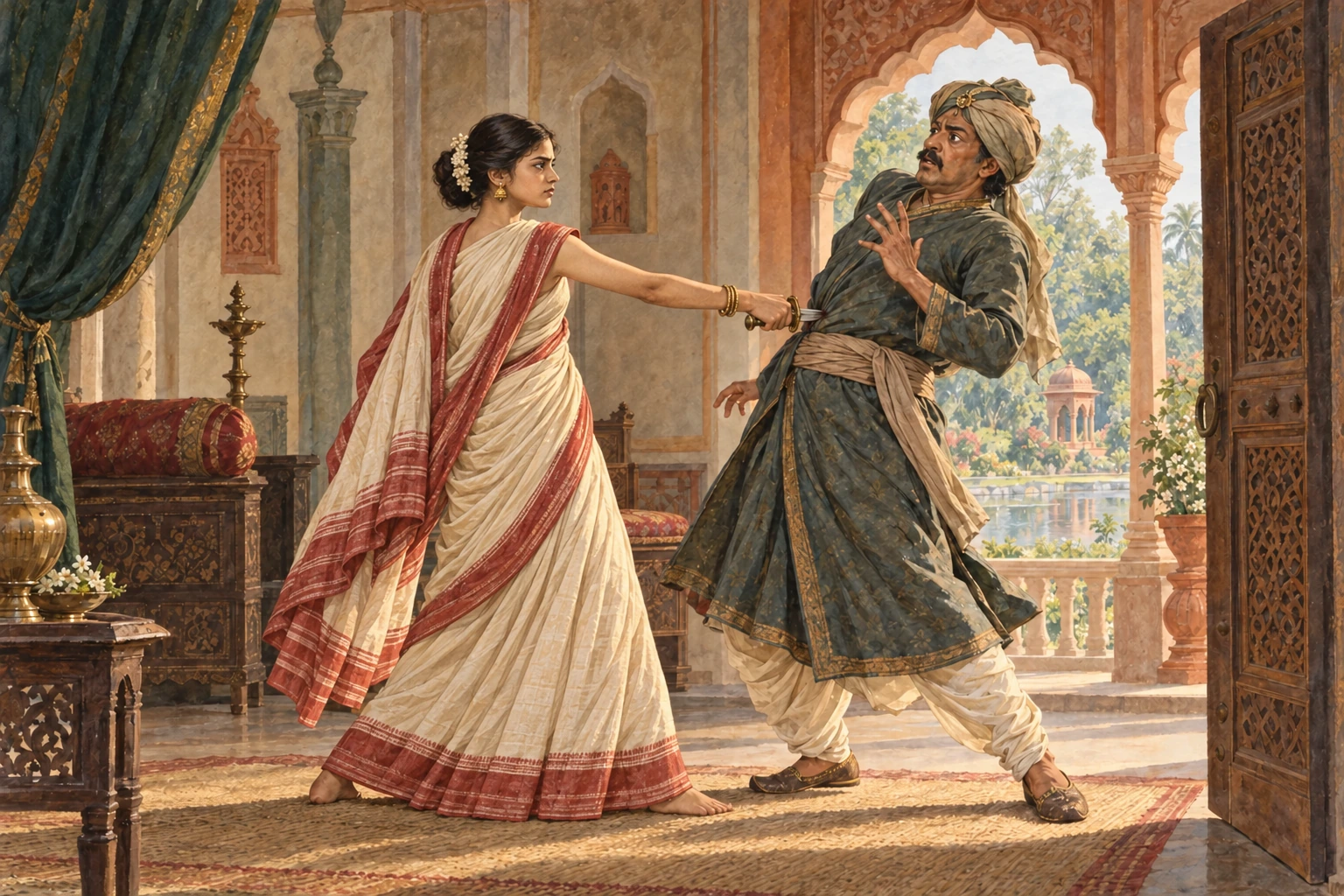
In 1696 Sobha Singh, zamindar of Chitua and Barda, rose against the Raj with the Afghan chief Rahim Khan of Orissa. Krishnaram Rai was killed in battle and his family captured (Wikipedia). The rebels seized western Bengal, and the local zamindars offered little resistance until the Mughal prince's army moved down the Badshahi road to Burdwan in late 1697 (McLane 1993, p. 129). Satyabati, the Raja's daughter, killed Sobha Singh, and the Mughal prince Azim-us-Shan finally crushed the rebels outside Burdwan (Peterson 1910, p. 27). The Raj's own troops had failed to protect the Raja. This article treats the revolt as the moment the Raj chose a standing army paid in cash from its treasury and answerable to the ruler alone. The Nagadee forces were the Raj's answer to the disaster of 1696.
Wars of expansion
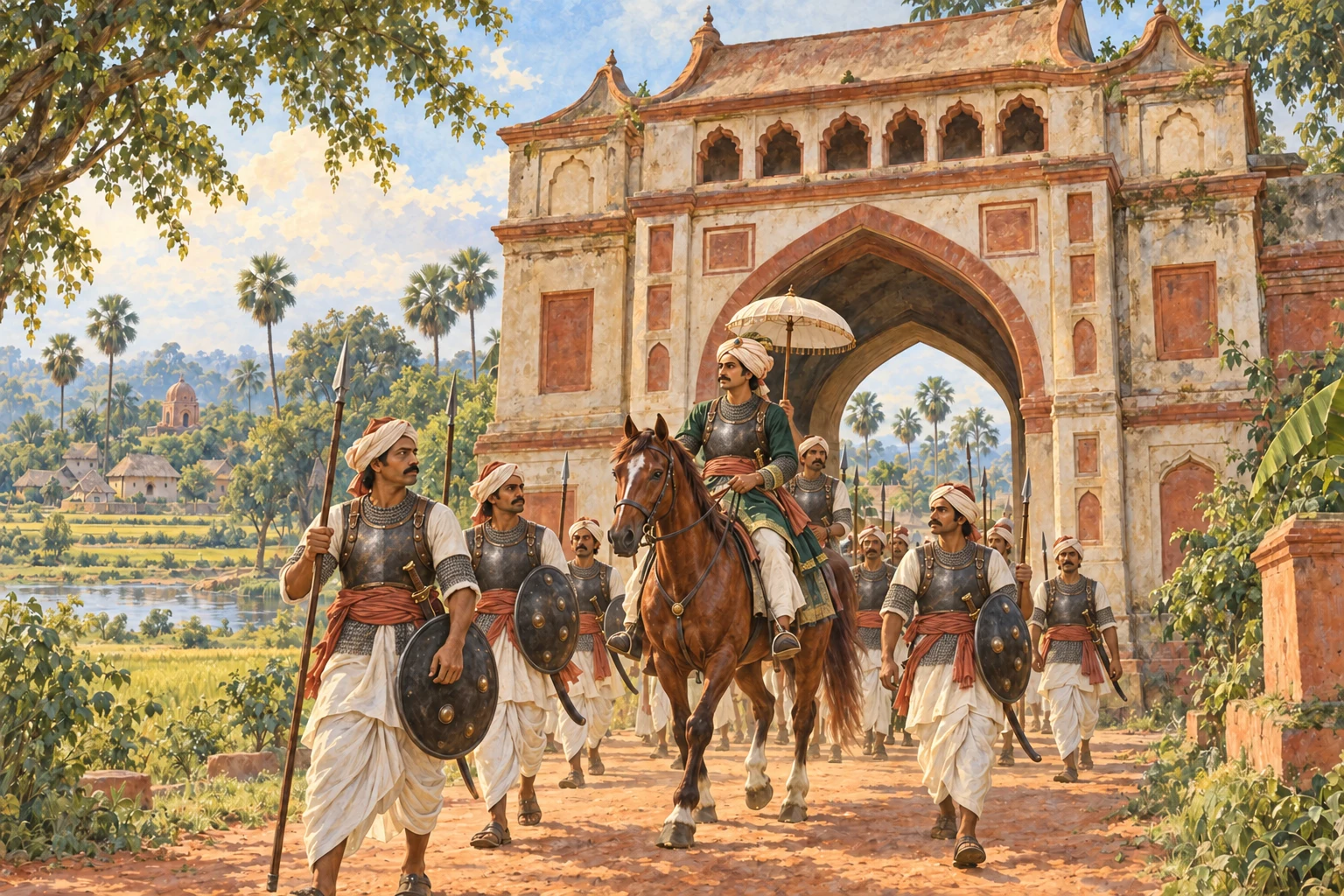
Under Kirtichand (r. 1702–1740) the estate grew into what John McLane calls "a virtual Hindu kingdom within the weakening provincial Mughal hegemony" (McLane 1993, p. 125). McLane stresses that Burdwan and the other expanded local kingdoms of eighteenth-century Bengal were "products of nawabi patronage rather than military adventurism" (p. 125). Patronage was the frame, but the Burdwan chronicles also record conquest. Kirtichand fought the Rajas of Chandrakona and Barda near Ghatal and took their lands, seized the Balghara estate near Tarakeswar, and added the parganas of Chitua, Bhurshut, Barda and Manoharshahi, registering himself at Murshidabad as their proprietor. His "boldest achievement" was the defeat of the powerful Raja of Bishnupur, which he marked with a victory gate, the Baraduari, at Kanchannagar (Peterson 1910, p. 28; the gate from Wikipedia). His successor Chitrasen Rai (r. 1740–1744) added the parganas of Mandalghat and Arsha (Peterson 1910, p. 31), and in 1744 took Gopbhum, the Sadgop kingdom whose last king had died fighting the Marathas (Wikipedia, citing Atul Sur). Bhaumik records the two stages of that takeover: Gopbhum's Sadgop rajas were reduced to feudatories of Krishnaram Rai in 1694, and Chitrasen annexed Gopbhum in about 1744 (Bhaumik 2023, p. 178). She links the change directly to the Aguris: "With the fall of Gops in Gopbhum, Aguris emerged as a dominant class" (p. 48). McLane himself allows that where resistance was met, as in Chandrakona and Gopbhum, "the Burdwan zamindari army, and if necessary the nawab's army," completed the transfer of control (McLane 1993, p. 159). Wars on this scale needed a standing army. They were the Nagadees' wars, fought by the cash-paid Aguri soldiers.
The Maratha raids, 1742–1751
Then the estate itself became the battlefield. Raghuji Bhonsle of Nagpur claimed chauth, a quarter of Bengal's revenue, and Alivardi Khan's seizure of the Nawabship in 1740 gave him allies among Alivardi's enemies (Wikipedia). In April 1742 Raghuji's diwan, Bhaskar Pandit, led 10,000–20,000 Maratha horsemen into Bengal. On 15 April they caught Alivardi at Burdwan with 3,000–4,000 cavalry and 4,000–5,000 musketeers, surrounded his camp, looted his baggage and cut off his supplies, and he had to fight his way out to Katwa. From June, Katwa was the Maratha headquarters, and the raiders, the bargis, plundered Burdwan, Birbhum, Bankura, Midnapore, Nadia and Murshidabad (Wikipedia; Purba Bardhaman district). Vaneshwar Vidyalankar, a pandit at the Burdwan court, called them "niggard of pity, slayers of pregnant women and infants, of Brahmans and the poor" (Sarkar 1964, p. 55). On 27 September Alivardi crossed the Ganga at Uddharanpur and fell on Bhaskar's camp while he celebrated Durga Puja; by December the Marathas had been driven back beyond Chilka.
Bhaskar returned in 1744. To end the invasions, Alivardi took the advice of his Afghan general Mustafa Khan and invited him to a parley. At Mankara, at the end of March 1744, Bhaskar and 21 of his commanders were cut down in the Nawab's tent, and Bhaskar's head was brought to Alivardi (Wikipedia, citing Sarkar). The killing enraged Raghuji, whose raids came every year until 1751, when Alivardi bought peace with chauth of 12 lakh rupees a year and gave up effective control of Orissa. The Dutch put the dead in Bengal and Bihar at about 400,000 (Wikipedia). The Nagadees acted as defensive guerrilla forces and treasury guards, protecting the western borders of Bengal from devastating Maratha cavalry raids. Through that decade the Nagadees defended the estate.
Local tradition in Asansol names two commanders of these years. Nakadi (Nakari) Roy and Ramkrishna Roy are remembered as the men who drove back a Bargi raid, were rewarded with rent-free land, cleared the forest and founded Asansol village, where they settled Aguri families. Statues of both stand in Budha Aguri Para. Their descendants, a Roy family said to number more than ten thousand today, date their Durga Puja to 1149 BS (1742–43), the year of the first invasion (ETV Bharat 2023; Bengal Mirror 2020; Sobbanglay, citing the local researcher Ramshankar Chowdhury). The tradition fits what is recorded of 1742. The Marathas came into Bengal through Pachet, which Wikipedia glosses as the Raniganj area, and fell back to Pachet after Katwa (Wikipedia, "First Maratha invasion of Bengal", citing Sarkar 1964). In about the same year Chitrasen Rai of Burdwan conquered Shergarh, the pargana of the Raniganj coalfield between the Ajay and the Damodar in which Asansol lies (Peterson 1910, p. 204). The earliest written trace of Aguri Roys at Asansol dates from 1891, when the community's journal named Baranasi Ray and Ramlal Ray of Asansol among its Ugra Kshatriya supporters (Ugrakshatriya-Pratinidhi, vol. 1, scan 110). No eighteenth-century record naming the two commanders has yet been found, and the published dates for the family puja range from about 1733 to 1742.
The last battle, 1760
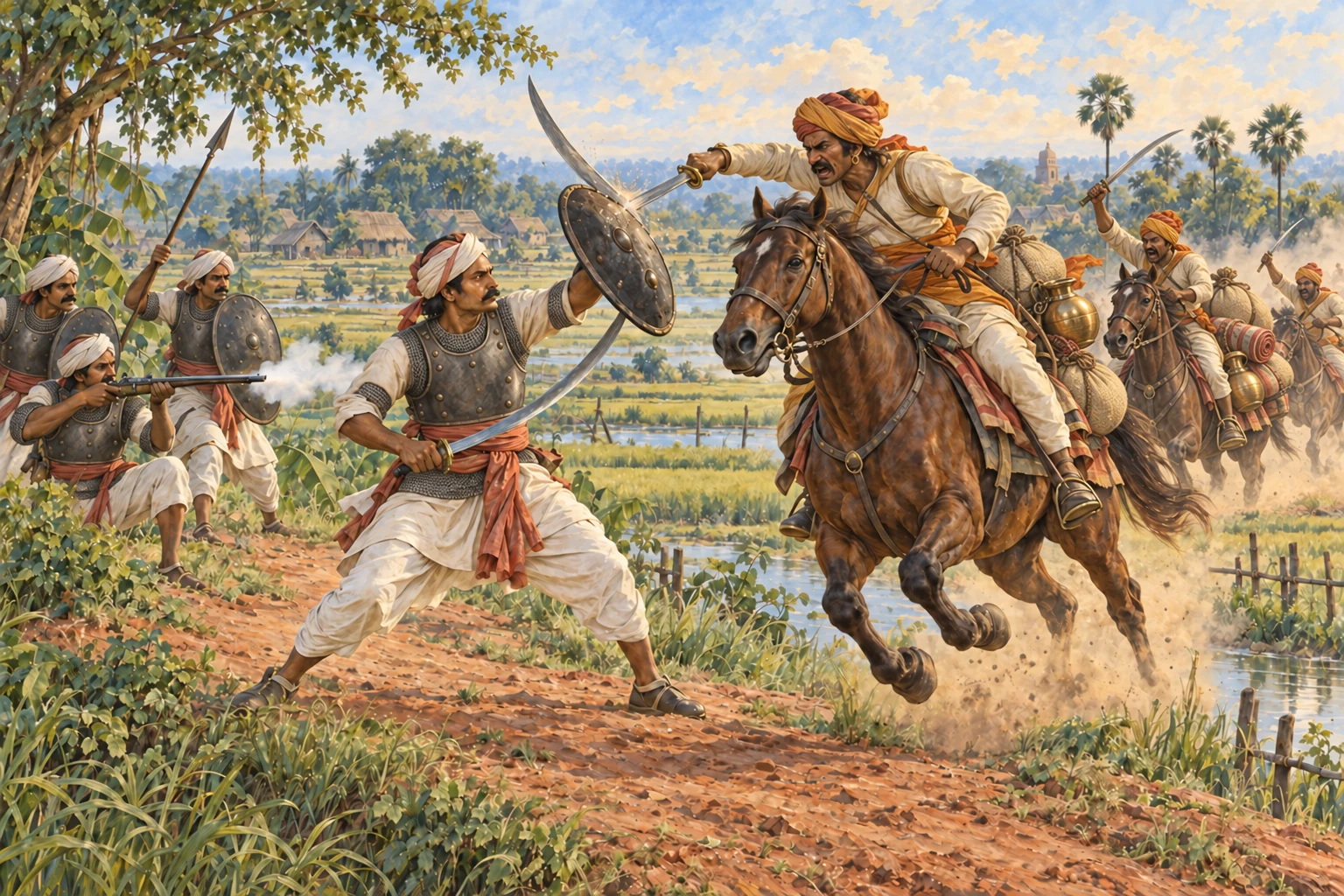
Three years after Plassey, in return for the Company's backing, Mir Qasim ceded Burdwan, Midnapore and Chittagong to the East India Company on 27 September 1760. At 5,174 square miles, Burdwan was reckoned the most productive district of the subah (Peterson 1910, p. 32). The Mughal prince Shah Alam was then invading Bihar, and the Maratha chief Sheo Bhat made neighbouring Bishnupur his base (Bankura district). Maharaja Tilakchand (r. 1744–1770) chose to fight. Months earlier his own soldiers had turned on the Company: in July 1760 the Raja's "unpaid discontented forces" fired on Company sepoys, because he had held back their pay to meet the revenue demand; by 1761 he owed them Rs 4.5 lakh, "equal to over a year's salary" (McLane 1993, p. 183). With the zamindar of Birbhum he met a Company force under Major Martin White on 29 December 1760, when White tried to ford the Damodar near Burdwan town (McLane 1993, pp. 184–185); local histories place the fight at a crossing of the Banka river near Sangotgola (Purba Bardhaman district), and it is also called the battle of Akna (Firminger 1917). Dutta's sources put about 10,000 Nagadee infantry in the field (Dutta 2023, p. 300, citing Halder 1982). McLane, working from the Company's records, gives "an estimated 10,000 troops from Burdwan, Birbhum, and other areas, as well as a body of faqirs", so the figure covers the whole allied force, not Burdwan's alone. They lost some 500 killed and 1,000 wounded; the Company had eleven wounded (pp. 184–185). "White easily defeated the forces of Burdwan and Birbhum" (Mandal 2025).
It was the Raj army's last battle. With the Nawab himself having signed the district away, Burdwan's soldiers still took the field against the Company. Dutta's sources call the Aguris "the bulk of the nagdees" (p. 299).
2. A cash army of hired men
The Nagadees were paid in cash because they had no land to serve from.
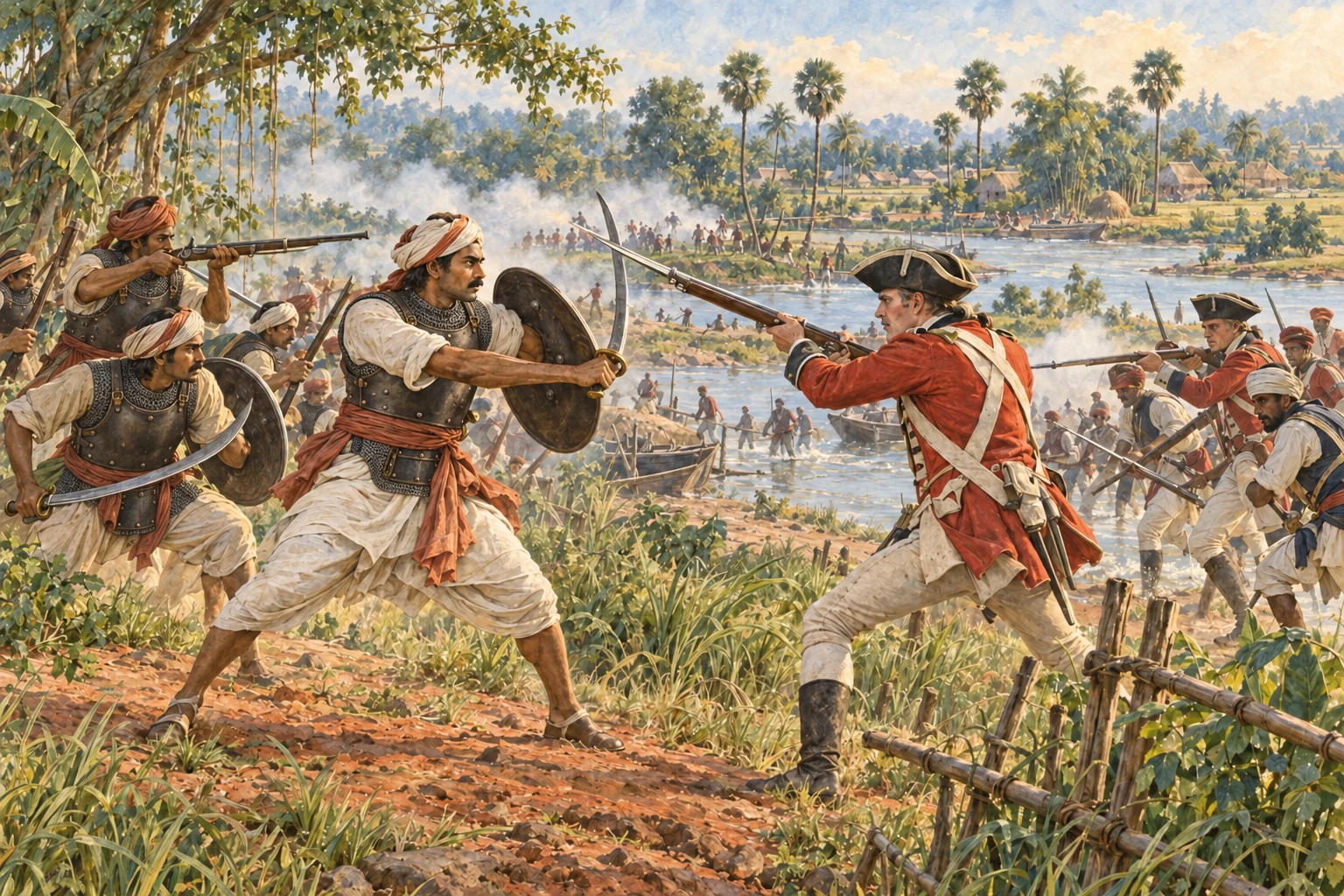
Nagadee (also nagdee, nagdi) comes from nagad, cash. Bengal's older retainers served in return for land (jagir, chakran); the Nagadees drew salaries from the Maharaja's treasury. Their upkeep exceeded Rs 3 lakh a year, and about 10,000 Nagadee infantry fought a Company force under Martin White in 1760 (Halder 1982 and the Burdwan settlement report of 1940, cited in Dutta 2023, pp. 299–300). McLane, working from the Company's records, uses the same word for the same body: "the raja of Burdwan's naqdi or cash-paid army", a "major part" of which the Company disbanded; between 1761 and 1767 "naqdi salaries were slashed from about Rs. 4 lakhs to just over Rs. 1 lakh" (McLane 1993, p. 117; Chakravarti 1970, p. 163). The cash army stood apart from the Raj's land-paid establishment: a table of the 1760s lists 32,032 chakaran servants, among them 4,793 guards in forts and passes and 19,846 village paiks, peons and kotwals (p. 118). Johnstone, the first Resident, pared the military payroll "from almost Rs. 4 lakhs to Rs. 2.64 lakhs", and in 1767 the Raja still kept 8,500 armed retainers, "exclusive of the 'inferior ones'" (McLane 1993, p. 192). By then little of the cash army was left: "The raja's naqdi or household guard was cut from 1,487 to 839 men" (p. 192, citing Hunter's Bengal MS. Records). McLane gives no headcount for the naqdi before the cuts.
This article reads the cash pay as the mark of hired Aguris with no local holdings. Dutta's sources call the Aguris "the bulk of the nagdees" (p. 299). The force had an up-country core of Rajputs, Bhumihars, Pathans and Afghans (Chatterjee 1986). Up-country recruits were familiar in eighteenth-century Bengal: hired matchlockmen were called Buxarries, "natives of Buxar" in Bihar, and Clive raised 200 of them in 1757 ("Buxerry", dictionary entry). McLane gives a different picture of the Aguris' place on the land: in most villages of western Bengal an "oligarchy" of dominant peasants, "typically Aguris, Kaibartas, or Sadgops", controlled the use of the land and organised cultivation (McLane 1993, pp. 54–55, drawing on Rajat Ray). He describes the eighteenth-century system without dating the Aguris' place in it, so it does not settle when they acquired land.
3. A Rajput link: the thread at marriage
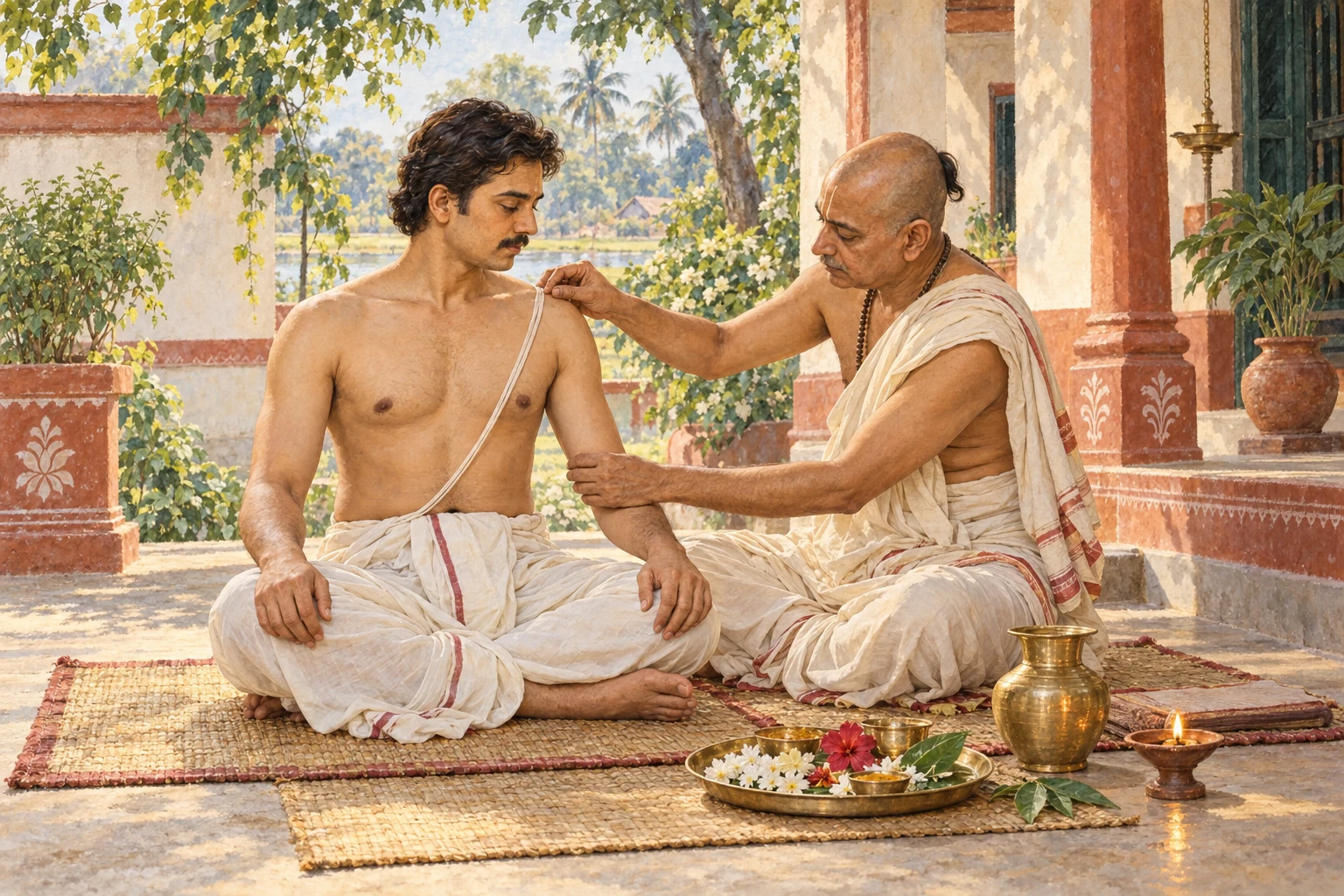
One Aguri custom points to the Rajputs of Bihar and eastern UP. In 1891 Risley found that a section of the Aguris took the sacred thread at marriage rather than in childhood (vol. I, p. 12). Bhojpuri Rajputs did the same: they "shuffle on the janeo in a rough-and-ready fashion when a boy gets married" (vol. II, p. 191). McLane, summarising Risley, notes that only one of the seven Aguri sub-castes wore the thread (McLane 1993, p. 158).
The shared custom links part of the Aguri community with the Rajputs of the Bhojpuri belt of Bihar and eastern Uttar Pradesh, perceived by the locals as people from Agra, i.e. Aguri.
A century later the thread was still part of Aguri ritual life at Kshiragram. During the Baishakh festival of the Jogadya temple, the representatives of the Datta and Samant lineages put on a sacred thread slightly thinner than a Brahman's; while they wear it they may not plough and must keep the prescribed abstinences. Togawa was told that Ugra Kshatriyas there had once worn the thread in daily life; by 1994–95 few did, though it was still worn at marriages and funerals (Togawa 2006, p. 92). Bhaumik adds a caution: around the 1911 census the Aguris were one of several Bengali castes, with Baidyas, Kayasthas, a section of the Telis, Subarnabaniks, Rajbansis and Jogis, who "had started wearing the sacred thread" as part of claims to higher rank (Bhaumik 2023, p. 247). That wave does not account for the Aguri custom. Risley recorded it in 1891, and Lalmohan Vidyanidhi's Sambandha Nirnaya (2nd ed., 1896) confirms the two divisions: the Janas take the sacred thread at marriage, though "those rites are not Vedic", while the Sutas live as Shudras (pp. 187–188). The practice was established two decades before the 1911 census, not adopted in response to it. On its own, though, the custom does not prove Rajput descent.
4. From soldiers to landholders
The Company ran the Nagadees down over half a century, and their soldiers moved onto the land.
John Johnstone, the first Company Resident at Burdwan, cut the force in 1763. The rest policed robber bands from the Birbhum and Bankura jungles and still guarded the Burdwan treasury in the 1780s; the arrangement ended in 1809 (Halder 1982 and the settlement report, pp. 22–23, cited in Dutta 2023, p. 300). McLane, from the Company's records, confirms that the cuts came in stages rather than at once. Between 1761 and 1767 naqdi salaries fell from about Rs 4 lakh to just over Rs 1 lakh (p. 117); in 1767 the Raja's 8,500 armed retainers were reduced, his household guard fell from 1,487 to 839, and the chakran lands that supported village paiks were resumed, adding Rs 1.2 lakh to the Company's revenue. Officials wrote of "the dread of the people ... of the oppression of the discharged troops", and dismissed soldiers and paiks were blamed for the growth of gang robbery (McLane 1993, p. 192). In 1787 Collector John Kinloch halved the remaining zamindari troops to 1,000 men and moved their command from a British officer to Maharaja Tejchand; they guarded the pargana kacharis, escorted treasure and put down disturbances (p. 263). Even in 1794 Burdwan counted 17,384 village paiks (p. 271). Firminger (1917, not yet checked) is cited for a sudden disbandment, and other accounts describe, without a source, a planned settlement of soldiers on frontier jotes; the regional sources describe gradual cuts and land acquired "through various means, including deception and trickery" (Dutta 2023, p. 300).
Many former Nagadee soldiers of the Aguri community joined a new stratum of powerful peasants, each holding 30 to 100 acres (Dutta 2023, p. 307, citing Halder 1982). By 1891 Risley found that "many of them hold estates and tenures of various grades, and the bulk of the caste are fairly prosperous cultivators" (vol. I, p. 13). McLane, drawing on Risley, calls them "a successful caste of jotdars and small traders" with "a special relationship with the Burdwan raj", many holding tenures and estates under it, and judges that they "seem to have been an important element in the Burdwan raj's success in consolidating its hold over its vast estate" (McLane 1993, p. 158). He does not say how. The tie to the Raj endured. At Kshiragram, where Ugra Kshatriyas held the larger part of the land, each of their nine lineages sent a representative to the rituals of a temple rebuilt around 1730 under Maharaja Kirtichand and run from the Raj's temple office (Togawa 2006, pp. 16, 49). The Datta and Samant lineages held chakran, service land granted by the Maharaja, for their ritual duties when the settlement survey of 1927–28 was made (pp. 59–61).
One lineage's own record ties its title to the Raj. A lineage chart handed down in the main Raychaudhuri family of Chaitanyapur, which Togawa quotes and summarises in a genealogy table, records that the Bardhaman Maharaja endowed the titles "Chaudhuri" and "Ray Chaudhuri" on a family formerly titled De, of pargana Dhenya. (Dutta lists the Roy Chowdhurys of Chaitanyapur among the prosperous Aguri families of Burdwan, p. 308.) It dates the family's arrival at Eruyar to 1154 BS (1746–47), at Kshiragram to 1182 BS (1774–75) and at Chaitanyapur to 1202 BS (1794–95) (Togawa 2006, pp. 148–149). These are the decades of the Maratha raids and the Company's first cuts to the Nagadees. The chart is a family document rather than an estate record, and it also claims descent from a raja, but it shows an Aguri lineage that understood its rank as a grant from the Burdwan Raj.
Do the numbers add up? They do if settlement began soon after 1696. The projection below starts in 1700 and grows the community year by year. It assumes wives aged 15–24 at settlement and a life expectancy of 25.5, Davis's figure for Indian women in 1872–91. It adds extra deaths for the Maratha raids (5%), the 1770 famine (5%; famine deaths in the Burdwan estate were "not severe") and the Burdwan fever of 1862–72 (10%).
| Couples settling, 1700 | Births per woman | Natural increase | Aguris projected, 1872 | Aguris counted, 1872 |
|---|---|---|---|---|
| 8,000 | 5.7 | 0.8% a year | 70,100 | 70,606 in Bengal; 59,887 in Burdwan |
The rates are realistic: India's natural increase in 1881–91 was 0.8% a year, from about 49 births and 41 deaths per 1,000 (Davis 1944, p. 262). At that rate about 8,000 settling couples reproduce the 1872 count: four-fifths of the 10,000 that Dutta's sources give for 1760, leaving room for men who went home. On McLane's figures the 10,000 was the whole Burdwan–Birbhum force, and he gives no headcount for the naqdi army before the cuts of 1761–67. The model assumes a single founding group and ignores later recruits.
5. Why Burdwan matters
Aguris are concentrated where the Burdwan Raj ruled.
| Year | Aguris in Bengal | In Burdwan district | Share |
|---|---|---|---|
| 1872 | 70,606 | 59,887 | 85% |
| 1881 | 78,349 | 57,272 | 73% |
| 1911 | 79,272 | 66,551 | 84% |
| 1921 | 68,816 | 59,949 | 87% |
Census figures as tabulated in Dutta 2023, Table 13.1; Risley's 1872–81 table shows the same pattern (vol. I, p. 13). Most of the rest lived in neighbouring Bankura. The 1872 census report already described the Aguri as having "their home almost exclusively in the district of Burdwan" (summarised in Bhaumik 2023, p. 232).
Within the district they were a substantial minority, not a majority. In 1901 they made up 11.1 per cent of the population of Raina, in the Dakshin Damodar, after Bagdis (24.3) and Muslim Sekhs (20.0); in the district as a whole they were 7.6 per cent in 1921 (Peterson 1910 and the 1921 census, cited in Ruud 2003, p. 123).
Theories set aside.
- Migration with Man Singh. A tradition brings the Aguris with Man Singh's Mughal army (Bhaumik 2023, p. 48). Man Singh, subahdar of Bengal from 1595 to 1606, campaigned from Orissa to Dhaka (Wikipedia). Burdwan was on his line of march: Todar Mal and Man Singh used Burdwan town as their headquarters against the Afghans, and in Man Singh's time it held a fort and a bazar that provisioned Mughal troops (McLane 1993, pp. 128–129). The geography alone therefore does not rule the tradition out. What it lacks is evidence: no record ties any Aguri family to his army or to a settlement of his soldiers, and the written versions located so far are late nineteenth- and twentieth-century community accounts.
- Khatri–Sadgop unions. W. B. Oldham's 1891 theory rests on what he called admissions by the Aguris themselves; a review that Bhattacharya quotes rejects them, although Oldham certified them as properly recorded (Bhattacharya 1896, p. 156). McLane calls Oldham "obviously misled", notes that Oldham did not say whether the marriages came before or after Chitrasen's conquest of Gopbhum, and finds "no historical record or admitted Burdwan raj family memory of a Sadgop rani of Burdwan" (McLane 1993, p. 157).
6. The Chandimangal couplet
The couplet cited for a sixteenth-century Aguri presence is firmly dated only to about 1700.
Mukundaram's Chandimangal, composed in the later sixteenth century, contains a couplet Dutta quotes as Aghari nibase pure / apnar brtti kare / anuchit na kare kakhano: "the Aghari dwell in the town, follow their own calling, and never do wrong". He cites Sukumar Sen's edition, pp. 82 and 135 (Dutta 2023, pp. 301, 319). McLane dates the poem to 1589 and uses it to argue that the Aguris are "an old caste" whose mention "almost certainly pre-dates the arrival of Khatris in Burdwan" (McLane 1993, p. 157). He quotes it in English through Dimock and Inden's "The City in Pre-British Bengal" (pp. 12–13): the Aguris perform "their own work, always thinking of battle. They are learned in many kinds of weaponry. They support their priest and preceptors, and never do anything wrong." That rendering carries martial lines absent from the couplet Dutta quotes, so Dimock and Inden were reading a longer or different passage, which also needs checking against Sen's edition.
Two points undercut that use. Sen's edition "was based on a manuscript dated 1700" (Famine & Dearth project), so the couplet is firmly attested only from about 1700. And the word is Aghari, which is also the name of a tribe of Chota Nagpur and the Central Provinces. Bhattacharya thought the Aguris could "with more reason" be connected with that tribe (1896, pp. 156–157), but the couplet does not say which people it means, so reading it as the Burdwan Aguris is an assumption.
Whether the couplet appears in the oldest surviving manuscripts or was added to later copies remains unverified. The next mention, in Bharatchandra's Vidyasundar (1750s), is set in Bardhaman itself: Bhaumik quotes it as Aguri, prabhiti ar nagari jatak (Bhaumik 2023, p. 48).
The wording of the Chandimangal line is itself unsettled. Bhaumik gives it as Aguri nibhaspure, manda karma nahi kare ("the Aguri live in the town and do no wrong"), with Aguri where Dutta has Aghari (Bhaumik 2023, pp. 48–49). Her note cites a Bardhaman district history rather than an edition of the poem (p. 65, n. 134). Two published scholars therefore quote different forms of the same line, which strengthens the case for going back to the manuscripts.
Sources
Primary and early sources
- Risley, H. H. The Tribes and Castes of Bengal, vols I–II. Calcutta, 1891. vol. I; vol. II
- Vidyanidhi, Lalmohan. Sambandha Nirnaya, Samanya-kanda. 2nd ed. Calcutta, 1896. archive.org
- Bhattacharya, J. N. Hindu Castes and Sects. Calcutta, 1896. GIPE scan
- Day, Lal Behari. Bengal Peasant Life (1878; first published as Govinda Samanta, 1874), 1916 reprint. archive.org
- Mukundaram, Chandimangal, ed. Sukumar Sen (Sahitya Akademi). Famine & Dearth project, University of Exeter: "Translation Chandimangal" and Bengali text.
- Firminger, W. K., ed. The Fifth Report from the Select Committee of the House of Commons on the Affairs of the East India Company, 28 July 1812. Calcutta: R. Cambray & Co., 1917.
- Oldham, W. B. Some Historical and Ethnical Aspects of the Burdwan District. Calcutta: Bengal Secretariat Press, 1891.
- Peterson, J. C. K. Bengal District Gazetteers: Burdwan. Calcutta: Bengal Secretariat Book Depot, 1910. Read directly: pp. 27, 28, 31, 32 and 204. Digitised copy
- Ugrakshatriya-Pratinidhi, vol. 1 (1891–92). Read directly: scan 110. Journal reader
Scholarship
- McLane, J. R. Land and Local Kingship in Eighteenth-Century Bengal. Cambridge University Press, 1993. Read directly: pp. 54–55, 117–118, 125–138, 157–160, 183–185, 192, 263 and 271. DOI
- Dimock, Edward C., and Ronald B. Inden. "The City in Pre-British Bengal." Cited via McLane 1993, p. 157; not yet examined.
- Chakravarti, Santosh Kumar. "The History of the Relations of the Rajas of Burdwan and the East India Company during 1760–1832." PhD thesis, Department of History, University of Burdwan, 1970. Read in full: p. 163. Shodhganga
- Dutta, A. K. "Prosperity, Dominance, and Social Mobility." In Explorations in Colonial Bengal, 297–324. Orient BlackSwan, 2023. Used for Halder (1982), the Burdwan settlement report (Hill and Banerjee 1940), Mitra (1953) and the 1921 and 1931 censuses; the specific passages used here have not been examined directly. Orient BlackSwan
- Bhaumik, S. The Changing World of Caste and Hierarchy in Bengal. Routledge, 2023. Routledge
- Togawa, Masahiko. An Abode of the Goddess: Kingship, Caste and Sacrificial Organization in a Bengal Village. New Delhi: Manohar, 2006. ISBN 9788173046773. Published version of the 1996 PhD thesis, A Sakta-Pitha in Bengal, University of North Bengal. Thesis in the NBU repository
- Ruud, Arild Engelsen. Poetics of Village Politics: The Making of West Bengal's Rural Communism. New Delhi: Oxford University Press, 2003.
- Chatterjee, Gouripada. Midnapore, the Forerunner of India's Freedom Struggle. Mittal Publications, 1986.
- Davis, Kingsley. "Demographic Fact and Policy in India." Milbank Memorial Fund Quarterly 22, no. 3 (1944), p. 262. PDF
- Life expectancy in high-mortality populations, citing Davis (1951), Max Planck Institute for Demographic Research. Table
- Sarkar, Jadunath. Fall of the Mughal Empire, vol. I, 1739–1754. 3rd ed. Orient Longman, 1964 (cited via Wikipedia).
- Mandal, Sanghapriyo. "Conflict and Collaboration: Burdwan Raj and Its Relationship with the British (1757–1947)." Journal of Historical Studies and Research, 2025. PDF
Local tradition and reporting
- ETV Bharat. "Durga Puja 2023: বর্গী হানা রুখেছিল উগ্র ক্ষত্রিয়রা, আসানসোলে সেই পরিবারের 9 দুর্গাপুজো." 2 October 2023. In Bengali. ETV Bharat
- Bandyopadhyay, Raja. "আসানসোল গ্রামের ঐতিহ্যের ৮ টি দূর্গাপুজো এবার জৌলুসহীন." Bengal Mirror, 20 October 2020. In Bengali. Bengal Mirror
- Sobbanglay. "আসানসোল." Local history, citing the researcher Ramshankar Chowdhury. In Bengali. Sobbanglay
Reference
Burdwan estate records, kul panjikas, oral histories and fieldwork offer ways to test the proposed connection between Nagadee service and Aguri origins. Explore the research topics →
Page views: