Add a memory or a record
Contribute to the story
Share a photograph, document, memory or correction in Bengali or English. Editors review contributions before publication; an approximate date or an incomplete account can still be useful.
The heritage projectAbout
Sourced from the Aguri Heritage project.
https://aguri-heritage.in/about
Original project material: all rights reserved. Other material retains its own rights. Copyright & reuse
An independent project celebrating the history, culture and people of the Aguri / Ugra Kshatriya community.
Last updated:
Aguri Heritage. “A heritage worth keeping.” Last updated: . https://aguri-heritage.in/about.
Citing this page does not grant permission to republish it. Copyright & reuse.
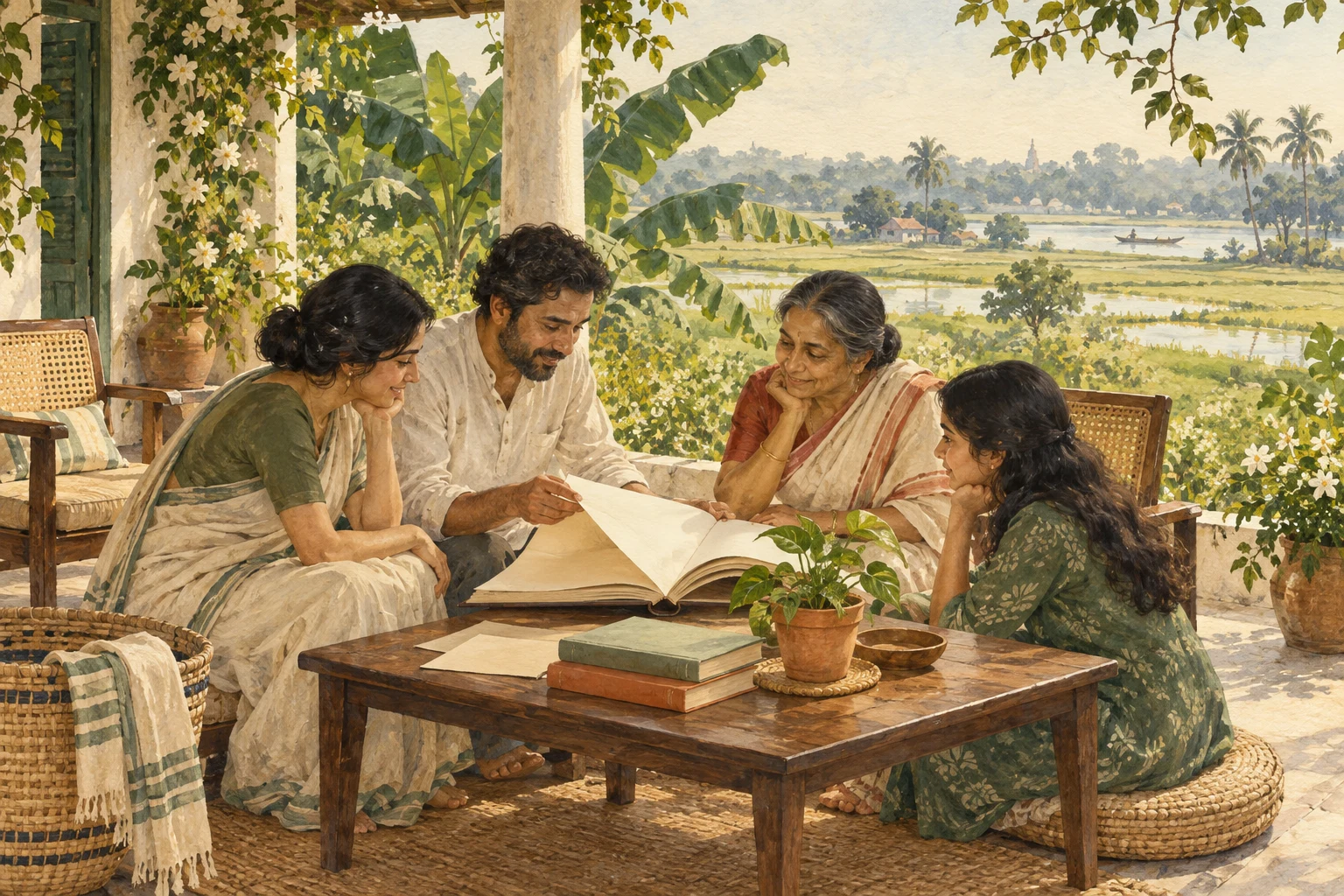
Aguri Heritage celebrates the history, culture, places and people of the Aguri / Ugra Kshatriya community of West Bengal. It welcomes families discovering their roots and anyone interested in the community’s place in Bengal’s wider story.
How did families make a living? What connects a village, a school or a remembered festival to the wider history of Bengal? This independent public history project brings together accounts of origins and livelihoods, village connections, notable personalities and cultural life so that readers can explore these questions without specialist knowledge.
Books, historical studies, biographical records and periodicals support the account. The aim is to connect academic history and field studies with credible oral history, keeping the evidence and its limits visible. Family photographs, documents and remembered experiences can enrich that work as the project grows. A date, a name or a correction can help make the shared story more accurate.
Explore, contribute and share
Follow a source, add something you remember, or learn how to share material with care.
Add a memory or a record
Share a photograph, document, memory or correction in Bengali or English. Editors review contributions before publication; an approximate date or an incomplete account can still be useful.
Share with care
Find the guidance for sharing links, quoting text and requesting permission to reuse material. Historical sources and other people’s work retain their own rights.
Before you contribute
Read how ownership, permission, credit, privacy and editorial review work. You keep ownership of your contribution; the terms explain the permission you give this project.
Follow the evidence
Browse books, research, biographies, regional records, translations and old periodicals. Find the material behind a story and see which sources were consulted.
Current articles, biographies, source descriptions and reading-room controls are available in English and Bengali. Use the language selector at the top right to switch between editions; your current article section or journal scan is preserved.
Paired editions share the same sources, citations and scans. Historical Bengali writings are presented through the original printed pages, with checked Bengali transcriptions where available. English translations are labelled separately. External websites and downloadable documents remain in their original languages.
Useful contributions include dated family photographs, village histories, school or association records, personal memoirs, festival accounts and historical publications. Record who supplied an item, what is known about its date and place, and whether the owner agrees to public sharing.
Use the online form to share a memory, photograph, document or correction in Bengali or English. Editors review each contribution before publication. The downloadable template is also available for gathering details offline.
Our original project material is all rights reserved, with limited permissions for personal study and attributed quotations. Contributors keep ownership of their work and grant the project permission to publish and maintain their contributions. Historical sources and third-party material retain their own rights.
Read our copyright and reuse policy and contributor terms, or send a private rights or reuse enquiry.
The Resources section brings together historical books, scholarly writing, biographies, regional records, English translations and a periodical archive. It includes Rajput O Ugrakshatriya in English, alongside its digitised Bengali original. The translation marks the gap left by two missing printed pages in the scan.
The journal PDFs were supplied by the project owner. Library marks visible in the scans are preserved as part of their provenance. Their presence does not imply that the library endorses this project or supplied these particular digital copies.
Page ornaments. The faint line drawings in the margins of articles are original drawings made for this website. They are modelled on Bardhaman’s temple terracotta and folk crafts, among them the temples of Kalna, Dokra metal casting, Natungram’s wooden dolls and shola work, which are the creations of the district’s temple builders and artisan communities. They are decorative and stylised: they do not depict Aguri practice, and none is an exact drawing of a particular monument or object.
The website uses locally stored assets and runs without an account. Searching takes place in your browser. External source links need an internet connection; the local articles and journal files remain available offline.
You can ask to be told when something substantial is published: a new article, a major research update or a new family profile. Notifications are off unless you choose them. Use Turn on notifications at the foot of any page; your browser then asks for permission. Expect at most a few messages a month.
The website stores only what your browser needs to deliver a message: a push address issued by your browser’s vendor, two encryption values and your language edition. It does not store your name, email address, IP address or reading history, and messages are not used for tracking. Use the same button to turn notifications off; the address is then deleted. You can also remove the permission in your browser’s site settings. On iPhone and iPad, notifications work only after the site has been added to the Home Screen.
The Page views total at the bottom of each page counts visits from the time the counter was introduced; it does not measure completed reads or unique readers. English and Bengali pages have separate totals. Only a page address and its total are stored for this counter, without visitor names, IP addresses or identifiers. A temporary marker in your browser tab avoids counting the same page again within 30 minutes. There are no tracking cookies or third-party analytics.
Page views: