The heritage projectPeopleRamapada Chowdhury
Ramapada Chowdhury
Sourced from the Aguri Heritage project.
https://aguri-heritage.in/person-ramapada-chowdhury
Original project material: all rights reserved. Other material retains its own rights. Copyright & reuse
The private life behind the stories
Last updated:
Cite this page
Aguri Heritage. “Ramapada Chowdhury.” Last updated: . https://aguri-heritage.in/person-ramapada-chowdhury.
Citing this page does not grant permission to republish it. Copyright & reuse.
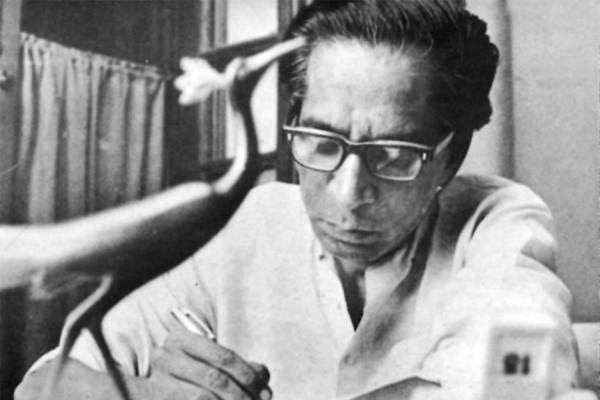
At the beginning of their married life, Ramapada Chowdhury and his wife, Sushama, lived in a single rented room. His writing often continued until half past one or two in the morning, and the light kept her awake. Sushama remembered what happened next: he brought home a table lamp and screened its light with paper so that she could sleep. The recollection, recorded by Argha Bandyopadhyay, offers an intimate glimpse of a writer whose working life had to make room for another person's needs. [1]
Readers knew Chowdhury as a novelist of uneasy households and troubled relationships. Younger writers sometimes encountered a forbidding editor. His family remembered the man at home. These perspectives belong together. The books emerged from a life that included the practical compromises of marriage, the demands of a newspaper office and a lasting curiosity about how people live with one another.
The railway town and the city
Born in Kharagpur in 1922, Chowdhury grew up in a railway household. His father, Taraprasanna, worked for the railway; his mother was Haridasi. [1] The town remained vivid in his later memoirs. In passages reproduced by the local historian Arnab Mitra, he remembered the large railway bungalow near Golbazar where the family lived. During hot afternoons, when their mother forbade them to go outside, the children ran up and down the wooden staircase and spoiled her nap. Such memories preserve a childhood with its own unruly pleasures, well before literary reputations and editorial responsibilities. [2]
Kharagpur was his birthplace and childhood home, but his Aguri family's rural roots lay in Burdwan. Reviewing his memoir Harano Khata, Anita Agnihotri describes a youthful visit to the family's village home for a relative's wedding, and the rural experiences through which he discovered his roots. [21] We can see recollections of the remembered village in his Banpalashir Padabali.
Books opened another route out of the bungalow. An Anandabazar Patrika editorial recalled his early reading in the railway institute's library, with its Bengali and English books. In 1939 he came to Calcutta, entered Presidency College and lived at Eden Hindu Hostel. College Street's second-hand bookstalls enlarged his reading further; it was there that he discovered Stefan Zweig. His literary beginning had a less solemn setting. At his friends' urging, he wrote a four-page story at a YMCA restaurant. He called it Tragedy. [3] Bandyopadhyay dates its composition to 1940. [1]
The route into print required persistence and money. Feature-writing earnings paid for his first three story collections. He began his career as a novelist with Pratham Prahar, and Banpalashir Padabali subsequently brought a wider readership. [1] Its village world follows lives that overlap through affection and quarrels, with the tensions between generations running through them. [8] Chowdhury's subjects would change, but the household, with all the claims its members make on each other, remained important to him.
The editor and his writers
For decades he edited Anandabazar Patrika's Sunday literary pages, alongside his own writing. [4] A young author could find the approach intimidating. Samaresh Majumdar recalled being so taken with Chowdhury's Titir Kannar Math that he borrowed its heroine's name, Arunima Sanyal, for a story of his own. He hoped the tribute would please its intended editor. It did not get that far. When Majumdar introduced himself as a contributor to Desh, Chowdhury told him to take the story there, without reading it. [5]
Majumdar kept his distance after that rebuff. Years later, Chowdhury unexpectedly asked him for a story. Closer acquaintance brought invitations to stay for afternoon muri, or puffed rice. Majumdar's remembrance allows the brusqueness to remain visible alongside the affection. He also credited Chowdhury's fiction with teaching him how to write a short story. [5]
Shirshendu Mukhopadhyay remembered the Saturday gatherings in the editor's office, where younger writers talked over tea, muri and fried snacks. He noticed a courtesy that complicates the image of the stern gatekeeper: Chowdhury generally addressed even much younger assistants as apni, the respectful Bengali form of address. He also drove his own small car and prepared his own income-tax returns. These modest details give the recollection its texture. [6]
His place in Bengali literature
Chowdhury belongs to the generation that carried Bengali fiction forward after Bibhutibhushan, Tarashankar and Manik Bandyopadhyay. Anandabazar Patrika's obituary places him explicitly in that succession. [22] Literary historian Arun Kumar Mukhopadhyay groups him with the writers who gave Bengali short fiction new directions around the Second World War, including Narayan Gangopadhyay, Samaresh Basu and Bimal Kar. [23]
His particular strength was to make the familiar household morally unsettling. Punarjit Roychowdhury describes fiction that exposes a middle class quick to condemn injustice elsewhere but reluctant to recognise its own failures of sympathy. Yet this was not his only territory: Bharatbarsha and Banpalashir Padabali look beyond urban rooms towards wartime disruption, poverty and a changing rural economy. [14] Shyamali Acharya, writing as a later practitioner, locates his distinction in restrained narration and close psychological observation, within a generation finding forms unlike those of the three Bandyopadhyays. [24]
Tilottama Majumdar's centenary assessment helps explain the effect: everyday language and an absence of display allow an ordinary disturbance to expose precarious lives. His restraint is not an absence of feeling; it is a way of making readers attend more closely. [7]
His influence also ran through the editor's office. Shirshendu Mukhopadhyay's recollections place him at the centre of a younger literary circle, while Samaresh Majumdar acknowledged learning the short story from his work. [6,5] His contribution to Bengali literature includes both the stories themselves and the encouragement he gave later writers.
In Je Jekhane Danriye, published first in the 1972 Puja issue of Desh, former lovers meet again after twenty years. Their encounter raises questions about marriage and desire, while a younger generation lives by changing expectations. [9] Bari Badle Jay turns towards the longing for a home of one's own. The publisher's account emphasises what happens to people when they become property owners. A change of address can alter relationships as well as living arrangements. [15]
Cinema gave some of these situations a further life. Mrinal Sen's Kharij follows the death of a young domestic servant and the discomfort of the household that employed him. The prospect of legal closure does not settle its moral unease. The film received the Jury Prize at Cannes in 1983. [10] Its force makes clear why Chowdhury's domestic worlds could furnish filmmakers with difficult questions rather than reassuring resolutions.
Another adaptation had a troubled beginning. Tapan Sinha recalled that he had filmed about a quarter of Abhimanyu, with Soumitra Chatterjee and Madhabi Mukherjee, when the producer announced his insolvency. Sinha eventually returned to the material in Hindi as Ek Doctor Ki Maut. [11] Released in 1990, the film concerns a doctor's research and the hostility that obstructs it. [12] The interrupted production is part of the story of how Chowdhury's work travelled beyond the Bengali page.
Recognition included the Sahitya Akademi Award for Bari Badle Jay in 1988. [13] Yet continued publication was not, for him, an obligation imposed by success. Punarjit Roychowdhury's account of a 2005 interview describes Chowdhury explaining his withdrawal from fiction: he no longer felt he knew the contemporary world sufficiently well. [14] It was a demanding standard to apply to himself, after a career spent observing the lives around him.
Chowdhury died in 2018. [3] The recollections left by his wife and fellow writers resist a smooth commemorative portrait. There is room in them for impatience, humour, practical kindness and exacting judgement. They bring us back to a person with whom others had to share a room or an office. That is a fitting approach to an author who asked readers to look closely at the people with whom a life is shared.
Selected bibliography
A selected reading list, not a complete bibliography. All Bengali works are by Ramapada Chowdhury. Publication or edition years are given only where the cited record supports them; film years are labelled separately.
Pratham Prahar. His first novel, drawing on the railway-town world of his early life. [1,2]
Banpalashir Padabali. Ananda Publishers, June 1962 book publication, as recorded by the Blind Persons’ Association. Interwoven village lives and generational tensions. Uttam Kumar’s film adaptation was released in 1973. [8,16]
Ekhoni. Novel. Tapan Sinha’s film adaptation was released on 30 April 1971. [16]
Je Jekhane Danriye. First appeared in Sharadiya Desh, October 1972, before book publication. A reunion tests remembered love against marriage and changed circumstances. [9]
Kharij. Calcutta: Ananda Publishers, 1974, the edition cited in scholarly research. Mrinal Sen’s film adaptation received the Cannes Jury Prize in 1983. [17,10]
Abhimanyu. Novel. The source of Tapan Sinha’s Ek Doctor Ki Maut, released in 1990. [11,12]
Bari Badle Jay. Ananda Publishers. A novel about home ownership and its effects on people; winner of the 1988 Sahitya Akademi Award. The award year is not a publication date. [13,15]
Harano Khata. Ananda Publishers. Memoir, documented in a contemporary April 2015 bestseller list. One of the sources for the remembered Kharagpur household. [18,2]
English translations
Second Encounter. Translated by Swapna Dutta from Je Jekhane Danriye. Niyogi Books. ISBN 9789385285448. [9]
Dwellings Change. Translated by Tania Chakravertty from Bari Badle Jay. New Delhi: Sahitya Akademi, 2023. ISBN 9789355486301. [19,20]
Sources and further reading
Numbers correspond to the citations in the essay and bibliography. Source titles and citation numbers are clickable. Online sources consulted 28 October 2026.
1. Argha Bandyopadhyay. Ghorer Manush. Anandabazar Patrika, 11 December 2022. Family recollections.
2. Arnab Mitra. The house of writer Ramapad Chowdhury in Kharagpur. Medinikatha Journal, 4 July 2025. Reproduces passages from Phele Asa Jiban and Harano Khata; the original memoir editions were not independently inspected.
3. Anandabazar Patrika. Shri Ramapada Chowdhury 1922–2018. Unsigned editorial, 30 July 2018. Used for reading, education and early writing, not its conflicting award date.
4. Niyogi Books. Ramapada Chowdhury. Publisher’s author biography. Used for his editorial career.
5. Samaresh Majumdar. Galpo ki kore likhte hoy shikhechhi onar lekha pore. Anandabazar Patrika, 30 July 2018. First-person remembrance of reading and working with Chowdhury.
6. Shirshendu Mukhopadhyay. Bindumatro chhilo na boro lekhoker ahankar. Anandabazar Patrika, 30 July 2018. First-person remembrance.
7. Tilottama Majumdar. Kolomer dekhanepona chhilo na. Anandabazar Patrika, 28 December 2022. Centenary assessment of his prose and editorial work.
8. Blind Persons’ Association. Banpalashir Padabali by Ramapada Choudhury in audio. Book and recording record. Gives June 1962 publication and identifies the April 1985 ninth reprint used for the recording.
9. Niyogi Books. Second Encounter. Publisher’s record, including original magazine appearance, synopsis and translation details.
10. Festival de Cannes. Kharij. Official film record and synopsis. Jury Prize, 1983.
11. Robi Basu. I Am a Worshipper of All Things Beautiful: An Interview with Tapan Sinha (Part IV). Translated by Suchandra Roy Chowdhury. Silhouette, 2 December 2014; reprints a Desh interview first published in 1991.
12. National Film Development Corporation. Feature Films Catalogue 2024. Ek Doctor Ki Maut entry, PDF page 30. Film dated 1990.
13. Sahitya Akademi. Akademi Awards in Bengali. Official list. The 1988 entry names Ramapada Choudhuri and Bari Badle Jai.
14. Punarjit Roychowdhury. Thamte janatao ekta art. Anandabazar Patrika, 18 April 2022. Reports Chowdhury’s 2005 interview with Shirshendu Mukhopadhyay.
15. Ananda Publishers. Translation Rights Catalogue. Bari Badle Jay entry, PDF page 6. Publisher’s thematic description.
16. Bengal Film Archive. Ekhoni and Banpalashir Padabali. Filmography records giving release dates and directors. Banpalashir Padabali record
17. Ishita Chakravarty and Deepita Chakravarty. For Bed and Board Only: Women and Girl Children Domestic Workers in Post-Partition Calcutta (1951–1981). Modern Asian Studies, published online 19 November 2012, note 90. Bibliographic citation of Kharij, Ananda Publishers, 1974.
18. Anandabazar Patrika. Bestseller. 25 April 2015. Contemporary listing of Harano Khata and its publisher.
19. Sahitya Akademi. Annual Report 2023–2024. Page 182. Dwellings Change, author, translator and ISBN.
20. Sanjukta Dasgupta. Transcending borders of orthodoxy and ritualistic practices. The Statesman, 1 July 2024. Review of Dwellings Change, identifying the 2023 edition.
21. Anita Agnihotri. Atiter akapat shanto chitrarup. Anandabazar Patrika, 14 May 2016. Review of Harano Khata; identifies the family’s village home in Bardhaman without naming the village.
22. Anandabazar Patrika. Tiyaranger dwip chhariye chole gelen Ramapada Chowdhury. Staff obituary, 30 July 2018. Places Chowdhury in the succession to Bibhutibhushan, Tarashankar and Manik Bandyopadhyay.
23. Arun Kumar Mukhopadhyay. Bangla chhotogalpo ei samay. Sahitya Patrika 35, no. 3 (1 June 1992), pp. 30–42. DOI 10.62328/sp.v35i3.2. Journal abstract situates Chowdhury among the Second World War generation of short-story writers.
24. Shyamali Acharya. Amar na dekha Dronacharya. Daakbangla, 28 December 2024. A writer’s appreciation of Chowdhury’s restraint and psychological observation.
Page views: