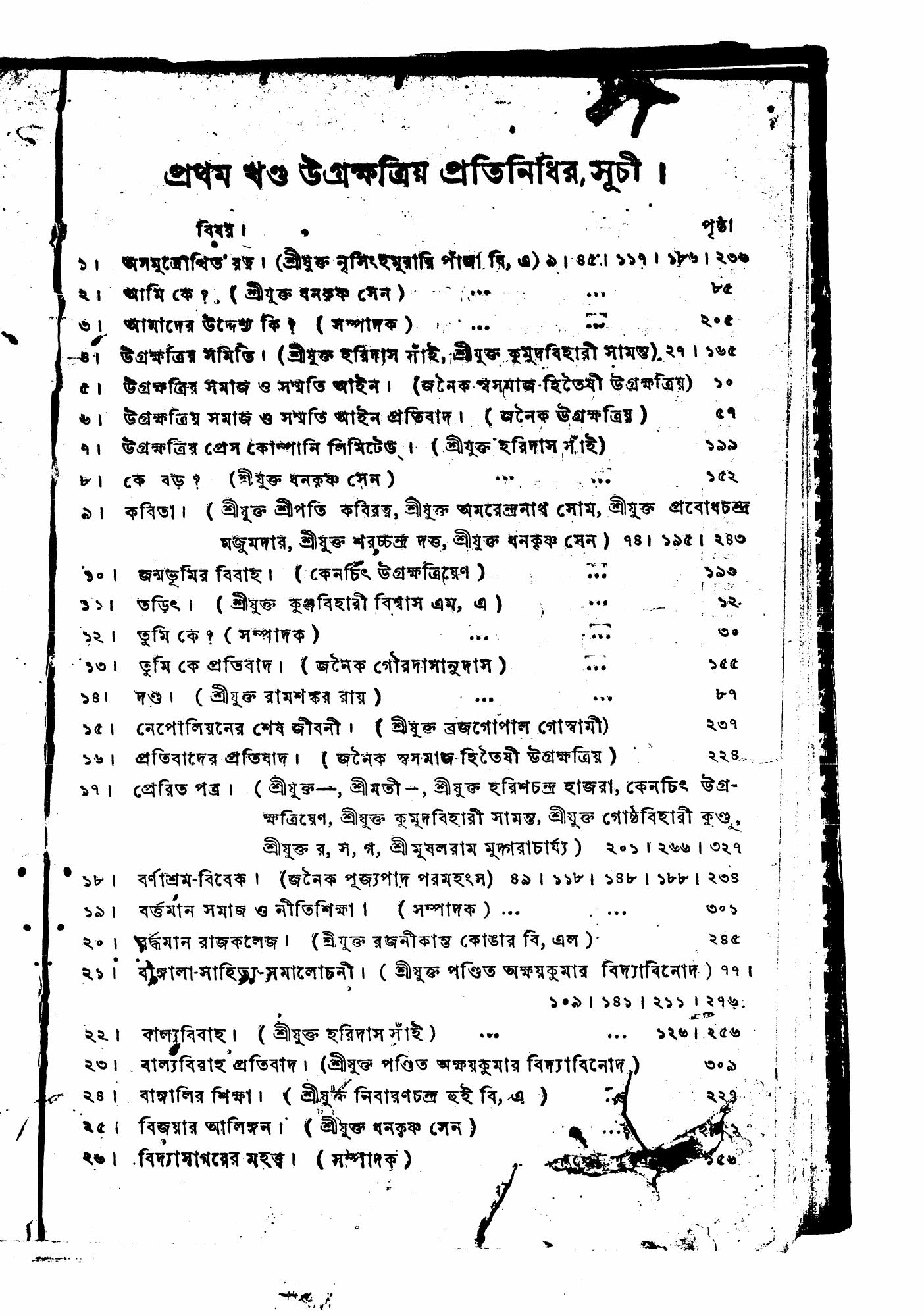
Original Bengali journalUgrakshatriya-Pratinidhi, Volume I (1298 Bangabda)
Owner-supplied scan: Ugrakshatriya_Pratinidhi_Vol_01.pdf. 175 PDF images, mostly two-page spreads. The cover and opening contents leaves were inspected directly. The year 1298 spans 1891–92; Baishakh 1298 falls in April–May 1891.
Owner-supplied PDF. Complete electricity essay (printed pp. 12–23) and first editorial’s opening-page extract translated against the scans; selected reading notes also available. Bengali OCR remains unreviewed. The contents leaves (scans 2–3) were re-read against the images on 8 October 2026 for the titles and authors cited on the Culture page.
Read Volume I ↗Original Bengali journalUgrakshatriya-Pratinidhi, Volume II (1299 Bangabda)
Owner-supplied scan: Ugrakshatriya_Pratinidhi_Vol_02.pdf. 167 PDF images, mostly spreads. The first image bears the second-volume label and year 1299 (1892–93), and begins Pratinidhir Atmakatha, the periodical’s account of itself. The report of the Ugrakshatriya Samiti’s sixth session, held on 17–18 Shraban 1299 (printed pp. 104–105, scan 53), lists the thirteen members present, the Samiti’s five aims, the transfer of the journal from its editor and proprietor, Srishchandra Ta, and a resolution against Risley’s account of the caste.
Owner-supplied PDF. Complete Pratinidhir Atmakatha (printed pp. 1–5) translated against the scans. Bengali OCR remains unreviewed; most of the volume is not translated. The Samiti report was read against the scan image on 8 October 2026; it has not been translated in full.
Read Volume II ↗Colonial ethnographyH. H. Risley, The Tribes and Castes of Bengal, Vol. I (1891), pp. 12–13
The Aguri entry in the original digitised volume: cultivation and trade, seven named subdivisions, marriage sections, ritual practices and a historical distribution table. Internet Archive item TheTribesAndCastesOfBengal. The item’s OCR was consulted directly; census figures were not transcribed from its broken table.
Evidence of what a colonial author recorded in 1891. The text’s caste hierarchy, origin speculation and character stereotypes are not descriptions this project endorses.
Open source ↗Historical scholarshipJohn R. McLane, Land and Local Kingship in Eighteenth-Century Bengal (1993)
Cambridge University Press, Cambridge South Asian Studies 53. Village “oligarchies” of dominant peasants, “typically Aguris, Kaibartas, or Sadgops” (pp. 54–55); “the raja of Burdwan’s naqdi or cash-paid army”, whose salaries fell from about Rs 4 lakh to just over Rs 1 lakh in 1761–67, and the 1760s table of 32,032 land-paid servants (pp. 117–118); chapter 6, “Mughal Burdwan and the rise of the Burdwan raj” (pp. 125–138): Burdwan as a Mughal garrison town, the Khatri origins of the Raj family, Abu Rai’s appointment (p. 134), Krishnaram Rai’s farman of 1695–96 (p. 137) and the revolt of 1696–97 (p. 129); Gopbhum, Oldham’s Khatri–Sadgop theory and the Aguris (pp. 157–160); the Raja’s unpaid troops and the battle of 29 December 1760 (pp. 183–185); Johnstone’s payroll cut and the 1767 reduction of the “naqdi or household guard” from 1,487 to 839 (p. 192); Kinloch’s 1787 halving of the zamindari troops to 1,000 (p. 263); 17,384 village paiks in 1794 (p. 271).
Read directly from the full Cambridge PDF (October 2026): pp. 54–55, 117–118, 125–138, 157–160, 183–185, 192, 263 and 271. McLane uses the Chandimangal, dated 1589 and quoted through Dimock and Inden’s translation, to treat the Aguris as older than the Khatris in Burdwan; this website records that reading and its limits on the Origins page. McLane does not connect the Aguris with the Raj’s naqdi (cash-paid) army or any other troops.
Open source ↗Doctoral thesis · read in fullSantosh Kumar Chakravarti, The History of the Relations of the Rajas of Burdwan and the East India Company during 1760–1832 (1970)
PhD thesis, Department of History, University of Burdwan, 1970; supervisor S. B. Chaudhuri. Shodhganga, CC BY-NC 4.0. Historical background, including the 1696 revolt (pp. 4–16); the action at the pass of the Banka river on 29 December 1760, from Captain White’s letter (pp. 22–24); the Raja’s 32,031 land-paid servants in 1766 (p. 162); the monthly allowance for the “Nugdean” or household troops, 1761–67, from the diwan’s representation of 1 October 1777 (p. 163); the 1767 establishment of 1,487 men, with those dismissed and retained (pp. 164–165); the abolition of the corps in March 1787 (p. 177); and the patni system on the Burdwan estate (chapter 4, pp. 123–154). McLane (1993) cites it as Chakrabarti, “History”.
Read in full through the text layer of the Shodhganga PDFs in October 2026; figures and page numbers checked against that text. The thesis does not record the caste or origin of any of the Raja’s troops.
Thesis on Shodhganga ↗Anthropology · preview consultedKanchan Mukhopadhyay, Uneven Terrain: Society and Foodways in Rarh Bengal (2026)
Routledge, 2026 (© Anthropological Survey of India). ISBN 9781041033073; DOI 10.4324/9781003625667. An ethnography of food and social relations in four Rarh villages in Paschim Medinipur, Jhargram, Bankura and Birbhum. The introduction, citing Porter’s 1931 census report (pp. 230–242), places agriculturist castes “such as Sadgop, Goala, and Aguri” in undivided Bardhaman and parts of Birbhum (p. 7).
Only the publisher’s preview (front matter, chapter 1 and references) was read. The single Aguri mention is a regional census observation; none of the four study villages is in Bardhaman.
Publisher’s DOI record ↗Historical scholarshipAchintya Kumar Dutta, “Rice trade in the ‘rice bowl of Bengal’: Burdwan 1880–1947” (2012)
The Indian Economic & Social History Review 49(1), pp. 73–104. The abstract discusses transport, expanding markets, rice merchants and millers. Its reference list independently names Ugra Kshatriya Pratinidhi, first year, Vol. I, 1298 BY, and a separate Ugra Kshatriya Patrika, 1337 BY.
Publisher’s abstract and references consulted. Full article requires access; no caste-specific conclusions are attributed to unread passages.
Open source ↗Historical scholarship · chapter consultedAchintya Kumar Dutta, “Prosperity, Dominance, and Social Mobility: Emergence of a Mobile Caste in Colonial Southwest Bengal” (2023), pp. 297–324
Chapter 13 in Achintya Kumar Dutta (ed.), Explorations in Colonial Bengal: Essays on Religion, Society, and Culture. Hyderabad: Orient BlackSwan, 2023. ISBN 9789354425134. Origins and military service: pp. 299–303; population tables: pp. 305–306; enterprise and landholding: pp. 306–311; Hazras of Anguna: pp. 308–309; associations and public figures: pp. 311–314; identity and status: pp. 314–319. The opening footnote identifies an earlier version published in 2011.
Complete chapter, including endnotes and references, read directly in the supplied book. Page references use its printed pagination. Origin hypotheses remain attributed to the author. Link opens the publisher’s book record.
Publisher’s book record ↗Historical scholarship · selected passages consultedSudarshana Bhaumik, The Changing World of Caste and Hierarchy in Bengal: Depiction from the Mangalkavyas c. 1700–1931 (2023)
Routledge, first published 2023 (imprint page). ISBN 9780367557553; DOI 10.4324/9781003146186. Aguri literary references, settlement traditions, Gopbhum and Jana/Sutto divisions: pp. 48–49, with note 134 on p. 65; dominant cultivating castes and the Burdwan zamindari: pp. 166, 178; landholding and patni tenures: p. 198; the 1872 census description: p. 232; identity, sacred thread, Kulinism, census claims and subdivision reform: pp. 242, 244, 247, 252. Manasa, Dharma Thakur and Gajan: pp. 52, 74, 80, 82.
Every Aguri and Ugra Kshatriya passage in the supplied book was located by full-text search and read in context; the rest of the book has not been reviewed. The Rajasthan–Man Singh migration account is presented as an attributed tradition alongside Dutta’s uncertainty about origins. Link opens the publisher’s book record. Its passages on Manasa and Dharma Thakur were read in context on 9 October 2026.
Publisher’s book record ↗District administrationPurba Bardhaman district: History and Background
Government of West Bengal district history. Used narrowly for Abu Rai’s 1657 appointment and the Burdwan Raj context, rather than as evidence for Aguri genealogy.
Web page consulted 13 September 2026. Regional history and community history are kept distinct.
Open source ↗District administrationPurba Bardhaman district: Geography
Official account of the district’s neighbouring districts, rivers and physical landscape. Describes alluvial plains as well as lateritic areas; the region should not be reduced to red-soil uplands alone.
Web page consulted 13 September 2026. Used for landscape and present-day orientation.
Open source ↗District administrationPaschim Bardhaman district: History
Official district account, including the creation of Purba and Paschim Bardhaman on 7 April 2017 and the association of Gopbhum with the area between the Ajay and Damodar.
Web page consulted 13 September 2026. Historical district boundaries must not be equated with current ones.
Open source ↗Attributed political remembranceBiman Basu, “The Birth Centenary of Comrade HareKrishna Konar” (2014)
People’s Democracy, 10 August 2014; organising and offices.
Partisan remembrance, read directly; conflicting prison dates and age excluded.
Open source ↗Secondary research gateway“Aguri (caste)” — reference article and bibliography
Wikipedia’s Aguri article, consulted 13 September 2026. Its seven-person notable list supplies the original seven profiles in this website’s biographical collection. Also a gateway to Kundu (2008), McLane, Sen, and Liyiyu and Dasgupta (2021).
The listed community connections are attributed to this article. Life and career accounts are separately sourced; the underlying books have not all been checked.
Open source ↗Bibliographic referenceAchintya Kumar Dutta, “Vertical mobility of an entrepreneurial caste: the Ugra Kshatriyas of Burdwan” (1999)
The Journal of the Anthropological Survey of India 48(2), June 1999, pp. 1–21. Listed in the author’s University of Burdwan bibliography, pp. 16–17.
Bibliographic record verified in the author’s university bibliography. Full article not consulted; no findings from this article are presented as having been read.
Open source ↗Parliamentary biography · mirrorAjit Kumar Panja — Eleventh Lok Sabha biographical sketch
IndiaPress reproduction of the Lok Sabha biography. Supports legal education, state and Union service, listed publications and the June 1992 parliamentary-broadcasting delegation.
The reproduced biography was read directly; it describes the career as recorded during the Eleventh Lok Sabha.
Open source ↗Parliamentary recordLok Sabha, obituary references, 10 December 2008 — Ajit Kumar Panja
Speaker’s obituary reference for Ajit Kumar Panja: Eighth to Thirteenth Lok Sabha membership, Union portfolios, writing and theatre. Parliament Digital Library, item 722032, document 10463.pdf.
Indexed text of the parliamentary record consulted. The archive’s PDF endpoint was intermittently unavailable during this review.
Open source ↗Parliamentary biography · mirrorDr Ranjit Kumar Panja — Twelfth Lok Sabha biographical sketch
IndiaPress reproduction of the parliamentary biography: education, 1974–90 professorship, research, textbook, honorary appointment, 1998 election, committee work and rural medical camps.
The reproduced biography was read directly. It is a period account, not a complete retrospective biography.
Open source ↗Contemporary obituary“Ranjit Panja dead” — The Telegraph
April 2006.
Death year corroboration only.
Open source ↗Film studio accountShakti Samanta — Shakti Films / Aradhana Films biography
Studio account of its founder: Shakti Films established in 1957, directing career, Hindi and Bengali film totals, and selected films.
Birth year 1925 differs from the widely reported 1926; the profile omits it. The precise language/category of the claimed Amanush Best Film award remains unresolved and is not used. No studio portrait is reused.
Open source ↗Wikipedia biographyBenoy Krishna Konar — Wikipedia
Used for life years, his relationship to Hare Krishna Konar and Memari elections. Bengali reporting was also consulted for his public life.
Article read 13 September 2026.
Open source ↗Bengali newspaper obituary“হরেকৃষ্ণ শতবর্ষেই প্রয়াত বিনয় কোঙার” — Anandabazar Patrika (15 September 2014)
Contemporary account of Benoy Konar’s work in the peasant movement, state and national Kisan Sabha leadership, Assembly service and the controversy over his Singur and Nandigram remarks.
Bengali article read directly; used in an original English paraphrase.
Open source ↗Bengali book · publisher’s recordবিনয় কোঙার, নির্বাচিত রাজনৈতিক প্রবন্ধ, স্মৃতি ও স্মরণ — National Book Agency
Publisher’s listing for Benoy Konar’s Bengali collection of political essays and recollections. Used to identify further reading.
Title, author, language and publisher checked. Full book not consulted; no passage is quoted or summarised.
View publisher’s record ↗Wikipedia biographyDasarathi Tah — Wikipedia
Used for life years, freedom-movement participation, Raina elections and the Damodar newspaper. The article cites Samsad Bangali Charitabhidhan, Volume II, p. 128.
Article read directly; the cited biographical dictionary passage has not been independently checked.
Open source ↗Bengali local-history reportingKrishna Saha, Bengali account of freedom fighter Dasarathi Tah — Krishak Setu
Used narrowly for the account of Roma Tah continuing the Damodar newspaper during her husband’s underground years.
Bengali article consulted 13 September 2026. This local-history account is explicitly attributed; dramatic wartime claims are not repeated without corroboration.
Open source ↗Parliamentary biography · mirrorNikhilananda Sar — Twelfth Lok Sabha biographical sketch
IndiaPress mirror: education, posts, other information.
Read directly; historical roles.
Open source ↗Bengali newspaper obituaryNikhilananda Sar obituary — Anandabazar Patrika (2020)
Bengali account of his teaching at Amarun and Jabagram, peasant organising, Mangalkot Assembly service, Zila Parishad work and Lok Sabha elections in 1998, 1999 and 2004.
Article read directly. The profile gives life years only: this obituary and Wikipedia differ on the precise July 2020 death date.
Open source ↗Bengali community historyহরিচরণ বন্ধু, রাজপুত ও উগ্রক্ষত্রিয় — Rajput O Ugrakshatriya, second edition (1940)
Compiled by Haricharan Bandhu; published in Calcutta by Dwijendra Chandra Ray. Digital Library of India scan, from Bangiya Sahitya Parishad, Kolkata. The publisher’s note is dated 27 Baishakh 1347. The book’s proposed origins are treated as historical arguments.
English reading translation of the dedication, prefaces, all nine chapters and surviving conclusion available as a 98-page PDF, with original errata sheets and a translator’s note. Printed pages 142–143 are missing from the digitised original. Uncertain readings are marked; this is not a fully verified scholarly edition. Separate preface readings include Bengali transcriptions and source images.
Read the digitised Bengali book ↗Bengali caste handbookLalmohan Vidyanidhi, Sambandha Nirnaya, Samanya-kanda, second edition (1896)
Calcutta, 1896. Digital Library of India scan. The Ugra Kshatriya entry (pp. 187–188, footnote) records the Suta and Jana divisions, the Janas’ thread at marriage, Hazra and Chaudhuri as mostly Kulin, and eight renowned houses in eight parganas of Burdwan, quoting a verse from the kulagrantha of Shashthidas Bhattacharya.
Aguri passage located in the archive.org text and read in context; the OCR is unreviewed. The genealogist’s source text has not been found. A later printing (1898) is also on archive.org.
Read the digitised Bengali book ↗Bengali literary book review“রাজপুত ও উগ্রক্ষত্রিয়” — Prabasi, Magh 1321 (1915), pp. 470–471
Review in Prabasi, fourteenth year, second volume. The scan is hosted with a Bengali transcription on Wikisource, images 498–499. It discusses an earlier edition of the book, not the 1940 second edition.
Complete review translated from printed pp. 470–471 (scans 498–499), checked against the images. A surname discrepancy and one unclear phrase are marked. This reviews an earlier edition, not the 1940 revision.
Read the review and scan ↗Bengali account of local ritualতরুণ চক্রবর্তী, “শরতের দুর্গোৎসবেও জলমগ্ন থাকেন ক্ষীরগ্রামের দশভুজা” — Anandabazar Patrika (24 September 2023)
Tarun Chakrabarti describes Yogadya worship at Khirgram, including gua daka and the naming of Aguri villages. Used for this specific account of participation in a shared regional tradition.
Bengali article read directly. Its inconsistent royal chronology is not used as historical evidence.
Open source ↗Bengali book · online transcriptionলোকেশ্বর বসু, আমাদের পদবীর ইতিহাস — Amader Padabir Itihas
Lokeshwar Basu’s discussion of Bengali surnames, available through eBanglaLibrary. The introductory discussion of names shared across communities is used as context for family research.
Online introduction read directly. The printed edition, date and page numbering have not been verified; no modern legal classification is taken from this text.
Read the Bengali introduction ↗Biographical overviewRamapada Chowdhury — biographical reference
Wikipedia biography, consulted 14 September 2026. Used for lifespan, Kharagpur birthplace, early novels, the Rabindra Puraskar for Ekhoni, and the Kharij and Ek Doctor Ki Maut adaptations.
Life and literary career only; this biography does not establish an Aguri community connection.
Open source ↗Publisher’s author biographyNiyogi Books — Ramapada Chowdhury
Author profile confirming decades of editorial work on the Sunday Anandabazar Patrika, novels and short stories, and film adaptations.
Publisher’s profile read directly. Its apparent typographical error in the Ananda Puraskar year is not repeated.
Open source ↗Bengali centenary essayতিলোত্তমা মজুমদার, “কলমের দেখানেপনা ছিল না” — Anandabazar Patrika (28 December 2022)
Novelist Tilottama Majumdar’s assessment of Chowdhury’s spare prose, social observation and encouragement of younger writers.
Bengali text read directly and paraphrased in English. Literary assessment is attributed to its author; no community affiliation is inferred.
Open source ↗Official literary award recordSahitya Akademi — Bengali award winners: 1988
The Bengali list records Ramapada Choudhuri and the novel Bari Badle Jai for the 1988 Sahitya Akademi Award. The official listing uses these transliterations of the author and title.
Used to verify the award, year and work.
Open source ↗Attributed party remembranceCPI(M) Polit Bureau — memorial statement for Benoy Krishna Chaudhury
CPI(M) Polit Bureau memorial: party membership, election and reform work.
Partisan tribute, read directly. Web date and birth-day discrepancies are not adopted.
Open source ↗Recorded oral-history interviewAndrew Whitehead, “Communist Voices: Benoy Choudhury” — interview, June 1992
The interviewer’s introduction identifies Choudhury (1911–2000) as a CPI(M) Polit Bureau member and outlines the recorded discussion of Jugantar, prison, peasant politics and land reform.
The interviewer’s written introduction was read. Audio is linked for further exploration; no transcript or direct quotation is claimed.
Open source ↗University institutional historyUniversity of Burdwan — Benoy Krishna Choudhury Rural Technology Centre
The university records that its Rural Technology Centre was renamed in his memory in 2000, and describes vocational training intended to support rural livelihoods.
Official university page read directly. Used for his institutional commemoration, not as evidence of community affiliation.
Open source ↗Original historical bookJogendra Nath Bhattacharya, Hindu Castes and Sects (1896), contents p. x and pp. 156–158
Calcutta: Thacker, Spink & Co. Part VII is headed “The Military Castes”; Chapter IX, “The Aguris of Bengal,” occupies pp. 156–158. Describes livelihoods and origin debates; p. 158 identifies Pratapa Chandra Ray as a Suta Aguri. Gokhale Institute of Politics and Economics scan, GIPE-000880. All four relevant pages were visually checked and are reproduced beside the history article.
Evidence of Bhattacharya’s classification and account, not official army recruitment or a regiment. His caste hierarchy, scriptural genealogy and character stereotypes are historical claims, not present-day facts. The chapter prints the translator’s name as “Kishori Mohan Ganguli”; the profile uses Kisari Mohan Ganguli, as credited in the Mahabharata edition’s publisher’s preface.
Consult the original library scan ↗Publisher’s account of the editionThe Complete Mahabharata in English: publisher’s preface
Preface to the Munshiram Manoharlal edition, reproduced on Motilal Banarsidass’s catalogue page. Credits Kisari Mohan Ganguli as translator, distinguishes Pratap Chandra Roy’s publishing role, and records completion by Sundari Bala Roy. Gives serial publication as 1883–1896.
Publisher’s preface consulted 14 September 2026. Used for the publication history and division of roles; the website does not follow later misattributions of the translation to Roy.
Read the publisher’s preface ↗Biographical referencePratāpacandra Rāya (Pratap Chandra Roy), Wikidata authority record
Wikidata item Q94636898 records 1842–1895, citing the OCLC FAST authority record 286863 for both years. It identifies him as an Indian bookseller and publisher.
Consulted 14 September 2026. Used narrowly for the lifespan and name variants, not for community identity or attribution of the Mahabharata translation.
Open source ↗Historical linguistics · sections consultedSuniti Kumar Chatterji, The Origin and Development of the Bengali Language (1926)
Calcutta University Press, 1926, in two volumes. Surname derivations are cited by the author's own numbered sections: Dalui or Dalai from dalavai, dalapati, a commander of troops (§172); Bhar from bhata, bhrta, glossed “soldier, servant” (§173 and §683); Satra from samanta-raja and Maiti from mahanta (§273); Kongar or Koar from kumara (§284); the lineage affix -ja from jata (§435); Pakrasi from a village name (§455); Chaudhuri described as “a title or surname” (§514–515); Sasmal from sahasra-malla (§532).
Section numbers taken from the digitised volumes held by this project; the machine-read text drops §515, so the Chaudhuri passage is cited as §514–515. These are the author's word histories, not histories of any family, and they do not establish the ancestry of anyone bearing a name.
Read the digitised volumes ↗Colonial ethnographic glossaryH. H. Risley, The Tribes and Castes of Bengal, Ethnographic Glossary, vol. II (1891)
The second volume of the glossary, covering headwords from L to Z, with Appendix I. Entries naming the Aguris directly: Samanta, “a chief … a title of Aguris, Brahmans, Khandaits, Rajputs, Sadgops, Telis, and some other castes”; Malla, “wrestler, a title of Khandaits in Orissa and of the Aguri or Ugrakshatri caste in Western Bengal”; Pan, “a title of Telis and Aguris in Western Bengal”; Rana, “a title of Aguris and Sutradhars”; Shahi Ugrakhatri, “a sub-caste of Aguris in Western Bengal bearing the title Shah”; Sandilya, a gotra of “the Aguri, Baidya, Brahman, Kamar, and Subarnabanik castes”; and the sub-castes Satsaikiya and Suta. Internet Archive identifier TheTribesAndCastesOfBengal_201509. Appendix I carries its own pagination.
Evidence of what a colonial writer recorded in 1891, read from the machine-read text held by this project. Its caste ordering, origin theories and character stereotypes are not endorsed here. An entry records that a name was used; it does not establish descent, an ancestor's office, or that any community used the name first.
Consult the second volume ↗Historical surname evidence · scans checkedJogendra Nath Bhattacharya, Hindu Castes and Sects (1896), pp. 148, 158, 582
Hati occurs in the Khandait title list (p. 148) and Suta Aguri surname list (p. 158). The index (p. 582) explicitly names both communities and derives Hati from Sanskrit hasti, elephant. PDF pages 172, 182 and 606 in this scan.
All three pages inspected as images on 21 September 2026. A lexical derivation and shared usage do not establish an individual ancestor’s occupation.
Open source ↗Online compilation · original book unchecked“বিভ্রান্তিকর পদবি” — comparative surname tables on eBanglaLibrary
The chapter attributes its tables to Khagendranath Bhowmik, Padabir Utpatti O Kramabikasher Itihas (Sanchayan, Calcutta, 1997). Nandi is explicitly listed under Ugra Kshatriya and several other communities.
Online table read on 21 September 2026. Original printed pages not inspected. Counts concern compiled surnames, not community population; the chapter’s wider origin theories are not adopted.
Open source ↗Dictionary explanation reproduced onlineAncestry.com, “Nandi Surname Meaning”
Credits Dictionary of American Family Names, second edition (2022). Describes the West Bengali surname through a personal name derived from Sanskrit nanda, joy, with Shiva-related associations.
Public entry read on 21 September 2026. Word history only; no Aguri family pedigree verified. Nandy’s separately retrieved page exposed no substantive meaning text.
Open source ↗Web explanation · attribution absentAncestry.com, “Hati Surname Meaning”
Suggests an elephant-related word origin and possible occupational connections, without a named supporting source in the retrieved explanation.
Read on 21 September 2026 to assess the source. Occupational suggestions are not treated as established; Bhattacharya’s original index provides stronger lexical evidence.
Open source ↗Dictionary explanation · competing derivationAncestry.com, “Dey Surname Meaning”
Credits Dictionary of American Family Names, second edition (2022). Its South Asian entry tentatively proposes Sanskrit deya; other entries concern European names.
Read on 21 September 2026. The deya proposal differs from Chatterji’s deva derivation. The Kayastha label is not an exhaustive distribution and cannot override documented use in other communities.
Open source ↗Literary primary source · page images checkedLal Behari Day, Bengal Peasant Life (1916 reprint), preface and pp. 10, 31, 59, 82, 149, 204–207, 278–280
First published as Govinda Sámanta (1874); new title Bengal Peasant Life (1878). The preface records the 1871 prize offered by Joy Kissen Mookerjea of Uttarpara and its award in 1874. The inspected 1916 reprint places Kanchanpur near Burdwan (chapter III, p. 10), identifies the Samanta brothers as Aguri (chapter V, p. 31), Natavara Samanta and Madhu Sinha through dialogue (IX, p. 59) and a Sen family through a matchmaker’s proposal (XIII, p. 82). Chapters XXIII (p. 149), XXX (pp. 204–207) and XLII (pp. 278–280) describe friendship across castes, the Navanna festival and the Aguri tenants’ protest against the zamindar. Archive scans n41, n69 and n92.
Pages 31, 59 and 82 read as page images on 21 September 2026. The preface and pp. 10, 149, 204–207 and 278–280 were read on 8 October 2026 in the item’s OCR text, using its running heads for page numbers; their page images have not been checked. Literary representation, not a verified pedigree or ethnography. Wording has not been collated against the 1874 edition.
Open source ↗Literary criticism · Bengal Peasant LifeSwati Moitra, “Those Backward Hordes: Representing the Indian Peasant as a ‘Rebel’ in Early Indian Fiction in English” (2020)
Postgraduate English (Durham University), issue 40, Summer 2020. Discusses the 1871 Uttarpara prize (p. 2) and Lal Behari Day’s portrayal of Aguri peasants confronting the zamindar, which presents their fierceness and other castes’ passivity as natural caste qualities (pp. 18–19).
Passages on Day’s novel consulted online on 8 October 2026. Used for its reading of the novel, not as evidence of Aguri history.
Journal article ↗Literary review · surname occurrence onlySourav Dutta, review of Banaphuler Shreshtha Galpa, Ganashakti (19 July 2024)
Identifies Banaphul’s short story Sripati Samanta (শ্রীপতি সামন্ত); also mentions Arjun Mandal (অর্জুন মণ্ডল). These provide surname comparisons, without an established Aguri identity for either character.
Review read on 21 September 2026. Original stories not inspected in this research pass; no caste identification inferred from their titles.
Open source ↗Medical journal historySaumya Panda, “Sixty Years of the Indian Journal of Dermatology: An Interpretation of the Journey” (2015)
Indian Journal of Dermatology 60(6), pp. 527–536. Ganapati Panja’s dermatology and bacteriology work, founding editorship (1955–1959), lifespan (1891–1959), and captioned portrait in Figure 2.
Article and Figure 2 consulted. Portrait reproduced unchanged under the article’s CC BY-NC-SA 3.0 licence; original photographer not identified.
Open source ↗Bengali medical biographyBaridbaran Ghosh, Ganapati Panja biography — Anandabazar Patrika (2 January 2017)
Biographical essay identifying Dhanapati as Ganapati’s younger brother; also records Ganapati’s 1921 appointment, 1932 Rockefeller scholarship and schools at Majigram.
Used for the brothers’ relationship and the specified career and educational work. Ganapati’s achievements are not transferred to Dhanapati.
Open source ↗Bengali medical obituaryEi Samay, obituary of dermatologist Salil Kumar Panja (1 September 2023)
Identifies Salil as Ganapati Panja’s son and Dhanapati Panja’s nephew, with both older physicians remembered in the development of dermatology.
Family and medical context. The obituary’s subject and photograph are Salil, not Dhanapati.
Open source ↗Archival biographyThe Nehru Archive — Jadabendra Nath Panja (1886–1961)
Biographical note: Non-Cooperation, imprisonment, Cottage and Small-scale Industries portfolio, and PCC presidency, 1958–61.
Biographical note read directly. Community identification separately supported by Dutta, pp. 310 and 314.
Open source ↗Library catalogueRamakrishna Mission Vidyamandira — Bengali library catalogue, printed p. 51
Entries under Satya Kinkar Sahana, Bidyabinod, including Kalika, Malika and Juthika.
Relevant catalogue entries checked in indexed text; the complete PDF exceeded the web reader’s size limit. Bibliographic evidence, with community context separately supplied by Dutta.
Open source ↗Official college recordAgra College — Our Principals
Lists Dr Manohar Ray, M.Sc., Ph.D., D.Sc., F.N.I., F.N.A.Sc., as principal from 1960 to 1970.
College list read directly. Uses the spelling Ray; Dutta identifies the mathematician of Nasigram as Manohar Roy.
Open source ↗Scientific archiveRoyal Society — referee’s report on Manohar Ray’s fluid-motion paper (1936)
RR/58/72: Taylor’s second report on Ray’s elliptic-cylinder paper, received 31 August 1936. The catalogue links the paper published on 3 February 1937, DOI 10.1098/rspa.1937.0037.
The August date records receipt of the referee report, not receipt or acceptance of Ray’s paper.
Open source ↗Interview-based recollectionBenoy Choudhury, “আমার বিপ্লবী জীবনে বিবেকানন্দ”
CPI(M) West Bengal reproduction, 12 January 2021; opening paragraphs and 1930 passage.
Read fully. Original interview/date unidentified; college-entry chronology conflicts with a government summary.
Open source ↗Contemporary regional obituary“মনে রাখবে শুধু মানুষের কথা, বলতেন বিনয়” — Anandabazar Patrika (15 September 2014)
Family, early-career and donation paragraphs.
Article read. Eye donation reported completed; body transfer was prospective. Offices described are historical.
Open source ↗Bengali historical reportingPradip Kumar Chattopadhyay — Burdwan freedom-fighters feature (15 August 2026)
Indian Express Bengali; newspaper paragraph and final two biographical paragraphs.
Read directly. Conflicting birth year and imprecise legislative terminology omitted.
Open source ↗Regional historical researchSukanta Pramanik, “Spontaneity, Resistance and Radicalism” (2025)
Journal of Historical Studies and Research 5(3), pp. 221–229; here pp. 223–224 (Dasarathi Tah’s leaflet, hartal and the Jamalpur raid; the Kalna crowd after Ananda Prasad Mondal’s arrest) and notes 4–6, p. 229.
PDF read. Underlying newspaper and archival records not independently inspected.
Open source ↗University history thesisBabulal Bala, Congress in the politics of West Bengal (2017)
University of North Bengal; chapter V, p. 300, note 124 on p. 350.
Passage and repository metadata read; cited Saroj Chakrabarty memoir, p. 277, not inspected. The dated event is a ministerial recommendation.
Open source ↗Parliamentary committee recordJoint Committee on Offices of Profit — First Report (2005)
Fourteenth Lok Sabha; Appendix I, pp. 11–12; committee composition, p. iii.
Official PDF read. Sar chaired one sitting in the permanent chairman’s absence.
Open source ↗First-person professional recordDhanapati Panja Memorial Oration — Kolkata Oncologist professional record
Media entry identifies the Dhanapati Panja Memorial Oration at the 85th reunion of Medical College, Calcutta.
Used only for commemoration. The displayed 27 May 2025 posting date does not establish the event date.
Open source ↗Legislative proceedingsBengal Legislative Council proceedings, 22 January 1934 — Bankura Medical School
Printed pp. 108–109, starred question 6: Satya Kinkar Sahana asks about government support for Bankura Medical School. West Bengal Legislative Assembly Library scan.
Question and reply read in the primary record. The question establishes his intervention, not the truth of every premise it asserts.
Open source ↗Municipal historical accountGirindra Sekhar Chakraborty, Historical Edifices of Bankura Town — Bankura Municipality
Section 28, Edward Memorial Hall: Sahana is named in the famine-relief committee formed on 18 January 1919.
Municipal account read directly; used for the named committee membership.
Open source ↗Official film-board registerCentral Board of Film Certification — List of Chairpersons
Shakti Samanta entry records service from 1 April 1991 to 25 June 1998.
Official tenure register read directly.
Open source ↗Government retrospective announcementAmbika Soni to inaugurate retrospective of Shakti Samanta Films — PIB, 8 July 2009
Information and Broadcasting Ministry announcement discusses bilingual filmmaking with Amanush and the planned Siri Fort opening with Amar Prem. Release 49880.
Used as an announced programme and official appraisal, without claiming that all scheduled events occurred.
Open source ↗Bengali centenary profileArgha Bandyopadhyay, “Ghorer Manush” — Anandabazar Patrika, 11 December 2022
Sections on his first story, pen names, early publishing and editorial work; includes family and literary recollections.
Full article read. Used for career details, not community affiliation.
Open source ↗Contemporary publishing recordContemporary press notices appended to The Mahabharata of Krishna-Dwaipayana Vyasa (1884), appendix p. 8
Notice describes Pratap Chandra Roy’s Datavya Karyalya and free distribution of translations, including the English Mahabharata. Digitized scan page 722.
Page-linked transcription read; used for publishing philanthropy, not translator attribution.
Open source ↗Archival catalogue · research leadS. Haldar, Settlement report on the Burdwan Raj and certain other estates, 1891–96 (1897)
British Library, India Office Records, IOR/V/27/314/34. The catalogue describes a report covering estates in Burdwan, Hooghly and Bankura.
Catalogue entry consulted in October 2026. The report itself and original Aguri grant deeds have not been inspected for the research-topics page; archival access and coverage need verification.
British Library catalogue ↗Genealogy and marriage · methodological readingRonald B. Inden, Marriage and Rank in Bengali Culture (1976)
University of California Press. A study of caste and clan rank using Brahman and Kayastha genealogical records in Bengal.
Publisher-hosted introductory and chapter descriptions on JSTOR consulted. A methodological comparison, not evidence that an Aguri kul panjika collection survives or has been inspected.
Book record and chapter descriptions ↗Village fieldwork · caste and landAtrayee Saha, “Caste Inequality, Land Relations and Agrarian Distress in Contemporary Agrarian Economy of Bardhaman, West Bengal” (2019)
Journal of Land and Rural Studies 11(2), first published online in 2019. The study concerns Paarhaati village in Memary II, Purba Bardhaman. DOI: 10.1177/2455328X19866997.
Publisher abstract consulted. A local field-study reference; its findings are not a statewide description or evidence of present conditions among all Aguris.
Publisher abstract ↗Official survey · data documentationMoSPI, Periodic Labour Force Survey, July 2023–June 2024: data dictionary
Household data documentation includes state, district, social group, religion and household consumer expenditure.
Data dictionary consulted. Broad social-group categories are not an Aguri-specific population register; sample size, survey weights and category definitions must be checked before analysis.
Official data dictionary ↗Official notifications · classification researchNational Commission for Backward Classes: Gazette notifications for Central OBC lists
An official starting point for tracing dated inclusion and amendment notifications in Central OBC lists. State lists and applicable orders must be examined separately.
Notification index consulted in October 2026. Linked as a research resource, not a determination of any Aguri household’s current classification or reservation eligibility.
Official notification index ↗Social anthropology · village fieldworkMasahiko Togawa, A Sakta-pitha in Bengal: Kingship, Caste and Sacrificial Organization in a Village Society (1996)
PhD thesis, Social Anthropology, University of North Bengal, November 1996; supervisor Ajit K. Danda. Ethnography of the Jogadya temple at Kshiragram, Bardhaman. Chapter I (pp. 28–30): 1991 Census figures, caste household table, Jana and Suta Aguri households and nine title-defined lineages. Chapter II: temple land and the Raj. Chapter VI (pp. 131–165): Durga Puja of the Ugra Kshatriya localities, including a Caudhuri family document (pp. 157–158).
The Culture page directly cites Chapter I, p. 32 for Manasa puja as the Bagdis’ biggest festival at Kshiragram, with their own priest; this passage was checked against the thesis scan. Other accounts of lineages, temple land and rituals cite the published 2006 book (see Togawa 2006). The thesis remains a distinct source.
University repository record ↗Social anthropology · village fieldworkMasahiko Togawa, An Abode of the Goddess: Kingship, Caste and Sacrificial Organization in a Bengal Village (2006)
New Delhi: Manohar, 2006. ISBN 9788173046773. Published version of the author’s 1996 University of North Bengal thesis, based on fieldwork at Kshiragram, Mangalkot block, from January 1994 to April 1995. Introduction (pp. 13–26): the village, the Raj and the temple rebuilt about 1730. Chapter 2 (pp. 49–74): caste table, Jana and Suta Aguri households, the nine Ugra Kshatriya lineages and the Maharaja’s service lands. Chapter 4 (pp. 90–110): the Baishakh festival, including the sacred thread worn by the Datta and Samant representatives (p. 92). Chapter 6 (pp. 130–158): the Durga Pujas of the Ugra Kshatriya lineages and the Raychaudhuri lineage chart (pp. 147–150). Appendix 4 (pp. 194–195): temples founded by the Bardhaman Raj.
Full book read. The study describes one village in 1994–95 and the author’s reconstruction of earlier practice; it is not a survey of all Aguri settlements.
Library catalogue record ↗Village ethnography · BardhamanSalini Saha, “Endangered cobras and conservation politics: Exploring multispecies encounters in agrarian landscapes of West Bengal” (2026)
Journal of Political Ecology 33(1). DOI 10.2458/jpe.6439. Draws on the author’s Presidency University doctoral fieldwork (thesis: Fertility Worship and Monsoon among Agricultural Communities of Bardhaman, awarded 2023), with immersive fieldwork in 2018–2019. Printed p. 7 identifies Ugra Kshatriyas as Musharu’s dominant farming community, alongside Sadgops, Goalas, Namasudras and Bagdis. Printed pp. 6, 7, 11–12 and 14 describe village deities as markers of village identity, Musharu’s goddess Jhankeshwari and the Jhanglai cobras, snake worship in other east Bardhaman villages, and the growing public celebration of Jhankeshwari’s Shravan worship since 2021.
Original article read; pp. 5 and 7 checked as page images, and pp. 6, 11–12 and 14 in the extracted text. Describes a shared village culture, not practices exclusive to Aguris. The thesis is listed separately (Saha 2023).
Journal article ↗Doctoral thesis · village fieldworkSalini Saha, Fertility Worship and Monsoon among Agricultural Communities of Bardhaman (2023)
PhD thesis, Department of Sociology, Presidency University, Kolkata; supervisor Sukanya Sarbadhikary. Title page dated 2023; deposited in the university repository in 2024. Fieldwork in villages around Bhatar and Mangalkot, Purba Bardhaman. Ugra Kshatriyas as more than half of the region’s farmers and agricultural labourers: pp. 13–14. Dharmaraj and Manasa in Bardhaman’s village religion, and household Manasa worship: pp. 87–90. Kal Rudra Shiva and Dharmapal at Bonkapasi, Mangalkot: pp. 119–122, 168–169, 191–198.
Read on 9 October 2026 by machine OCR of the repository’s chapter files, which are page scans; the cited passages were read in context. The villages studied have mixed populations, and the thesis does not single out any practice as Aguri. The 2026 journal article drawn from it is listed separately (Saha 2026).
University repository record ↗Social anthropology · Burdwan districtMorton Klass, From Field to Factory: Community Structure and Industrialization in West Bengal (1978)
Philadelphia: Institute for the Study of Human Issues. Fieldwork 1970–1975 in “Gondogram” (a pseudonym), Asansol subdivision, Burdwan district, studying how a nearby factory changed economic transactions, social relations and religious practice.
Bibliographic record and abstract consulted through the eHRAF World Cultures catalogue. The book was not read; no Aguri-specific finding is attributed to it.
Catalogue record ↗Political anthropology · Burdwan villagesArild Engelsen Ruud, “Land and Power: The Marxist Conquest of Rural Bengal” (1994)
Modern Asian Studies 28(2), pp. 357–380. DOI 10.1017/S0026749X00012440. Examines how the CPI(M) built rural support in the late 1960s through an alliance across peasant strata. Part of Ruud’s research in Burdwan district, also presented in his LSE PhD thesis “Socio-cultural changes in rural West Bengal” (1995), based on two Burdwan villages, and in Poetics of Village Politics (Oxford University Press, New Delhi, 2003).
Publisher’s abstract consulted. The article and thesis were not read; Ruud’s Aguri material is cited from his 2003 book (see Ruud 2003).
Publisher record ↗Political anthropology · Burdwan villagesArild Engelsen Ruud, Poetics of Village Politics: The Making of West Bengal’s Rural Communism (2003)
New Delhi: Oxford University Press, 2003. Fieldwork in 1992–93 in two adjacent villages of Raina I block, Dakshin Damodar, Burdwan, given the fictitious names Udaynala and Gopinathpur. Aguris (“Uggra-Kshatriya”) are Gopinathpur’s dominant caste: population and land table, 1993 (pp. 16–17); the Mandal family and village leadership, 1953–77 (pp. 36–41, 52–53); landownership by caste about 1960 (pp. 115–116); education (p. 86); kin in service and business (pp. 84–85); census shares for Raina and the district (p. 123, n. 21–22 on p. 149); Dasarathi Tah as Raina’s MLA (p. 21).
Chapters 2–5 read in the supplied scan, with all Aguri passages located by full-text search. Village and personal names in the book are the author’s; the villages are deliberately disguised and should not be identified with real places.
Library catalogue record ↗Colonial district gazetteerJ. C. K. Peterson, Bengal District Gazetteers: Burdwan (1910)
Calcutta: Bengal Secretariat Book Depot, 222 pp. Digitised by the Gokhale Institute of Politics and Economics. On p. 22 the gazetteer states that Aguris, “by their own admission”, arose from unions between Burdwan Khatris and Gopbhum Sadgops within the previous two hundred years, repeating Oldham’s explanation. Pages 56–57 describe the worship of Manasa and Dharmaraj in the district, quoting R. C. Dutt on Manasa’s origins.
Read from the digitised copy in October 2026. The p. 22 passage was checked against the page image; the pages cited on the Origins page (pp. 27, 28, 31 and 32) were read in its text layer. A colonial assertion reported here as a disputed claim, not as established history. The Manasa and Dharmaraj passages (pp. 56–57) were read in its text layer on 9 October 2026.
Digitised copy ↗Folklore study · Census 1951Asutosh Bhattacharyya, “Dharma Worship in West Bengal”, in A. Mitra, The Tribes and Castes of West Bengal (1953), pp. 351–360
Census 1951, West Bengal. Calcutta: West Bengal Government Press, 1953, pp. 351–360; based on the author’s Bangla Mangal Kavyer Itihas (2nd edn, 1950), chapter IV. The area and spread of the cult (p. 351); a Dharma Thakur kept as the tutelary deity of an Aguri (Ugra Kshatriya) family at Khudkuri, Khandaghosh police station, Burdwan district, worshipped daily by a Brahman with boiled rice and put out in the sun in drought (pp. 352–353, 359); Dom and Brahman priests (pp. 352–353); the season of the annual worship (p. 354); earlier theories of Dharma’s origin and the author’s reading of him as a primitive sun-god (pp. 358–360).
Read on 9 October 2026 from the North Bengal University repository scan (PDF pp. 359–368) by machine OCR; p. 352 was checked against the page image. The Khudkuri account describes one household around 1950. The argument about origins is the author’s interpretation, including his disputed derivation of the name Dharma from Dom.
University repository record ↗Party journal · reprinted speech“Harekrishna Konar” — editorial introduction to his 1969 speech, The Marxist XXXI(1) (2015)
Communist Party of India (Marxist), The Marxist, January–March 2015. Introduces a speech Konar delivered on 24 July 1969, noting his transportation to the Cellular Jail at 18, his leadership of the kisan movement in Burdwan and West Bengal, and his posts as land minister and All India Kisan Sabha general secretary.
Read directly. A partisan source, used for his own published views and for the party’s account of his career.
Open source ↗Wikipedia biography · used selectivelyHare Krishna Konar — Wikipedia
Used for the exact dates of his two ministerial terms (1 March–21 November 1967; 25 February 1969–16 March 1970), the reported birth village, which differs from Biman Basu’s account, and the Cellular Jail section on the 1933 and 1937 hunger strikes, his arrival in April 1933 and his release on 27 March 1938.
Article read 6 October 2026; Cellular Jail section read 8 October 2026. Several claims in the article (languages, foreign party memberships) lack adequate sourcing and are not used; its account of the 1937 hunger strike has no specific references.
Open source ↗Election results compilationKalna Assembly constituency — election results, 1957–1972
Wikipedia’s constituency page, compiled from Election Commission of India statistical reports. Records Konar’s wins in 1957 (two-member seat, with Jamadar Majhi), 1962, 1967, 1969 and 1971, and Nurul Islam Molla’s win in 1972.
Read 6 October 2026. The underlying Election Commission reports have not been inspected individually.
Open source ↗Participant’s account · Economic and Political WeeklyD. Bandyopadhyay, “Land Reform in West Bengal” (2000)
Economic and Political Weekly 35(21–22), 27 May 2000, commentary. The author, appointed by Konar as director of land records and surveys, describes the drive to vest ceiling-surplus land held clandestinely or benami, and Konar’s view of the Naxalbari movement.
Publicly visible opening of the article read; the remainder is behind a paywall. A participant’s retrospective account, not a neutral audit.
Open source ↗Interview · Review of Agrarian StudiesAparajita Bakshi, “Contextualising Land Reform in West Bengal: An Interview with Benoy Konar” (2014)
Review of Agrarian Studies 4(2). DOI 10.25003/RAS.04.02.0009. Benoy Konar, Hare Krishna Konar’s younger brother and later Kisan Sabha leader, discusses the 1967–69 land movement, benami land and the limits of land reform.
Read directly. A family member and party colleague’s recollection; used as his testimony.
Open source ↗Weekly journal · editorial essay“Other Voices in Naxalbari Movement”, Frontier 53(22–25) (2020)
Frontier, 29 November–26 December 2020. Describes Konar’s meeting with Kanu Sanyal near Siliguri in 1967, a ministerial delegation’s appeal to the peasants, and the failure of the understanding before police action.
Read directly. A later retrospective essay; exact dates of meetings differ between accounts and are not relied on.
Open source ↗Contemporary political analysisGautam Appa, “The Naxalites”, New Left Review I/61 (1970)
New Left Review I/61, May–June 1970. A contemporary analysis sympathetic to the Naxalite movement; reports that Konar tried to appease local cadres and cites a Statesman report of him calling the rebels “bandits”.
Read directly. A critical, partisan view; the newspaper quotation is reported second-hand.
Open source ↗Policy research paperAtig Ghosh, Left Front Government in West Bengal (1977–1982): Considerations on “Passive Revolution” and the Question of Caste in Bengal Politics (2017)
Policies and Practices 93, Mahanirban Calcutta Research Group, 2017. Pp. 8 and 11 discuss Konar and compare peasant land seizures under the United Front with later Left Front redistribution, arguing that the party later relied on the bureaucracy rather than mobilisation.
Read directly. The acreage comparison is reproduced from earlier literature and is not independently verified here.
Open source ↗Newspaper tributeChanchal Sarkar, “He was a man of the masses” — The Tribune, Spectrum (25 June 2000)
Column remembering Benoy Choudhury’s land-reform work as Minister of Land and Land Reforms from 1977, including security of tenure for sharecroppers.
Read directly 8 October 2026. Calls him “the senior most member of the West Bengal cabinet after Jyoti Basu”; a tribute, not an official record of cabinet rank.
Open source ↗Wikipedia biography · used selectivelyShashi Panja — Wikipedia
Used only for her marriage into Ajit Kumar Panja’s family (her husband is his son) and her terms as a state minister, 2013–2026.
Article read 8 October 2026. Her connection to the Panja family is by marriage; this website does not infer her own community from the surname.
Open source ↗Official projection · used as denominatorTechnical Group on Population Projections, Population Projections for India and States, 2011–2036 (National Commission on Population, Ministry of Health and Family Welfare, 2020)
Projects West Bengal’s population at about 10 crore in 2026, the denominator for the share given on the homepage. The Aguri figure of roughly 3.2 lakh is this project’s own estimate: a cohort-component projection from the 1921 census count of 68,816 (Dutta, Table 13.1) that follows West Bengal’s fertility and mortality trends. Other plausible assumptions give about 2.7 to 4.1 lakh.
Report record consulted via PARI’s library. The Aguri figure is an estimate, not a count: castes other than Scheduled Castes and Tribes have not been enumerated since 1931, and changes in self-identification are not modelled.
Library record ↗Official census tableCensus of India 2011, West Bengal, Table A-2: Decadal variation in population since 1901
Barddhaman district totals on 2011 boundaries: 15,33,868 in 1911 and 14,34,766 in 1921. Set against Dutta’s Burdwan Aguri counts of 66,551 and 59,949 (Table 13.1), Aguris formed about 4.3 and 4.2 per cent of the district.
Table read 8 October 2026. The census totals are adjusted to 2011 district boundaries, while Dutta’s counts follow the boundaries of the time, so the shares are approximate.
Official census record and downloads ↗Official constituency directoryPaschim Bardhaman district — current constituencies and elected representatives
The district administration lists Agnimitra Paul of the Bharatiya Janata Party as the MLA for 280-Asansol Dakshin.
Official directory read 9 October 2026. Used for her constituency and party; it is not evidence of community affiliation or a source for vote totals.
Official constituency directory ↗Official announcementPress Information Bureau — West Bengal ministers take oath (9 May 2026)
The Prime Minister’s Office announcement, published by PIB on 9 May 2026, names Agnimitra Paul among the ministers taking oath in the West Bengal government.
Official announcement read 9 October 2026. Used for the start of her ministerial service in May 2026, not for portfolio allocations or community affiliation.
Official oath announcement ↗News profileDebajyoti Chakraborty, “Burnpur to Brigade - Pupai traverses a long road” — UNI (9 May 2026)
Profile of Agnimitra Paul’s Asansol upbringing. Names her father, the paediatrician Dr Ashok Roy, and her husband, Partho Paul.
Profile read 8 October 2026. The publisher’s migrated page, checked 9 October 2026, displays a 9 May 2026 publication date and an opening preview; full access requires sign-in. Her marriage into an Aguri family is stated on the project owner’s information; no published source for the Paul family’s community has yet been found.
Open source ↗Reporting and commentaryAajkaal, Bhatar’s outgoing and newly elected MLAs meet (6 May 2026)
Identifies Soumen Karfa and Man Gobinda Adhikari as Aguri/Ugra Kshatriya and reports their meeting at Eruar.
Bengali reporting checked through indexed article text; not evidence of a community-wide voting pattern.
Open source ↗Research and scholarshipBiswajit Ghosh, Social Structure in Bardhaman (draft report)
Draft chapter written before Bardhaman’s district division, uploaded in 2021; landholding, commerce, marriage and caste relations.
Author-uploaded text consulted; not a 2026 survey.
Open source ↗Research and scholarshipSwapan Kumar Pramanick, review of Explorations in Colonial Bengal (2025)
Journal of the Asiatic Society LXVII(3), pp. 95–100, especially p. 99; reviews Dutta’s account of Ugra-Kshatriya social mobility.
Used as a scholarly review, with attribution to the reviewer.
Open source ↗Research and scholarshipAbdul Qaiyum, Education and Social Change: Role of a School in the Transformation of a Village (2017)
International Journal of Applied Research 3(7), pp. 1095–1100; educated Aguris’ departure from Dolan, Manteswar.
A village study; broader village migration findings are not treated as Aguri-specific statistics.
Open source ↗Ugra Kshatriya (AGURI) — public Facebook group description
Community description of geographical dispersal and occupations, read on 9 October 2026.
Community self-representation; not a migration census or independently verified occupational distribution.
Open source ↗Reporting and commentarySanjay Dey, profile of Chandrasekhar Bandyopadhyay — Ei Samay (9 April 2026)
Reports the politician’s employment concerns and marriage to Mahua, identified as Aguri; Chandrasekhar is identified as Brahmin.
A reported personal example and political statements; not proof of migration rates or unemployment causing inter-caste marriage.
Open source ↗Institutional recordGovernment of West Bengal — Migrant Worker Welfare Scheme
Official description of welfare for workers employed outside West Bengal, including abroad.
Used for policy context; supplies no Aguri-specific migration count.
Open source ↗Institutional recordWest Bengal Backward Classes Welfare Department — caste lists
Official classification lists consulted for Scheduled Caste status.
Classification context checked on 9 October 2026; not evidence that reservation guarantees employment.
Open source ↗Institutional recordWest Bengal OBC notification (18 May 2026)
Government notification hosted on an admissions portal; list consulted for the article’s statement about Aguri classification.
Dated legal classification, checked for this essay; later amendments may change eligibility.
Open source ↗Institutional recordWest Bengal — official EWS certificate application guidance
Official income and asset eligibility guidance for Economically Weaker Sections certification.
Consulted on 9 October 2026; eligibility is conditional, not automatic for all Aguri households.
Open source ↗Ugra Kshatriya Paribar — public matrimonial discussion (October 2026)
A farming household’s matrimonial notice and a reply about salaried employment; viewed on 9 October 2026.
Private individuals are not named in the essay. Illustrates expressed preferences, not a representative marriage trend.
Open source ↗Research and scholarshipSucharita Sen, Caste No Bar? Non-Resident Indian Grooms Searching for Brides in Kolkata (2025)
Public Humanities; qualitative research on caste and transnational matrimonial preferences.
Comparative context only; not an Aguri-specific study.
Open source ↗Institutional recordElection Commission of India — Bhatar Assembly result (May 2026)
Official result for constituency 267: Karfa Soumen, BJP, 98,820 votes; Shantanu Koner, AITC, 92,292.
Verifies electoral result and parties, not candidate caste or caste-specific voting.
Open source ↗Reference sourceHare Krishna Konar — biographical reference and bibliography
Wikipedia biography cites Liyiyu and Abhijit Dasgupta, Alternatives in Development (2021), p. 156, for Aguri background.
Reference attribution only: the underlying book passage was not independently inspected for this essay.
Open source ↗Primary sourceBritish Library EAP1230 — admission record ADF_E_0138 (15 September 1947)
Catalogue entry for Ranajit Kumar Panja, son of physician Dr Dhanapati Panja; religion/caste recorded as Hindu, Ugra Kshatriya.
Indexed catalogue text consulted. Identity matched through name and father; spelling differs from the parliamentary biography.
Open source ↗Reference sourceBarasat parliamentary constituency — election history
Historical election results supporting Ranjit Kumar Panja’s 1998 and 1999 victories and the 2004 change.
Election reference; used for terms, not caste identification.
Open source ↗Historical recordAjit Kumar Panja — Twelfth Lok Sabha biographical sketch
IndiaPress reproduction identifying Ajit Panja’s father, constituency and Trinamool affiliation in the Twelfth Lok Sabha.
Parliamentary biography mirror; does not independently declare caste.
Open source ↗Primary sourceRediff interview with Ajit Kumar Panja (25 April 2001)
Interview confirms his former external-affairs role and relationship to his brother, Barasat MP Ranjit Kumar Panja.
Interview used for public career and family relationship; political opinions remain the speaker’s.
Open source ↗Institutional recordMinistry of External Affairs — Annual Report 2000–2001
Official report documenting Ajit Kumar Panja’s service as minister of state for external affairs.
Used for ministerial office, not community identification.
Open source ↗Reporting and commentaryAnandabazar Patrika — Asansol municipal shop dispute (27 December 2024)
Bengali report of Aguri residents’ mobilisation and municipal/police intervention over an allotted shop.
Allegations are attributed to the report; no finding of guilt is asserted.
Open source ↗Basab Choudhuri — Ugra Kshatriya Mahasabha meeting at Khirgram (27 September 2026)
Public post naming attendees, reported office-bearers and proposed work in education, health, agriculture and small industry.
Read directly on 9 October 2026. Office-bearers and proposals are attributed to the post, not independently certified.
Open source ↗History and Culture of Ugra-Khastriya — public Facebook page
Page introduction names Ugrakshatriya Mahasabha; January 2021 post asserts Rajput/Kshatriya ancestry; October 2021 post links an Asansol unit.
Evidence of public identity claims, not proof of ancestry or formal party affiliation. Private linked group was not inspected.
Open source ↗Reporting and commentarySajjan Kumar — opinion on Bengal caste politics, Indian Express (20 March 2021)
Political analyst’s assessment that BJP caste outreach brought communities including Aguris towards Hindutva.
Attributed opinion, not a caste voting survey or evidence of Mahasabha party membership.
Open source ↗Institutional recordBisk Farm — company history
Company account of founding in 2000 by K. D. Paul and manufacturing expansion, including Nagpur and Bengaluru.
Company source for business history; does not document caste.
Open source ↗Institutional recordSAJ Food Products Private Limited — annual return, FY2024–2025
Statutory MGT-7 return for 1 April 2024–31 March 2025; turnover approximately ₹1,666.5 crore.
Statutory company record; no inference about community-wide prosperity.
Open source ↗Institutional recordBisk Farm — leadership announcement (31 July 2025)
Company-hosted announcement identifies Arpan Paul as executive chairman.
Used for the stated business role.
Open source ↗Institutional recordICRA — SAJ Food Products rating rationale (30 May 2025)
Credit assessment discusses FY2024 income decline, FY2025 recovery, input costs and deferred investment.
Dated company assessment, used to qualify claims of uninterrupted expansion.
Open source ↗Research and scholarshipKuntala Lahiri-Dutt and Pallabi Sil, Beyond the Boundary (2004)
Contemporary South Asia 13(3), pp. 257–272; Aguri woman’s insurance/savings and cosmetics work, especially pp. 263–264.
Historical qualitative case; not a measure of women’s work in 2026.
Open source ↗Research and scholarshipAmit Mitra, Bhadralok Women Do Not Work Outside the Home (2014)
Journal of the Indian Anthropological Society 49; 2007 fieldwork includes an Aguri widow managing a roadside restaurant.
Dated ethnographic case; private individual not named in this essay.
Open source ↗