The heritage projectAbout
A heritage worth keeping
Sourced from the Aguri Heritage project.
https://aguri-heritage.in/about
Original project material: all rights reserved. Other material retains its own rights. Copyright & reuse
An independent project celebrating the history, culture and people of the Aguri / Ugra Kshatriya community.
Last updated:
Cite this page
Aguri Heritage. “A heritage worth keeping.” Last updated: . https://aguri-heritage.in/about.
Citing this page does not grant permission to republish it. Copyright & reuse.
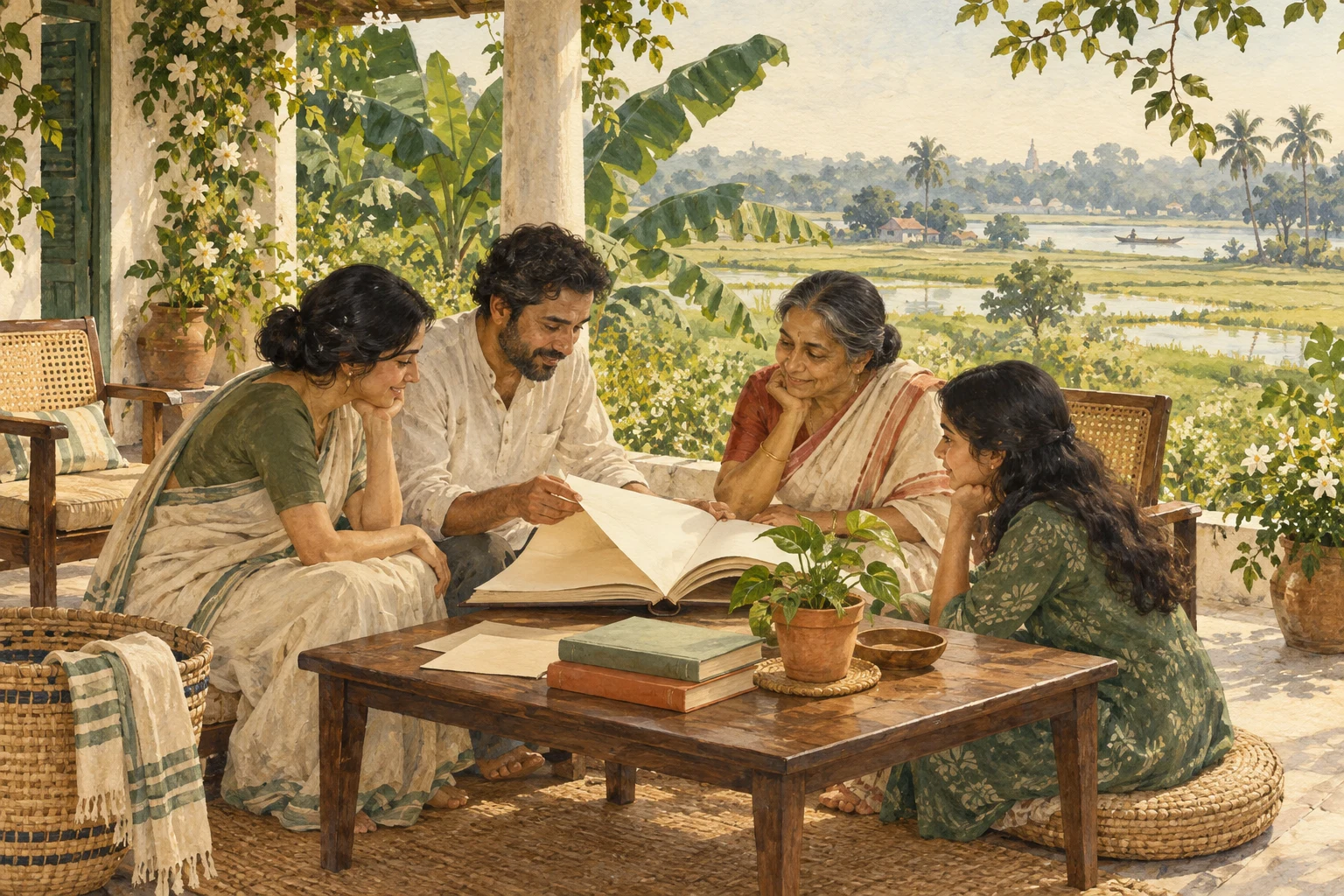
Aguri Heritage celebrates the history, culture, places and people of the Aguri / Ugra Kshatriya community of West Bengal. It welcomes families discovering their roots and anyone interested in the community’s place in Bengal’s wider story.
The project brings together accounts of origins and livelihoods, village connections, notable personalities and cultural life. Books, historical studies, biographical records and periodicals provide supporting material. Family photographs, documents and remembered experiences can enrich this account as the project grows. This is an independent community heritage website.
Our editorial approach
- Keep the document close. Link a claim or reading note to its source and, wherever possible, its actual scan.
- Make uncertainty visible. Separate documented details from interpretations and community traditions.
- Respect the people in the record. Do not repeat caste stereotypes as fact or infer a person’s identity from a surname.
- Allow the account to grow. New evidence can refine a date, correct a name or change an interpretation.
English and Bengali editions
The articles, biographies, source descriptions and reading-room controls are available in English and Bengali. Use the language selector at the top right of any page to switch to its other edition. Your current article section or journal scan is preserved.
Both editions share the same sources, citations and scans. Historical Bengali writings are presented through the original printed pages, with checked Bengali transcriptions where available. English translations are labelled separately. External websites and downloadable documents remain in their original languages.
Add a piece of the story
Useful contributions include dated family photographs, village histories, school or association records, personal memoirs, festival accounts and historical publications. Record who supplied an item, what is known about its date and place, and whether the owner agrees to public sharing.
Use the online form to share a memory, photograph, document or correction in Bengali or English. Editors review each contribution before publication. The downloadable template is also available for gathering details offline.
Community participation and copyright
Our original project material is all rights reserved, with limited permissions for personal study and attributed quotations. Contributors keep ownership of their work and grant the project permission to publish and maintain their contributions. Historical sources and third-party material retain their own rights.
Read our copyright and reuse policy and contributor terms, or send a private rights or reuse enquiry.
Resources supporting the website
The Resources section brings together historical books, scholarly writing, biographies, regional records, English translations and a periodical archive. It includes Rajput O Ugrakshatriya in English, alongside its digitised Bengali original. The translation marks the gap left by two missing printed pages in the scan.
The journal PDFs were supplied by the project owner. Library marks visible in the scans are preserved as part of their provenance. Their presence does not imply that the library endorses this project or supplied these particular digital copies.
Page ornaments. The faint line drawings in the margins of articles are original drawings made for this website. They are modelled on Bardhaman’s temple terracotta and folk crafts, among them the temples of Kalna, Dokra metal casting, Natungram’s wooden dolls and shola work, which are the creations of the district’s temple builders and artisan communities. They are decorative and stylised: they do not depict Aguri practice, and none is an exact drawing of a particular monument or object.
The website uses locally stored assets and runs without an account. Searching takes place in your browser. External source links need an internet connection; the local articles and journal files remain available offline.
Notifications and sharing
You can ask to be told when something substantial is published: a new article, a major research update or a new family profile. Notifications are off unless you choose them. Use Turn on notifications at the foot of any page; your browser then asks for permission. Expect at most a few messages a month.
The website stores only what your browser needs to deliver a message: a push address issued by your browser’s vendor, two encryption values and your language edition. It does not store your name, email address, IP address or reading history, and messages are not used for tracking. Use the same button to turn notifications off; the address is then deleted. You can also remove the permission in your browser’s site settings. On iPhone and iPad, notifications work only after the site has been added to the Home Screen.
The Share button on articles and biographies uses your device’s own share menu where it has one, and otherwise offers WhatsApp, Facebook, email and a copy-link option. Nothing is sent to those services unless you choose one, and shared links carry no tracking codes.
The Page views total at the bottom of each page counts visits from the time the counter was introduced; it does not measure completed reads or unique readers. English and Bengali pages have separate totals. Only a page address and its total are stored for this counter, without visitor names, IP addresses or identifiers. A temporary marker in your browser tab avoids counting the same page again within 30 minutes. There are no tracking cookies or third-party analytics.
Page views: