Freedom movement · Organising · Public service
Life and work
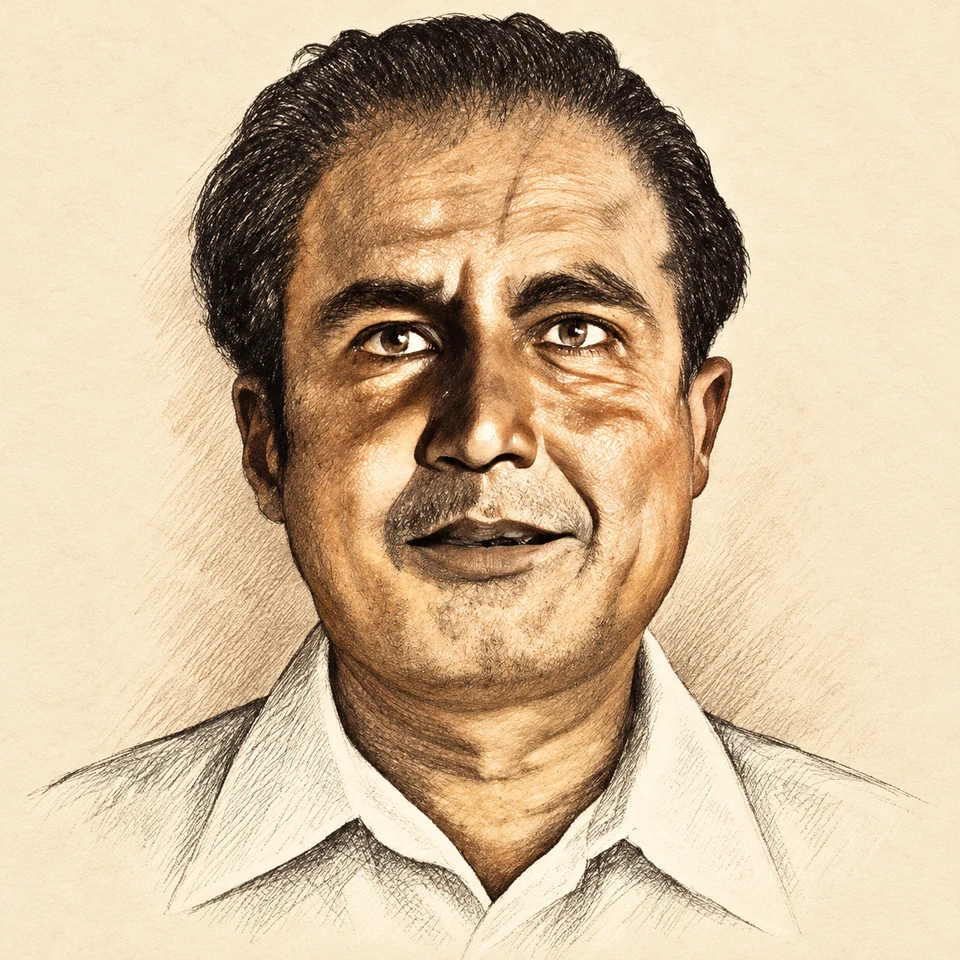
Shib Shankar Chowdhury is named by historian Achintya Kumar Dutta among the Ugra Kshatriya, or Aguri, participants in Bengal’s freedom movement. Bengali accounts also remember him by the familiar name “Kalo” or “Kalo-da”, bringing into view a life of organising and service that continued well beyond independence. [1, p. 314] [6, p. 460]
Family, schooling and the freedom movement
According to the Saheed Shibsankar Seba Samity’s biography, he was born on 10 May 1912 in Bazar village, near Bankapashi in the Katwa subdivision. The youngest son of Rakhaldas Choudhury and Prabhabati Devi, he came from a prosperous family. In 1923 he entered Mathrun M.V. Institution, where poet Kumudranjan Mallick was headmaster. [2]
The Salt Satyagraha of 1930 drew him into direct confrontation with colonial rule. Ekkari Chattopadhyay’s Bengali district history records that he led a contingent from Burdwan towards Pichhabani in Midnapore. Alongside a separate contingent led by Jadabendranath Panja, the volunteers were arrested, sentenced and sent to Dum Dum jail. [6, pp. 441–442]
The Samity records another arrest in Burdwan in 1932, followed by two years’ imprisonment and a 200-rupee fine. His refusal to pay brought another six months. It dates his Communist Party membership to 1938. In 1940 he became Burdwan District Congress secretary at the Barakar conference, an appointment also recorded in Syed Shahedullah’s Bengali memoir. [2] [5, pp. 80–81]
Workers, villages and relief
Shahedullah supplies glimpses of everyday political work. After the 1942 municipal election, he and Chowdhury helped municipal workers petition over their grievances, collecting thumbprints and joining a deputation. His account follows the dispute through a sanitation workers’ strike to a settlement that secured some demands. [5, pp. 94–95]
During the wartime food crisis, Chowdhury and lawyer Musa Mian cycled through much of Katwa and Mangalkot, organising around affordable food supplies. In the 1943 flood relief effort, he worked around Satgachia, Bijur and Kalna; Shahedullah credits him with organising cloth distribution throughout the Kalna area. [5, pp. 112, 136–139]
The memoir also preserves a more personal memory: when Shahedullah was seriously ill, Kalo cycled to fetch Dr Abul Hasnat, bringing him back on his bicycle. As an election organiser, he favoured canvassing from six in the morning, before people left for work. These recollections convey practical habits rather than ceremonial leadership. [5, pp. 238, 280]
Communal peace and later political life
His public work included efforts to prevent communal violence. Chattopadhyay names him among leaders and police whose joint intervention defused tension surrounding a Muslim sweet seller at Mandalgram’s Hat-tala fair in May 1942. The same history records Kalo-da touring Burdwan town and district localities with Communist and Congress leaders to maintain peace after the August 1946 disturbances. [6, pp. 460, 462]
Political activity after independence could still require secrecy. In a memorial essay first published in 1974, Shahedullah names Chowdhury among the district-committee comrades who remained underground in 1951, while others resumed open political work. It is a specific glimpse of his continuing organisational responsibilities. [7]
Death and public remembrance
The Samity’s biography records that Chowdhury was shot dead near B.C. Road in Burdwan on 23 May 1971. Seven years later, on 23 May 1978, the Saheed Shibsankar Seba Samity was founded in his memory, with freedom fighter Fakir Chandra Roy as its first president. [2] [3]
The choice of a health organisation as his memorial gave practical expression to the concern for ordinary people evident in these accounts. The Samity emphasises prevention and health education, alongside services including outpatient care, diagnostics and a blood centre. His name thus remains attached to public service in the district where he worked. [3] [4]
Sources and bibliography
References link to the publications or websites below. Page numbers refer to printed pages, not scan numbers. Bengali passages have been paraphrased in English. Sources were consulted on 22 October 2026.
- Achintya Kumar Dutta, “Prosperity, Dominance, and Social Mobility: Emergence of a Mobile Caste in Colonial Southwest Bengal,” in Explorations in Colonial Bengal: Essays on Religion, Society, and Culture, edited by Achintya Kumar Dutta (Orient BlackSwan, 2023), pp. 297–324, at p. 314. Publisher’s page. The chapter page was checked directly; the link identifies the volume.
- Saheed Shibsankar Seba Samity, “Shibsankar Choudhury”, undated institutional biography. Source for family, education, the 1932 sentence, party membership and death.
- Saheed Shibsankar Seba Samity, “Vision and Mission”, undated. Source for the memorial’s founding and public-health aims.
- Saheed Shibsankar Seba Samity, official home page, undated. Source for listed health services.
- Syed Shahedullah, বর্ধমান জেলায় কমিউনিস্ট আন্দোলনের অতীত প্রসঙ্গ [Bardhaman Jelai Communist Andolaner Atit Prasanga] (Burdwan: Natun Chithi Prakashana, first edition, September 1991), pp. 80–81, 94–95, 112, 136–139, 238 and 280. Digitised book. Cited passages checked against page images.
- Ekkari Chattopadhyay, বর্ধমান জেলার ইতিহাস ও লোকসংস্কৃতি [Bardhaman Jelar Itihas O Lokosanskriti], vol. 1 (Kolkata: Radical Impression, first edition, October 2000), pp. 441–442, 460 and 462. Digitised book; 1930 campaign; 1942 peace work; 1946 peace work. Cited pages visually checked.
- Syed Shahedullah, “হরেকৃষ্ণ কোঙার” [“Harekrishna Konar”], Marxbadi Path, 23 July 2023. The page identifies the essay’s first publication in Nandan’s memorial issue, Shraban 1381 (1974), and republication in a National Book Agency collection in 2015.
Note on the evidence
The community identification rests on Dutta, not on the surname. Family details remain attributed to the memorial institution; no additional independent Bengali family record was found. Shahedullah’s participant memoir and Chattopadhyay’s later district history add substantial detail, but the latter’s communal-history section draws on Shahedullah and should not be counted as wholly independent testimony. No claim about the identity of Chowdhury’s killer is included.