Business · Literature and scholarship · Public life
Life and work
5 May 1874 – 7 October 1960 · Shuripushkarini and Bankura
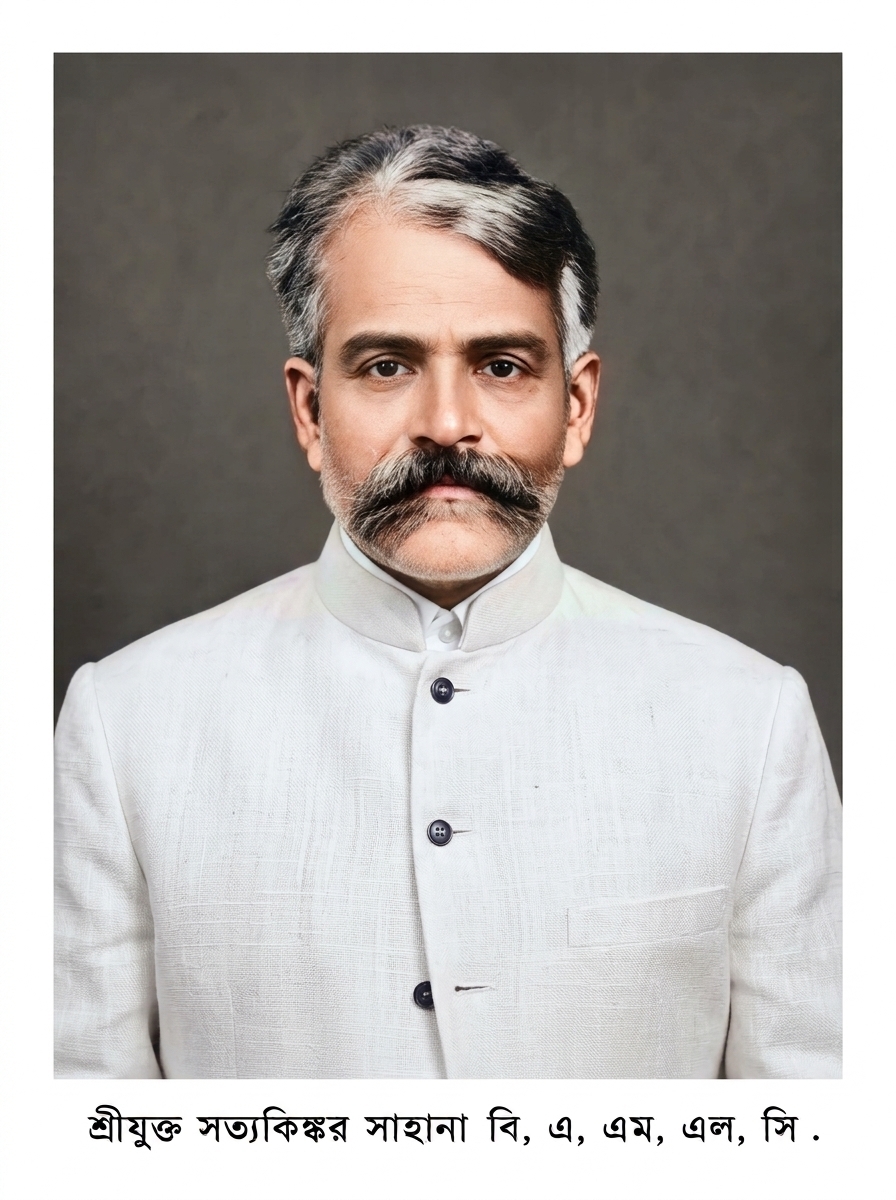
Satya Kinkar Sahana’s life joined the counting house, the landed estate, scholarship & literature and the provincial legislature. Born on 5 May 1874 at Shuripushkarini in Bankura, he became a businessman, landlord, writer, regional scholar and public representative. His family’s prosperity connected the agricultural economy of western Bengal with the coal and mica districts of Bihar. His business and landholding interests underpinned his public life. [1][2]
The family’s prominence rested on accumulated capital, property and social connections. These resources supported education, cultural patronage and public service; they also gave Sahana a substantial interest in preserving property rights, commercial security and local authority. His career suggests a form of paternalist reformism: a willingness to improve conditions through schools, medicine, irrigation and scholarship while retaining the hierarchy within which prosperous families exercised leadership. This is an interpretation of his holdings and recorded actions, rather than a claim to know the private motive behind every decision. [2][3][4][5]
A family fortune built across Bengal and Bihar
Achintya Kumar Dutta identifies the Sahanas as an Ugra Kshatriya, or Aguri, family whose activities expanded from cultivation and moneylending into transport, warehousing, mining and rice milling. His account, in Explorations in Colonial Bengal, traces their commercial growth through Raniganj, Giridih and other centres. Railways opened opportunities for moving goods and developing mineral businesses. Profits from commerce and mining were subsequently invested in land. Their caste background located them within the agrarian society of Rarh; their particular class position arose from the scale and variety of their assets. [2]
The immediate makers of this fortune included Sahana’s grandfather Gosain Das, his father Prankrishna and his paternal uncle Rajkrishna. The Bengali family chronicle Bangsha-Parichay remembers Gosain Das learning Hindi and account keeping while working for a timber merchant. It describes Prankrishna’s management of family property and trade, and Rajkrishna’s expansion into contracting, mica and coal. The story is one of several generations of business experience, apprenticeship and investment. [6]
Satya Kinkar assumed responsibility for the joint family’s affairs when his father and uncle died within a short interval in 1908. He continued to invest mining profits in land and settled in Bankura in 1917. Dutta describes his eventual holdings as seven zamindaris and eight houses across Bengal and Bihar, and identifies him as a landlord, moneylender and grain dealer. The same account credits his Sridhar Rice Mill with encouraging other Bengali traders to enter rice milling in Bankura. These are substantial, overlapping interests in production, credit, processing and rent collection. [2]
Ananda Kutir, his Bankura home, became a base for family, agricultural and civic activity. The 1932 chronicle describes wells and tanks dug to improve a large stretch of stony land, with fruit, flower and vegetable cultivation. It also records his involvement with the local college and district school, municipal affairs, cooperatives and the honorary magistracy. Such positions brought a prosperous householder into repeated contact with teachers, officials and neighbours. They provided opportunities for useful work and reinforced his standing as a district notable. [6]
Property, credit and the protection of wealth
His class affiliation becomes especially concrete in the court record. In Sunder Mull v. Satya Kinker Sahana, decided on 6 December 1927, the Privy Council considered a mortgage for Rs 12,000 made in 1907, carrying 15 per cent annual interest and annual compounding of unpaid interest. By the start of the suit in 1919, the judgment recorded Rs 37,000 outstanding. The borrowers challenged the family managers’ authority to accept those terms. The appeal was dismissed and the lenders’ position upheld. The case illustrates the legal machinery through which the family defended its credit interests; the judgment did not declare this loan unlawful. [7]
The family chronicle gives litigation a humorous face. Sahana reportedly joked that, although he had avoided becoming a lawyer because he disliked lawsuits, he should enter going from case to case as his occupation in the next census. The joke makes sense in a life crowded with property disputes. It also reminds us that the practical management of wealth demanded time, documentation and repeated engagement with colonial courts. [6]
Historian J. H. Broomfield, using family papers and diaries, describes litigation and mortgage foreclosure as instruments of expansion and links the family’s land accumulation with Santal dispossession. His findings challenge the celebratory family narrative. [8]
For Sahana, maintaining the status quo therefore had a material meaning. A dependable legal order protected debts, leases and estates. Public standing helped a family act effectively within that order. Support for agricultural improvement or medical care was compatible with these interests: healthier villages and more productive cultivation could benefit tenants and also sustain the economy from which landlords and traders drew income. The evidence supports this connection between class and outlook, without reducing every act of generosity to calculation. [2][7][3][4]
The household: women, children and local obligations
The family’s public reputation was also made through women’s work. Sahana’s mother was Hridaybasini Devi, also known as Ambika Devi, daughter of Durgacharan Ray and granddaughter of Kamalakanta Ray of Kendur. His wife, Binodini Devi, was the daughter of Ashutosh Datta of Paita. Bangsha-Parichay portrays both women as active in caring for neighbours and dependants. Their presence helps explain how the household exercised local patronage in everyday life. [6]
One of the most revealing stories concerns Ambika and the harvest workers. While Prankrishna was away, she arranged fish and date-palm jaggery for a substantial meal for tenants working on the family’s harvest. Satya, who had recently left college, questioned the need for such an elaborate meal and suggested that it would reduce their afternoon work. His mother rebuked him: [6]
“গরীব প্রজারা শুধু কি তোর কাজ করতেই আসে?”
“Do the poor tenants come only to do your work?”
According to the chronicle, he was ashamed and arranged the food. The context matters: these tenants were performing begar, customary unpaid labour. The anecdote records a demand that privilege carry obligations. Its moral world assumes the continuing authority of the landlord’s household, with good treatment bestowed from above. It is evidence of paternalism and a maternal lesson in responsibility, rather than proof of equality on the estate. [6]
Binodini’s own activities deserve equal attention. The chronicle describes her sending food and provisions to poor neighbours during illness, welcoming local Lohar, Khaira and Bauri families at Bijaya, and joining the Bankura Mahila Samiti. These details show how care, food and sociability helped maintain the family’s relationships beyond its gates. They remain the account of a sympathetic family source, whose praise must be read with that perspective in mind. [6]
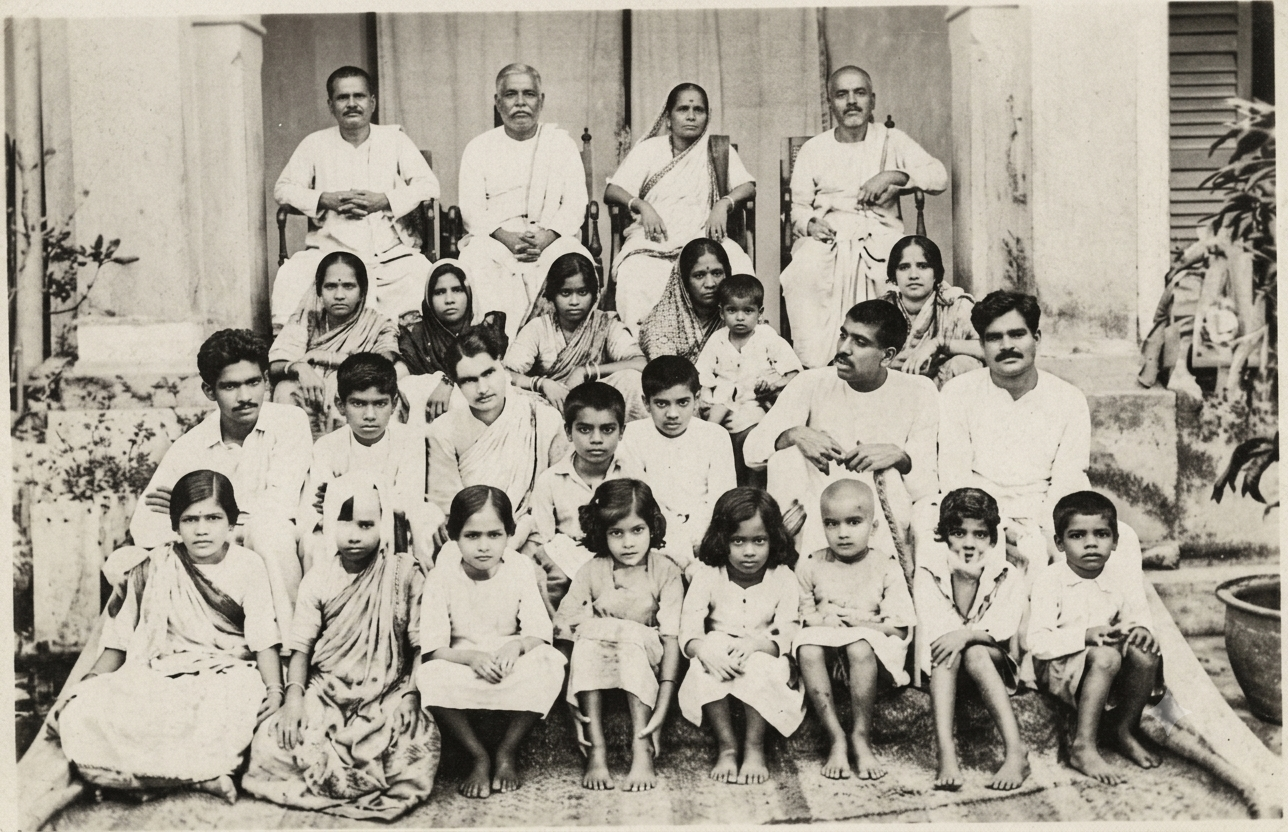
The 1932 genealogy names six sons: Debeshbijoy, Sureshbijoy, Rameshbijoy, Dhaneshbijoy, Raneshbijoy and Pareshbijoy. It names three daughters: Manjumalini, Pankajabasini and Shantibhashini. Broomfield later refers to four daughters, so the 1932 list does not establish a definitive lifetime total. Debeshbijoy managed the rice mill before taking responsibility for mica operations at Koderma; Rameshbijoy subsequently managed the mill. Pareshbijoy later helped preserve and publish his father’s intellectual legacy. This was a household in which business responsibilities, education and cultural work passed between generations. [6][9]
The wider family also combined business with civic standing. Among Rajkrishna’s sons, Kamalakinkar managed mica concerns at Koderma, while Bimalakinkar served as an elected member of Giridih municipality, according to the 1932 account. [6]
A reader who became a writer
Formal education and intellectual appetite did not always move together. Sahana passed the Entrance examination in 1891, the FA in 1894 and the BA in 1898, after illness and examination difficulties. His Calcutta education took him through General Assembly’s Institution and Presidency College. The family biography recalls his borrowing Bengali books from the Chaitanya Library and reading them with greater enthusiasm than he devoted to his prescribed college work. He undertook further studies in English and law without completing those qualifications. [1][6]
His writing ranged across poetry, classical literature, religion, social observation and regional history. A selection of securely attested titles follows. Dates refer to identified editions or catalogue records; a later edition is not treated as the work’s first appearance. [1][2][9][10]
| Work | Scope and bibliographic evidence |
|---|---|
| কলিকা · Kalika | Poetry; a digitised edition is dated 1931. Read full scanned book (1931 edition). |
| যূথিকা · Juthika | Poetry; digitised copies and library holdings survive. A catalogue records a second edition in 1364 BS (1957–58). Read full scanned book (first edition, 1932). |
| মালিকা · Malika | Poetry; a library catalogue records an edition in 1363 BS (1956–57). |
| আর্য্যশতক · Aryyashatak | A separately published literary work; a 1956 edition is catalogued. Read full scanned book (1956 edition). |
| মহাভারতে অনুশীলনতত্ত্ব · Mahabharate Anushilantattva | A study concerning the Mahabharata; listed among his principal writings, with a 1930 edition recorded. View catalogue record only (second edition, 1366 BS / 1959–60). |
| চণ্ডীদাস প্রসঙ্গ · Chandidas Prasanga | Regional literary history and the Chandidas controversy; a 1959 publication is cited by Broomfield. |
| শকুন্তলা রহস্য · Sakuntala Rahasya | A study of Shakuntala; Cotton University lists a first edition, Jijnasa, Calcutta, 1959. |
| বিবিধ প্রবন্ধ · Bibidha Prabandha | Collected essays, 1959. Read full scanned book (first edition, 1959). |
Dutta also identifies Hindu Dharma among Sahana’s writings. The title Shakuntala Prasanga in the biographical dictionary is treated as an unresolved title variant, not automatically as a second separate book. [1][2][8][9][10]
Bibidha Prabandha gives access to his voice. Its 1959 publication was arranged through Pareshbijoy Sahana of Sridhar Prakashani; the preface identifies earlier appearances in the Bankura periodicals Shankha and Hindubani. In “রাজনীতিক হইবার সাধ” (“The wish to become a politician”), he presents a humorous recollection of youthful ambition. An older hostel companion, Krishnaram Ray, urges study and understanding of people before political leadership; the impatient younger man objects that poorly educated speakers can become famous. The piece is literary satire, so its conversation should not be treated as a stenographic record. [9]
In “কৃষি-প্রসঙ্গে” (“On agriculture”), Sahana respects villagers’ practical arithmetic and knowledge, notices the distance between educated townspeople and rural language, and urges the collection of agricultural sayings. These essays connect his literary interests with the social world of cultivation. They show curiosity about ordinary knowledge, even though his own place in that world was a position of property and authority. [9]
History as manuscripts, places and argument
Sahana’s historical work belongs especially to the study of Rarh and the disputed identities and local associations of the medieval poet Chandidas. Jogeshchandra Ray’s reply in Probasi records that he and Sahana jointly wrote “ছাতনায় চণ্ডীদাস” (“Chandidas at Chhatna”) in 1333 BS, or 1926–27. The surrounding exchange reveals disagreement about manuscript authenticity and the strength of competing regional claims. Sahana participated in that controversy; the contemporary evidence does not justify saying that he conclusively proved Chandidas’s birthplace. [11]
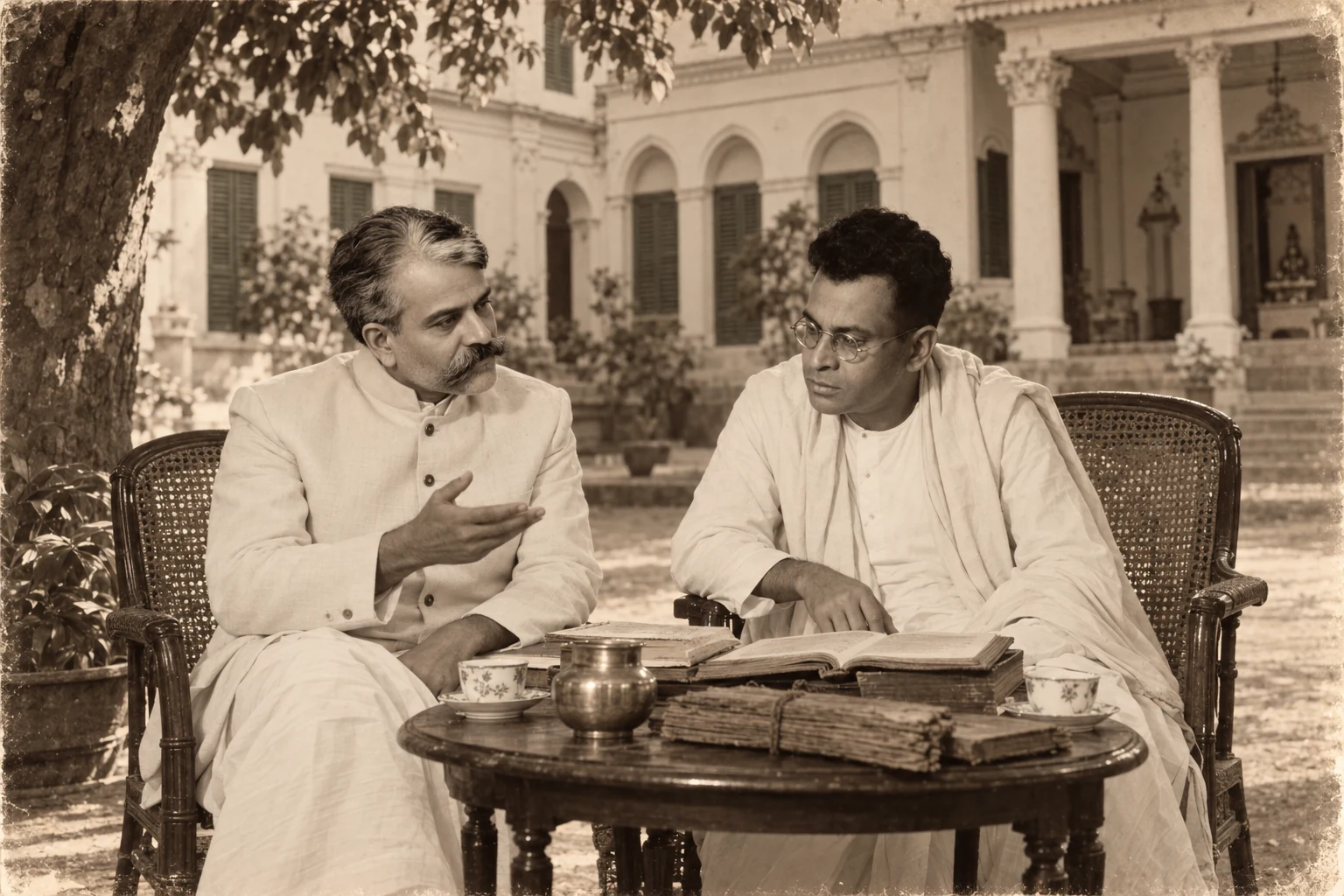
Suniti Kumar Chatterji supplies an unusually vivid picture of the work. He recalled receiving assistance and hospitality in Bankura while investigating Chandidas’s songs with Harekrishna Mukhopadhyay. Sahana took them by motor car to Maulban village, where they searched for manuscripts without finding a suitable one. The unsuccessful journey is valuable evidence: regional literary history required travel, introductions, patient enquiries and the possibility of returning empty-handed. Sahana contributed his local knowledge and resources to that shared undertaking. [11]
A later Probasi report records his pledge of Rs 1,001 towards the Bankura Sahitya Parishad’s proposed Chandidas Smritimandir. The plan combined commemoration with a library, collections and regional research. The source establishes a pledge and a proposal, rather than confirming completion. Such patronage brought historical scholarship into the institutional life of the district and helped associate the family’s name with its cultural standing. [12]
In the Bengal Legislative Council
The institution in which these pre-independence interventions took place was the Bengal Legislative Council. Contemporary rolls identify Sahana with Bankura East, in the constituency category then officially called “Non-Muhammadan.” Records securely establish his activity in 1932 and 1934. Broomfield describes two Council terms in the 1930s, although his essays differ on the dates: one gives election in 1929 and defeat in January 1937; another gives 1930 and 1936. [8][3][5]
On 2 August 1932, Sahana moved a resolution for provincial assistance to Bankura Medical School. He told the Council of a Muslim woman whose difficult delivery had endangered her and her baby; according to his account, Dr Ramgoti Banerjee’s operation saved both. He used this story to argue for affordable rural care and an institution serving people beyond Bankura. The minister cited financial constraints and offered a future assurance. Sahana withdrew the resolution. The record documents advocacy, not a grant secured at that sitting. [3]
The following day, 3 August, he supported a proposal to bring Bengali-speaking border districts under one administration. Drawing on his life in the Bengal–Bihar borderlands, he cited Jhumur and Bhadu songs, devotional poetry, customs and older territorial names. Literary history became political evidence in his speech. His argument also absorbed diverse communities’ practices into a Bengali regional claim, which should be understood as a contested position rather than an objective map of identity. [3]
On 31 January 1934, he questioned quinine distribution in Bankura. How could people in villages far from dispensaries obtain medicine? Could union boards and sanitary staff distribute it more widely? He also challenged the adequacy of the allocation. The government placed part of the responsibility on the district board and did not promise the increase he sought. His questions show practical attention to access, beyond the mere existence of a supply. [5]
That day he also raised the deterioration of tanks and embankments and asked about irrigation funding. The exchange has a useful corrective: when he suggested that Bankura had no irrigation canals, the government named Salbund and Amjore. A sound account preserves the correction alongside his concern. The result was an intervention on rural infrastructure, not proof that the district lacked canals or that new funds were obtained. [5]
Reform, authority and the status quo
Sahana’s concern for local welfare coexisted with support for colonial security legislation. On 10 January 1934 he supported the Bengal Smuggling of Arms Bill, presenting it as a response to killings, robberies and insecurity. His speech expressed confidence in government and a desire for public order. This position is consistent with the interests of a businessman and landlord whose activities depended upon stable administration, though the speech’s stated concern for violence should also be taken seriously. [4]
He nevertheless sought safeguards against arbitrary power. On 6 September 1932, during debate on the Bengal Suppression of Terrorist Outrages Bill, he proposed clearer protection from collective fines for inhabitants uninvolved in the specified offences. He warned that local discretion might follow officials’ personal likes and dislikes and deepen distrust. He described his approach as that of a “friend and co-operator” of government. His amendment was defeated. This episode can be read as an attempt to make government more credible by limiting the scope for administrative abuse. [13]
Broomfield’s account records distrust of representative politics, bitterness after electoral defeat, Hindu communal concerns and later support for the Hindu Mahasabha. These positions coexist with the medical-school speech’s inclusive appeal. Local philanthropy, religious commitments, regional pride and defence of social rank could inhabit the same political life. [8][3]
He favoured improvements that prosperous local leaders could finance, manage or seek from government. Such activity could relieve suffering and expand learning while strengthening the authority of those leaders. Commercial innovation and cultural curiosity could coexist with the desire to preserve property and social rank. His public service and his investment in the existing order formed connected parts of his career. [2][7][3][4][13]
A legacy of learning and power
Sahana remained intellectually active into old age, with several books appearing in the 1950s. He died on 7 October 1960. His legacy includes the writings themselves, his participation in regional historical research, and a record of persistent attention to Bankura’s institutions. It also includes the economic and social relationships through which his family became prominent. [1][9][10]
The reader who neglected his syllabus for Bengali books, the son chastised over the harvest meal, the manuscript seeker, the creditor and the legislator were the same man. His family’s distinction arose through enterprise, learning and public work within an unequal society. Understanding that society makes his achievements, his commitments and the limits of his reforming outlook more intelligible. [2][7][6][3][11][13]
Surviving diaries
The National Library, Kolkata, lists 36 of Sahana’s English personal diaries for selected years between 1915 and 1960. Their references are R 30/1–R 30/36, with accession numbers G 24962–G 24997; they were accessioned on 20 December 1973. The catalogue establishes a holding of diaries, rather than providing digital editions of their contents.[14]