Publishing · Sanskrit literature · English readership
Life and work
1842–1895 · Publisher of the English Mahabharata
A publisher of the Mahabharata
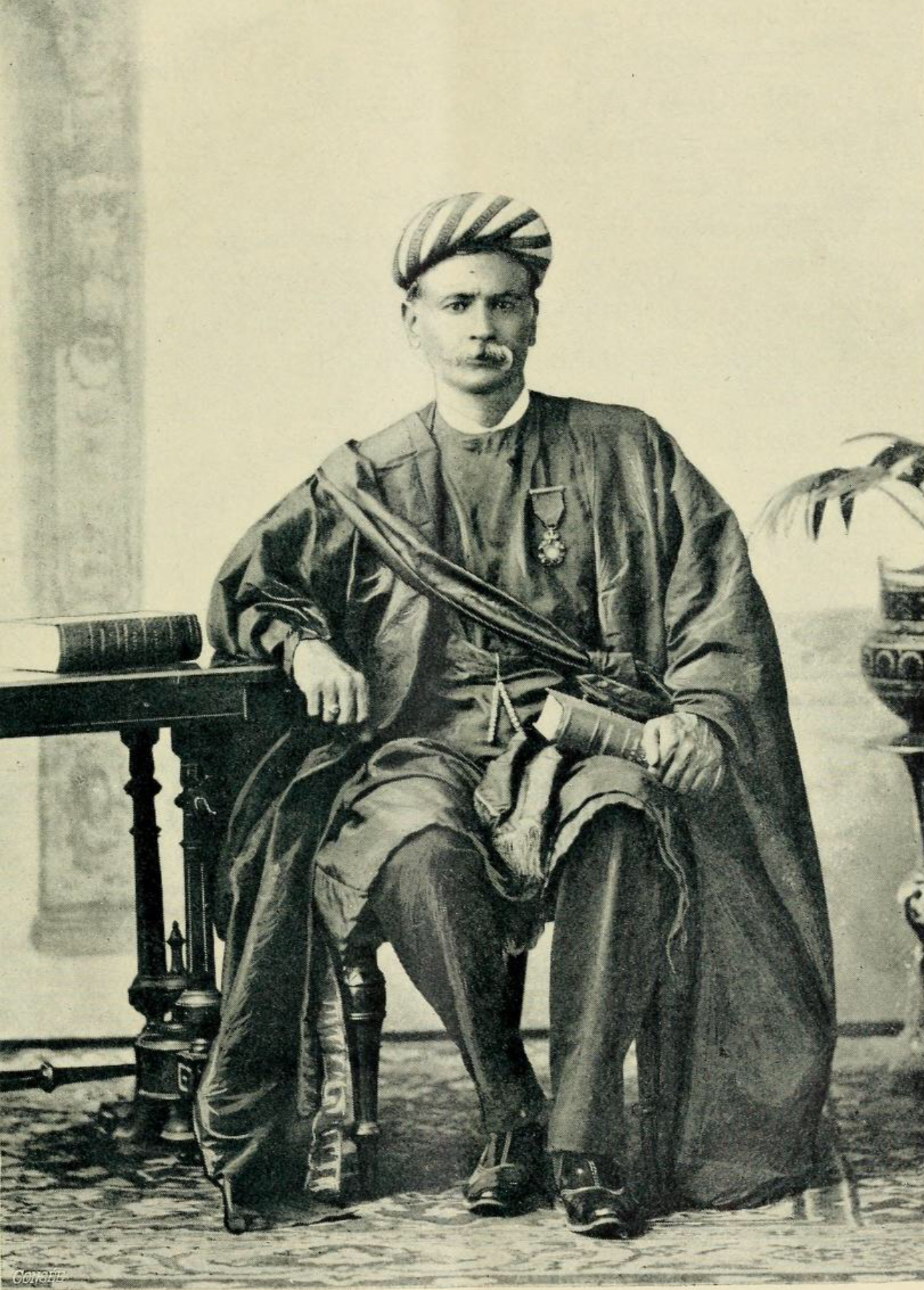
Pratap Chandra Roy was a Calcutta bookseller and publisher associated with bringing Indian classics to a wider readership. He undertook the publication of a complete English prose Mahabharata, which appeared in instalments between 1883 and 1896. The enterprise joined Roy’s work as publisher with the translation of Kisari Mohan Ganguli; after Roy’s death, his widow, Sundari Bala Roy, carried the publication to completion.[1][2]
Roy built this undertaking through years of bookselling, fundraising and the circulation of religious literature. His own publishing statements reveal the practical scale of the work. The later family biography in Bangsha Parichay adds a personal history of bereavement, education and enterprise, extending the outline preserved in the publication record. Read together, these sources show how a bookseller created an organisation capable of sustaining a large literary project.[3][4]
Shanko and the journey to Calcutta
Roy came from Shanko in Burdwan district. Bangsha Parichay names his parents as Ramjay Roy and Drabamayi Debi and gives his birth as 15 March 1842. Its account of his childhood expressly draws on the recollections of his elder sister, Sarbamangala. After their mother’s death, Sarbamangala cared for him; a widowed relative, Krishnamani Debi, subsequently took him to Kalna and brought him up as her son. These details belong to a family history published in 1934, nearly four decades after Roy’s death.[3]
The same account remembers a childhood in which obtaining an education depended on small acts of assistance. After his father’s death, Krishnamani struggled to maintain the household. A Brahmin neighbour provided support in return for her domestic work and the boy’s cattle-herding, before arranging his admission to a local pathshala. One remembered episode describes Roy collecting coconuts offered to the Ganga and selling them to buy schoolbooks. The story gives a concrete form to the family’s memory of his early difficulty gaining access to books.[3]
Bangsha Parichay places his move to Calcutta after Krishnamani’s death. It connects his early employment to Kaliprasanna Singha, the patron of a Bengali Mahabharata, first in household service and later in rent collection. It also recalls his concern for people unable to obtain copies of Singha’s publication. The chapter’s ages and dates do not fit together consistently, so the precise timetable of this employment remains uncertain. The association is best understood as a later account of his introduction to a world where publishing and religious charity met.[3]
His place in Aguri history has a near-contemporary printed reference. In Hindu Castes and Sects (1896), p. 158, Jogendra Nath Bhattacharya identifies Pratap Chandra Roy as a Suta Aguri and praises his enterprise as a publisher. Bhattacharya also distinguishes the publisher from the scholar who performed the translation.[5]
Bangsha Parichay situates the family in Shanko’s remembered landscape of moats, temples and tanks. Its claims about distant royal ancestors and Mughal grants belong to family tradition; they do not establish an independently documented pedigree. The more immediate evidence concerns the household from which Roy emerged and the local connections his family maintained after his death.[3]
From a small shop to a publishing institution
The family biography describes Roy beginning business in a small room beside the Seal family’s Jorasanko house, then occupied by the Calcutta Normal School. He sold schoolbooks, including Barnaparichay, arithmetic tables, stationery and inexpensive goods for pupils. The shop grew into a business supplying goods to order. Roy’s own earlier account confirms the broader progression: he had worked as a bookseller and general agent, accumulated savings and reached a position in which he could have retired. He chose instead to invest in publishing Sanskrit religious literature in forms accessible to a wider public.[3][4]
His first Bengali Mahabharata was a substantial commercial commitment. Roy states that he printed 3,000 copies, priced a complete set at 42 rupees and took a little more than seven years to finish the edition. Following a domestic bereavement, he travelled outside Calcutta and heard readers praise the work while explaining that its price remained beyond their means. Returning to approximately 1,000 unsold copies, he began giving them away. When some recipients resold their copies, he sought a more organised way of distributing the books.[4]
His publishing work was also philanthropic. He founded the Datavya Bharat Karyalaya to circulate translations of Sanskrit religious literature.[4]
The contemporary accounts point to a charitable programme taking shape around 1876: Roy’s introductory account, issued with the English undertaking in 1883, looks back over seven years of free publication, while Sundari Bala’s completion statement in 1896 describes twenty years of institutional work. This is an approximate chronology of activity, rather than a securely established date of formal foundation. Bangsha Parichay locates the office at 67 Upper Chitpur Road and records its move in 1886 to premises Roy purchased at 1 Raja Gurudas Street.[3][4][1]
Durgacharan Bandyopadhyay was central to the enterprise. Sundari Bala credits him with Bengali translations of the Mahabharata, Ramayana, Harivamsa and Srimad-Bhagavata, supervision of the Sanskrit Mahabharata, and management of finances and the printing establishment. The institution’s output extended well beyond the English epic. In 1896 she reported four Bengali Mahabharata editions, three Sanskrit editions and other religious works, amounting altogether to 259,000 physical volumes over twenty years. That figure is the publisher’s own aggregate across several works and languages, not a count of complete English Mahabharata sets.[1]
Financing the English edition
The English project was under discussion by 1882. Roy’s preface quotes a letter dated 6 October that year from Reinhold Rost conveying the Marquis of Hartington’s support. Publication began in 1883. Roy hoped that English would carry Indian literature to readers abroad and to educated Indians; he also argued that familiarity with the epic could help British administrators understand the people they governed. His programme combined religious and cultural commitment with an active search for support from colonial officials and Indian patrons.[4]
The distinction between publisher and translator is essential. Kisari Mohan Ganguli translated the English Mahabharata, while Roy organised its publication. Ganguli’s initial anonymity contributed to later editions incorrectly crediting the translation to P. C. Roy.[2][6]
Ganguli’s own concluding postscript, dated 15 July 1896, explains that he had requested anonymity because so large an undertaking might eventually require more than one translator. Roy opposed that anonymity. They agreed that the publisher would sign his own preface while the translator’s preface remained unsigned. This contemporary explanation gives no basis for depicting Roy as deliberately appropriating Ganguli’s authorship. Ganguli also acknowledged assistance with portions of the work, while describing the translation as substantially his own.[2]
The original financial plan estimated a cost of 100,000 rupees and proposed an edition of 1,250 copies. Most were intended for presentation to Indian patrons, officials and scholars abroad, with a reserve for replacement. A further 250 were to be supplied on payment: 50 rupees in India or 65 rupees overseas, including postage, with some concessions for readers unable to pay the full amount. Roy described these paying recipients as donors. The English Mahabharata was therefore a predominantly charitable venture supported partly by paid subscriptions; free circulation did not mean that every copy was free. These figures describe the announced plan, not an audited final allocation.[4]
Production also depended on the timing of support. Bangsha Parichay describes payments arriving months after copies had been delivered and Roy mortgaging his house to meet immediate expenses. Sundari Bala’s contemporary statement confirms that substantial patronage coexisted with debt: she reported about 45,000 rupees from the Secretary of State and British Indian governments, alongside important contributions from Indian rulers, yet approximately 10,000 rupees remained owing when the work was complete. The printing establishment had to keep operating between receipts, with staff, materials and distribution continually requiring money.[3][1]
The British press and readers abroad
Roy’s enterprise attracted attention in Britain as well as in the English-language press of British India. A review in The Times of London dated 9 October 1885, preserved as a reprint with a Vana Parva fascicle, discussed the first eighteen parts. It drew attention to the scale of the undertaking, its estimated cost and the provision of copies without charge. It also considered the prospects of bringing the epic before European readers, while doubting that it would become as familiar or popular as Homer and Virgil.[7]
The review’s praise came with an imperial interpretation. It presented the revival of Indian literary activity as evidence of the benefits of British rule. This is the newspaper’s political framing, rather than a neutral explanation of Roy’s achievement. Its discussion nevertheless shows that a Calcutta publishing venture had become a subject for a major London newspaper, with questions of literary value, translation and philanthropy reaching readers far beyond its original Bengali audience.[7]
Newspaper attention could assist fundraising. In her 1896 postscript, Sundari Bala recalled Max Müller repeatedly bringing the project before readers of the London Times and other journals, attracting interest among scholars and Indian patrons. Her testimony establishes the importance she attached to this publicity; it does not identify Müller as the author of the unsigned review of 9 October 1885.[1][7]
The English-language press in India formed a related but distinct audience. A Times of India notice dated 19 December 1885 acknowledged that the work and its costs had exceeded Roy’s expectations and supported his appeal for assistance. Earlier notices from the Englishman, Pioneer and other newspapers were collected in the 1884 Adi Parva appendix. These publisher-selected extracts helped promote the project, although some blurred the roles of publisher and translator. They document reception in British India and should not be counted as newspapers published in Britain.[7][8]
The response was not uniformly admiring. In “The Epics of India,” published in Lahore’s Civil and Military Gazette on 24 August 1886, Rudyard Kipling discussed the twenty-fifth instalment. He admired its printing and the perseverance behind it, but sharply questioned the epic’s appeal to contemporary readers. His review shows how recognition of the publisher’s labour could coexist with dismissive judgments about the literature itself. Like some other notices, it wrongly associated Roy with the translation, a confusion that the publication’s own prefaces resolve.[9]
A later British tribute associated the completed work with Roy’s death. Bangsha Parichay reproduces a passage from Edwin Arnold’s “A Dead Man’s Victory,” attributed to the Daily Telegraph. Hendrik Clemens Muller’s Lectures on the Science of Literature independently identifies two Daily Telegraph articles under that title in June 1897. The month and year are therefore better supported than an exact day taken from an indistinct later reproduction. This posthumous coverage framed the finished Mahabharata as the fulfilment of a publisher’s commitment that had survived him.[3][10]
Completion and remembrance
The personal history in Bangsha Parichay gives the publishing story a wider family setting. It names Roy’s first wife as Golap Sundari and their daughter as Haridasi, and describes the grief caused by Golap Sundari’s early death and Haridasi’s later widowhood. Sundari Bala, his second wife, became responsible for carrying his final undertaking forward. These family details come from the later biography; the publication’s own closing statements document her work as its surviving publisher.[3][1]
Roy died in 1895. He had published the first fourteen parvas, or books; Sundari Bala published the remaining four. The English Mahabharata was completed in 1896.[2][6]
Completion depended on continuing cooperation. Sundari Bala records Ganguli’s promise to finish the translation and Roy’s concern for subscribers who had already paid. She also credits Aghore Nath Banerjee with managing the institution through Roy’s final illness and helping her sustain it afterwards. Her closing statement makes clear that the last instalments emerged from continued labour and financial responsibility after the founder’s death. Ganguli’s dated postscript supplies a firm contemporary anchor for the completion year.[1][2]
The family’s remembrance also returned to Shanko. Bangsha Parichay credits Sundari Bala with carrying out provisions for the Golap Sayar tank, named for Golap Sundari, and the Prataperswar Shiva shrine. Haridasi later financed repairs to the temple and the dredging of the tank. These local works connect the internationally circulated books to the family’s continuing obligations in its home village.[3]
Roy’s achievement rests in the sustained organisation of publication: committing his resources, securing assistance, maintaining a press and finding readers for works on a formidable scale. Ganguli’s translation, the contributions of the Bengali scholars and publishing staff, and Sundari Bala’s completion of the project are all part of that history. Recognising their different responsibilities gives a fuller account of how the English Mahabharata reached its readers.