Freedom movement · Law · Public service
Life and work
1886–21 September 1961 · Freedom fighter and state minister
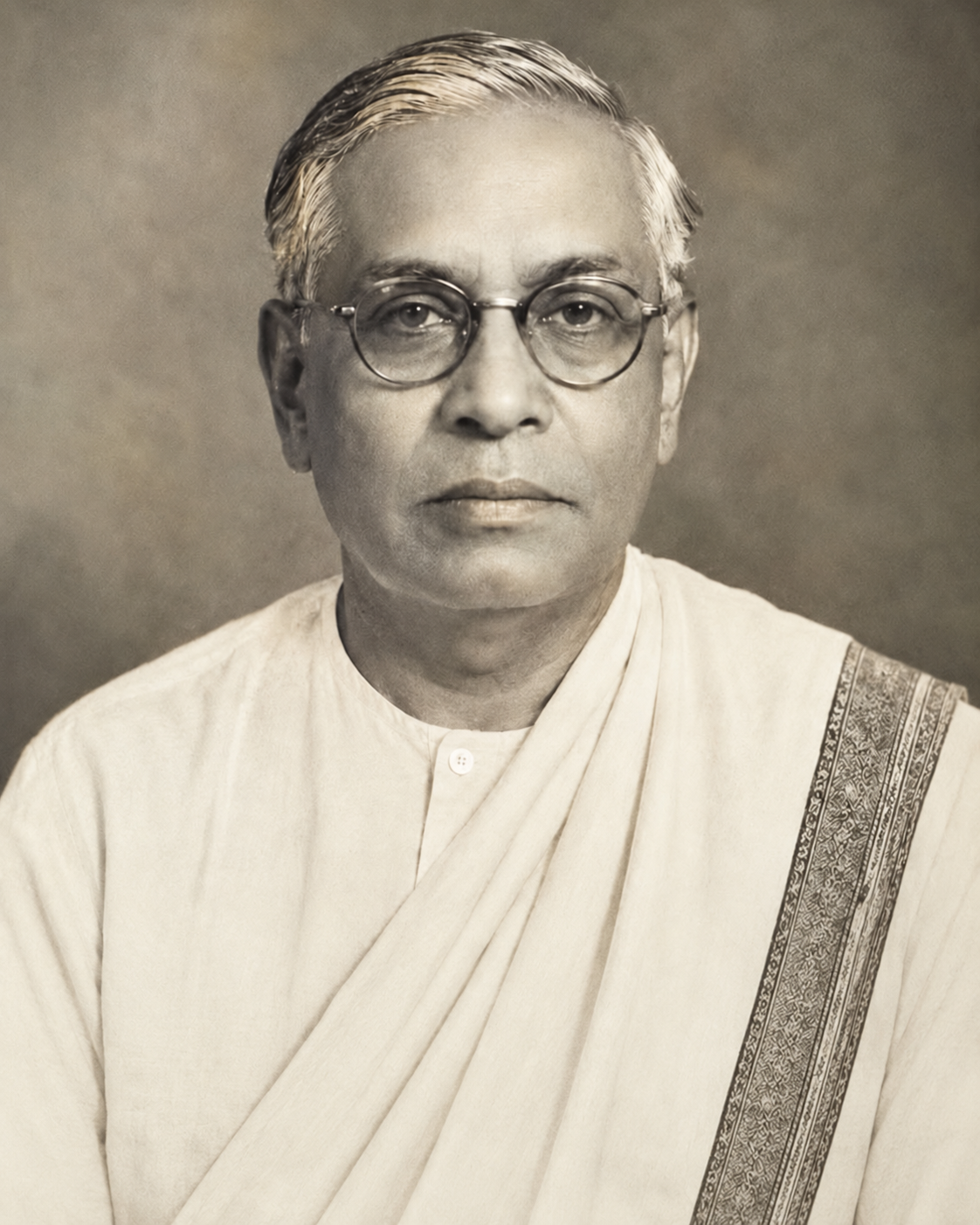
The poet Shankha Ghosh remembered a visit to a modest room near College Street in Calcutta in 1950. The room contained two floor mats, modest bedding and tin suitcases. While Ghosh spoke to the revolutionary Kiran Chandra Mukherjee, another man was resting nearby. Reminded that it was time to leave, the man got up, put on a worn panjabi and left.[1]
Ghosh was astonished when he learnt who the departing lodger was: Jadabendra Nath Panja, a minister in the West Bengal government, on his way to Writers’ Buildings. Kiran’s response was:
“মন্ত্রী তো কী হলো, সেটা কোনো কথা নয়, ও হলো যাদবেন্দ্র পাঁজা।”
“Minister? That changes nothing; he is Jadabendra Panja.”[1]
The scene captures something that stayed with those who remembered him. Public office had brought him responsibility; his daily life remained remarkably modest.[1]
Panja’s concern for other people was equally visible in his public work. He took up the cases of cultivators losing their land, questioned the burdens placed on those who needed irrigation, and pressed government to restore fields damaged by floods. Among the Aguris, he is remembered for representing the community in a dispute over its official classification. His humanism took shape in these particular responsibilities, through the people and problems to which he gave his attention.[2][3][4][5][6]
The life he chose
Born in 1886, Panja belonged to Satinandi in Burdwan district. The Panja family of Sathinandi, Burdwan was one of the prominent 19th century Aguri families which took a Dar-patni tenure. Writing about the 1930s, historian Achintya Kumar Dutta records that Panja’s family possessed 1,500 bighas of land in Burdwan. His father, Nrisinghamurari Panja, was a teacher at Burdwan Raj School. Panja passed the F.A. examination at Burdwan Raj College, studied at Ripon and Scottish Church colleges in Calcutta, and obtained a law degree. He began practising in Burdwan. The local historian Sudhir Chandra Da also records his contact with Ripon College’s principal, Ramendrasundar Trivedi.[7][8][9]
He carried intellectual interests into political life. Atulya Ghosh remembered his knowledge of philosophy and Rabindranath Tagore. In 1921, answering the call of Non-Cooperation, Panja gave up legal practice. He never returned to it. He had exchanged legal practice for the uncertain work of the freedom movement.[8][10][11]
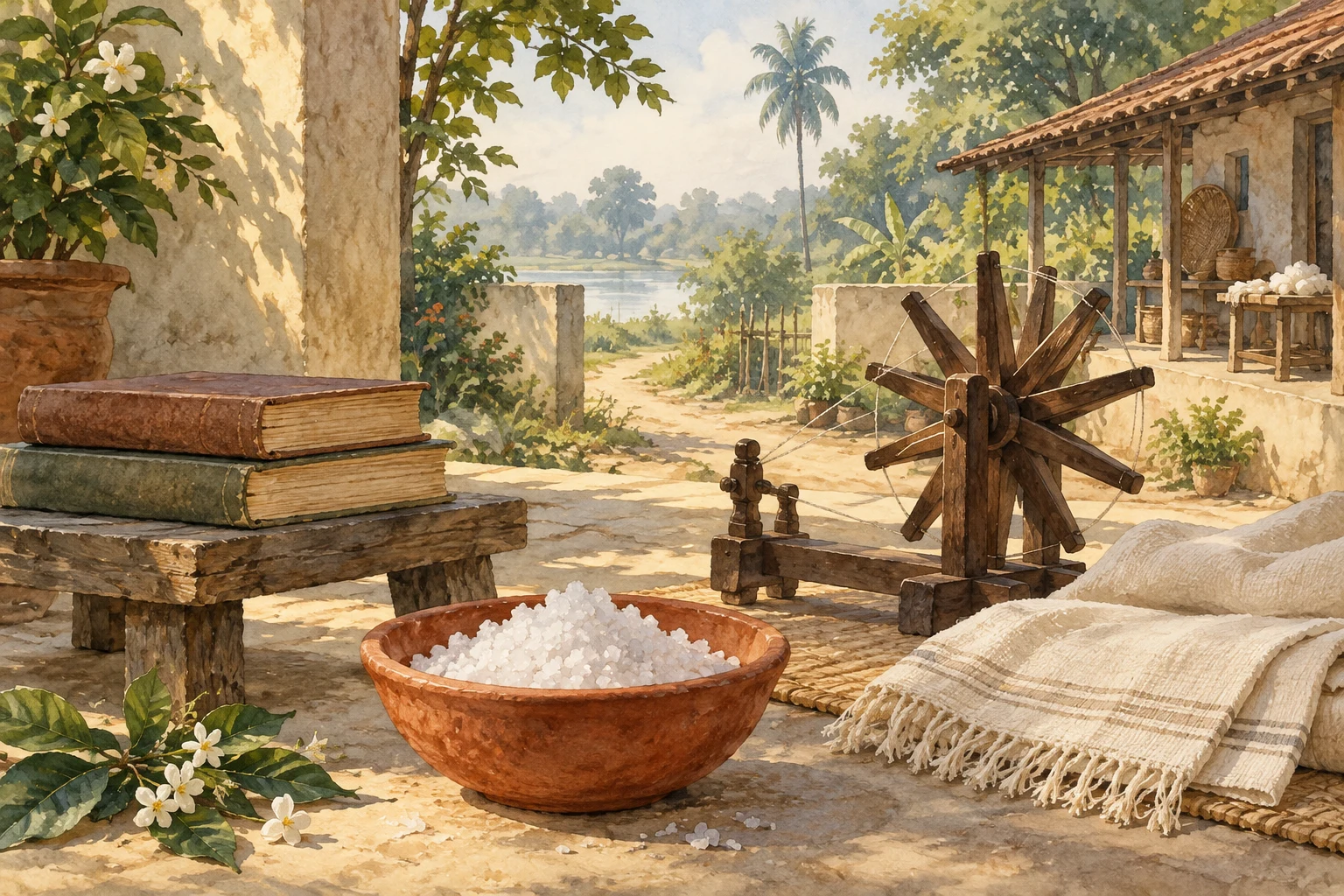
That work often meant explaining national events in villages and encouraging people to participate. During the Salt Satyagraha of 1930, Bengali local histories place Panja among the organisers who carried the movement into Burdwan’s countryside. Ekkari Chattopadhyay records his leadership of twenty-five volunteers going to Mahishbathan. Sudhir Chandra Da describes a wider campaign of village meetings, spinning and weaving. The movement needed people who could make its purpose understood in everyday life.[7][11]
The commitment brought punishment into his own life. In January 1932, Panja was convicted of promoting a meeting of the banned Burdwan Congress Committee. He received two and a half years’ rigorous imprisonment and a fine of Rs 500, with another six months in prison if the fine was not paid. Some of his movable property was seized and sold.[12]
Panja later maintained that he had served the full additional term even though part of the fine had been recovered. A further attempt to collect the balance led to a court challenge. In January 1936, the Calcutta High Court set aside that later recovery warrant. The legal record gives a stark sense of what political commitment could cost: imprisonment, the loss of possessions and a dispute that continued after release. He was imprisoned again in 1942.[12][13]
Alongside such sacrifices was the quieter work of caring for fellow workers. Atulya Ghosh recalled the district Congress office as a place where they found food and lodging, with Panja looking after them like a guardian. Political organisation depended on these ordinary acts of support as well as on speeches and campaigns.[10]
Taking the cultivator’s side
In the Bengal Legislative Assembly, Panja repeatedly brought the experience of rural people into discussions of government policy. A field taken for a public project, a charge for canal water or land left under flood deposits could determine a family’s ability to make a living. He asked ministers to account for such consequences.[4][5][6]
In August 1946, he spoke for cultivators around Panagarh whose land had been taken during the war. They had expected it to be returned when the war ended. Panja complained that compensation had been inadequate and delayed. He also challenged further acquisition around the Hirapur ironworks while previously acquired land remained unused. His argument required government to reckon with the people who were giving up their land.[4]
The same concern appeared in his questions about the Damodar Canal. In September 1946, he challenged the rise in the irrigation charge from two rupees nine annas to four rupees eight annas an acre. Why, he asked, was a higher charge necessary when the canal accounts showed an annual surplus? The minister pointed to rising maintenance costs and agricultural prices. Panja had placed the cultivator’s burden before the Assembly and required an explanation.[5]
Flood damage raised another difficulty. A field buried under sand could remain a holding on paper while ceasing to provide a crop. In March 1947, Panja pressed for the reclamation of damaged land, particularly in Burdwan. The minister replied that removing the sand would be prohibitively expensive and that recovery through the deposit of fresh silt was being studied. The farmer’s need to get the land back into cultivation was the problem Panja had brought to government.[6]
He also pressed for the unfinished bridge over the Damodar on the Burdwan–Arambagh road. During the monsoon, he told the Assembly, communication with Raina, Khandaghosh and Arambagh was cut off. He contrasted the elaborate foundation ceremony with the lack of progress. He urged completion before people could say:
“it was begun in flash and ended in smoke.”[4]
The phrase preserves his humour and impatience with ceremonial promises.
His August budget cut motions were defeated. His later motion on flood reclamation met the same outcome. Even so, his interventions kept the losses and difficulties of rural communities before the provincial government. He insisted that officials explain decisions which could otherwise remain remote from those most affected by them.[4][6]
That concern extended to the use of public money. In the budget debate of February 1947, Panja asked what increased expenditure had achieved for health, education and living standards. He pressed for technical education, restoration of derelict tanks and irrigation works in Burdwan Division, and supported the Damodar Valley Project. He also criticised unequal distribution under Civil Supplies, the department responsible for food and other essential supplies, and wanted separate accounts and a separate budget so that its spending could be examined. The finance minister defended its subsidised food provision but did not accept the separate-budget demand.[14]
Standing beside the Aguris
Panja also holds a place in the history of the Aguri, or Ugra Kshatriya, community to which he belonged. Here, his service is remembered through a dispute about how the community should be classified by government.[9]
According to the family account passed down by the contributor’s father, efforts were made in the 1930s to place the Aguris among the backward classes or Scheduled Castes. Panja took up the community’s case, opposed the proposed classification and secured the correction it sought. In this oral history, his intervention stands as an example of a leader accepting responsibility for concerns that mattered deeply to the community.[2]
A related account appears in Dinabandhu Panja’s Bengali article “উগ্রক্ষত্রিয় জাতির সামাজিক সংস্কার”, published by History and Culture of Ugra-Khastriya. It also credits Panja with leadership in the effort against Scheduled Caste inclusion. These accounts preserve his place as a community representative who was prepared to take its case to the authorities.[3]
Disputes over official descriptions had a longer history. The 1931 census records objections to the name “Aguri” and an agreement to use “Ugra Kshattriya (Aguri)”. For the community, such representations were a way of having its understanding of its identity heard by government.[15]
The later census records provide supporting context. An administrative inventory for the 1951 census identifies a file called “Caste Aguri”, numbered 5C-10.Nearby entries concern scheduled castes, scheduled tribes and backward classes. The published tables list “Ugra Kshatria” among the castes declared non-backward by the state government for census purposes. Panja’s part in securing a correction is preserved in the family and community accounts; these official records document the community’s administrative history.[16][17]
His work for the Aguris belongs within a life spent representing people before institutions that held power over them. In the community’s remembrance, he was someone who took its concerns seriously and helped obtain the response it sought.[2][3]
The responsibilities of office
Panja entered government during Bengal’s difficult passage to independence. On 20 June 1947, he voted with the Assembly section representing the predominantly non-Muslim areas for the province’s partition and for West Bengal to join India’s existing Constituent Assembly. The vote placed him among those who supported the creation of West Bengal within India.[18]
The weeks before Independence Day also brought a test of solidarity. Atulya Ghosh recalled that, when the young Scheduled Caste minister Radhanath Das faced exclusion from the ministry, Panja and several colleagues immediately wrote resignation letters. A temporary compromise followed. Panja had joined a protest in which his own position in office was at stake.[10]
In May 1948, Panja held Agriculture, Veterinary, Forests and Fisheries in B. C. Roy’s cabinet. He also served as minister for Cottage and Small-scale Industries. His responsibilities thus included fields of government closely connected with rural livelihoods. At the first general election, in 1951–52, he was returned from Galsi, then a constituency electing two members, alongside Mahitosh Saha.[13][19][20]
His political responsibilities continued into old age. He served as president of the West Bengal Pradesh Congress Committee from 1958 until his death.[13]
Through these changes in office, he retained the simplicity for which Burdwan remembered him. Indrajit Chowdhury’s Bengali account records that Panja stopped wearing shoes when he joined the Congress in 1920 and continued to go barefoot even as a minister. The local name “Burdwan’s Gandhi” drew meaning from such habits and from his long commitment to the freedom movement.[21]
Remembering the man
Panja died at his home in Satinandi on 21 September 1961. His wife had died about a year earlier. He left two daughters and grandchildren. The contemporary obituary describes Congress leaders arranging for his body to be brought to the district office and for his daughters to come from Calcutta before the funeral procession. His family and the organisation to which he had given so much came together in that farewell.[8]
The people in the story of his public life give his legacy its human scale: the Congress worker needing food and a place to sleep, the cultivator waiting for compensation, the family dependent on flood-damaged land, the colleague facing exclusion and the community seeking a hearing. Panja met these concerns through personal care, protest and representation. That is the life of service behind the modest figure Shankha Ghosh watched leave for work.[1][2][3][4][6][8][10][12]