The heritage projectHistoryMilitary settlers
Military settlers and community formation in Bengal
Sourced from the Aguri Heritage project.
https://aguri-heritage.in/military-settlers-bengal
Original project material: all rights reserved. Other material retains its own rights. Copyright & reuse
From Mughal expansion to the colonial period: military service, migration, households and the making of local communities.
Last updated:
Cite this page
Aguri Heritage. “Military settlers and community formation in Bengal.” Last updated: . https://aguri-heritage.in/military-settlers-bengal.
Citing this page does not grant permission to republish it. Copyright & reuse.
From Mughal expansion to the colonial period
In 1612, as Mughal victory changed the future of Sylhet's Afghan chiefs, Bayizid returned home to arrange to bring his wife and children. Their next place of residence would depend on the conquerors. Such brief glimpses of households help us understand what military migration meant beyond the movement of armies. [14]
Military service brought people into Bengal by land and sea, and drew people already living there into new forms of employment. Some arrivals remained with their households, obtained land and founded local lineages. Others changed employers or left when a campaign ended. Their histories run through Rajput and Afghan families, Portuguese and Indo-Portuguese settlements, Khatri officers, families later identified as Mahishya, Tili or Ugrakshatriya, and the local service communities who sustained Bengal's armies and estates.
The clearest common thread is a recurring route through service, livelihood and settlement. A shared military occupation did not necessarily produce a shared ancestry or one community name. Land rights, marriage, religious institutions and local recognition shaped what happened to each household after its first arrival. The district was part of that setting, but it did not assign every settler to the same caste.
This history follows Bengal from the late sixteenth century into the colonial period, with later family histories used to trace remembered origins and established identities. Its geography includes western, northern and eastern Bengal, much of it now in Bangladesh. Odisha, Bihar and northern India enter as recruiting grounds, neighbouring political territories and routes of movement. The boundaries of these territories changed; the later Bengal Army also recruited well beyond Bengal proper.
Routes to settlement and community identity
| Earlier setting or origin | Bengal locality | Service or settlement evidence | Later identity or proposed path |
|---|---|---|---|
| Imperial commanders 1594 onwards |
Posts across Bengal | Cavalry supported by revenue assignments; military deployment. [1] | Imperial service → possible settlement. The appointment record does not assign one jati. Oral history via Bangha Parishays attribute these settlers to the founders of several Mahisya and Ugrakshatriya Families. |
| Mughal and Burdwan military employment Successive phases |
Burdwan and Rarh | Burdwan employment is recorded; family histories preserve earlier service traditions. [3][5][9] | Ugrakshatriya hypothesis: some military settlers + established local households → community consolidation. Individual admissions are unverified. |
| Bawali family tradition Uttar Pradesh and Man Singh |
Bawali 24 Parganas |
Early service is remembered. Mahishya identity and a 1923 Bawali–Hili marriage are recorded. [5][6] | Mahishya: remembered migration and service → later Mandal-family membership. The entry date and procedure remain unknown. |
| Birulia family tradition Puri or Odisha |
Birulia Midnapore |
The Jana genealogy recalls migration, later Tamluk military office and village grants. [5] | Mahishya: the family is identified as Mahishya in its later genealogy. No admission date or causal link to service is established. |
| Maratha settlement tradition Eighteenth century |
Itachuna Hooghly |
The 1972 gazetteer gives a Maratha-to-Tili legend; the 1921 genealogy gives Ugra Kshatriya origins. [5][7] | Tili: Maratha settlers → Tili admission is a legend. The Ugra Kshatriya account is a competing tradition, not a proven earlier stage. |
| Rajputana and Kalinjar Remembered arrivals |
Nadia and Burdwan | Singha Ray family histories record migration and retain Rajput identification. [5] | Rajput identity retained in these family accounts; |
| Other districts Observed in the 1870s |
Kuch Behar | Immigrant Rajputs described in personal or military service. [18] | Rajput or Kshattriya identification continued. The enumeration is not a count of soldiers alone. |
| Arakanese maritime service 1665 |
Dhaka and Chittagong | Portuguese or Indo-Portuguese households received into Mughal service. [15] | Service households → settlement opportunities. Connections to later Christian communities require family evidence. [20] |
| Mughal expedition 1666 |
Chittagong frontier | Service land and the later landed interests of officers or descendants. [2][4] | Garrison service → landholding families. |
| Maratha war period 1742 to 1751 |
Maslandpur near Mahishadal | A Christian community later claimed descent from Portuguese gunners. [17] | Christian families with Portuguese names. Gunner service → settlement is their retrospective origin tradition. |
Mughal expansion and the movement of military households
Akbar's expansion into Bengal preceded Raja Man Singh's governorship. Campaigns against the Afghan rulers, including those associated with Todar Mal, had already brought imperial commanders and troops into the region. Man Singh's appointment in 1594 reorganized that presence. His Rajmahal centre and campaigns in the following years helped extend imperial power through a province whose conquest remained incomplete. [1][2]
The Akbarnama connects the appointment with the redistribution of military and revenue resources. Bengal assignments supported 5,000 cavalry attached to the prince's establishment; the named officers included Rajputs and men of other backgrounds. Man Singh received a maintenance jagir and charge of Bengal. A jagir was an assignment of revenue, not necessarily a privately owned estate. The passage establishes an imperial military establishment supported from Bengal, rather than 5,000 permanent settler families. [1]
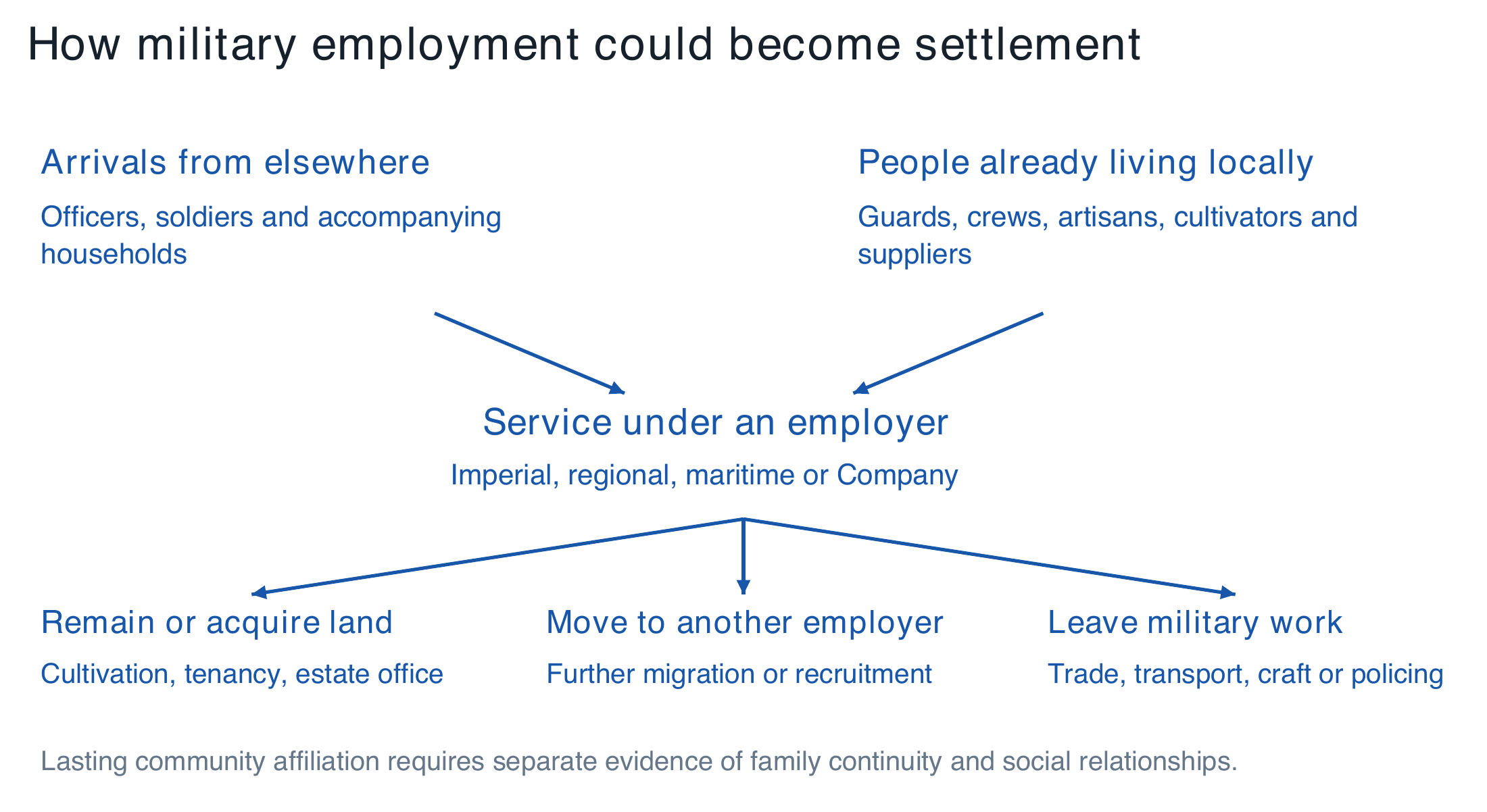
Commanders could move with retainers, and garrisons created demand for suppliers, artisans, clerks and transport workers. Service thus brought more people into contact with a new region than a troop count alone can show. Permanent settlement required a further step: a household remained, a grant or tenancy endured, or a family developed a livelihood and relationships beyond its original employer.
The later Bangsha Parichay histories preserve both migration and local recruitment. The Bilwagram Hazra narrative remembers Ugra Kshatriya houses already in Burdwan being invited to join Man Singh's army. The Sahana introduction preserves an Agra and Man Singh connection, while its detailed family story describes established local commerce. Such histories are valuable accounts of family memory, but their early episodes were recorded centuries after the events. They must be distinguished from contemporary appointments and grants. [5]
Afghan families between resistance and imperial employment
Afghan soldiers did not simply disappear when the Mughals defeated the rulers and chiefs they served. Some continued resistance, some moved to new strongholds, and others entered imperial employment. Bengal's military labour crossed political boundaries even while armies fought over them.
Mirza Nathan's Baharistan i Ghaybi describes the settlement following Khwaja Usman's defeat in 1612. Khwaja Shiru was admitted to imperial service, and 400 Afghan officers of different ranks received gifts. The movement of Usman's family and commanders towards Jahangirnagar, or Dhaka, took place under supervision. Incorporation therefore involved both employment and political control. The 400 are officers in a particular episode, not a census of Afghan households settled across Bengal. [14]
Bayizid's family appears briefly amid the chronicle's account of submission. He returned home intending to bring his wife and children after a week. At Dhaka, the reception of the Afghan leaders included horses, robes of honour, dinner and rose essence. Residences were assigned, but trusted officers kept them in custody. An imperial order then summoned Usman's sons and brothers, Bayizid and other Sylhet heirs to court. Accommodation offered no assurance that a household could stay: the same authority that assigned a house could order another journey. Nathan records these arrangements, rather than a completed transition into permanent local settlement. [14]
Nathan's own household experienced a different consequence of military service. After his father's death, seven revenue units from his father's jagir were assigned to him with government approval. A parent's service could thus leave resources for the next generation, but succession still depended on the state. The defeated chiefs' supervised households and Nathan's inherited revenue rights show how differently military families could fare within the same imperial system. [14]
A much later district account supplies a separate settlement observation. Hunter, drawing on James Taylor, described Pathantali near Dhamrai in the Dhaka region as inhabited by Afghan descendants. This supports the presence of an Afghan-descended local community in the nineteenth-century account. It supplies no genealogy connecting those residents to Usman's followers. The possible absorption of particular Afghan soldiers into other communities remains a family-level hypothesis. [20]
Afghan service continued under later rulers as well. The military world of eighteenth-century Bengal included Afghan commanders and soldiers, with recruitment extending into Bihar. Their histories belong alongside Rajput and other imperial service lineages.[3]
The river and sea frontiers
Bengal's eastern frontier depended on its rivers and sea routes, which connected Dhaka with the delta, Sandwip and Chittagong. Arakanese forces and Portuguese or Indo-Portuguese mariners operated in this contested maritime zone, sometimes as allies and sometimes under different patrons. Contemporary labels such as Magh and Firingi were broad and often hostile terms, not names for uniform populations or occupations.
The Mughal conquest of Chittagong in 1666 sought to end Arakanese control of the port, suppress raids into the eastern delta and secure the approaches to Dhaka. Those raids killed and displaced inhabitants, destroyed livelihoods and carried captives away for forced labour or sale. The Mughal campaign imposed further burdens by requisitioning ships, timber, provisions and local labour. Its strategic aims and human costs therefore extended far beyond the forces engaged in battle. Shaista Khan, Aurangzeb’s maternal uncle and the subahdar of Bengal, organized the campaign; his son Buzurg Umed Khan led the Mughal forces that advanced on Chittagong. [2][15]
The preparations for the conquest of Chittagong show how many kinds of labour a fleet required. Talish's contemporary account describes naval officers and workmen supported through revenue assignments and stipends, the requisition of village carpenters and timber, and shipbuilding at several ports. Kishor Das managed naval revenue assignments. The expedition included Rajah Subal Singh Sisodia alongside Ikhtisas Khan, Farhad Khan and other officers; Bengal sailors and Portuguese defectors also took part. The army's diversity was practical as well as social. [15]
In late 1665, the Portuguese fighters' change of allegiance also became a journey for their households. Talish describes them leaving Chittagong with their families in a flotilla of jalbas and reaching Farhad Khan at Noakhali. Captain Moor and several leaders went on to meet Shaista Khan at Dhaka, while the others remained with their vessels at Noakhali. The men who would help the Mughals take Chittagong had brought people whose future depended on the new arrangement. [15]
Bernier gives a related account of recruitment through promises of land and increased pay, and places accommodation for the families at Dhaka. His version and Talish's are separate accounts, not a single eyewitness itinerary. Together they make clear why recruitment cannot be understood through troop numbers alone: negotiations over military work also involved where accompanying families could live. [15]
Later observations show communities with livelihoods and institutions beyond the fleet. Hunter described Firinghi Christians around Nagari, Bandura and Hasanabad in the Dhaka region, including cultivators, domestic workers and landholders. Such evidence establishes a settled social presence; it does not give every resident the same route into Bengal. [20]
In 1740, Nathalia Peres gained her freedom and a house in Stroobazar near Chinsura. She had been enslaved by a pilot and was the mother of his only son, Dirk. Titas Chakraborty recovered this episode from Dutch records. Nathalia's place in the port became tied to a home she received and a change in her legal status, within a deeply unequal household relationship. Her life belongs to the maritime society around military settlement, although the record does not identify her as a soldier's wife or descendant. [25]
The Portuguese community included people brought together through maritime work, conversion, slavery and emancipation as well as migration from Europe. A Portuguese name could therefore carry several different histories. Nathalia's record gives a woman and a child a place in a story otherwise dominated by officers and grants of land. [25]
Bowrey's observations from 1669–1679 add the daily work of settled households. Around Hooghly and Bandel he distinguished Europe-born from India-born Portuguese residents and described men sailing on English or Muslim-owned ships. Other household livelihoods included baking, knitting and preparing food for sale. These communities were sustained through work beyond warfare. His evidence does not make every Portuguese resident a former gunner or connect every family to the 1665 transfer. [16]
Chittagong and the passage from garrison to landholding
The conquest of Chittagong in 1666 offers one of the clearest provincial examples of military service leading to settlement. The expedition included a land force of about 6,500, and the subsequent garrison received small rent-free land allotments in return for service. Over time, changing revenue arrangements turned troopers or their descendants into petty landholders. This mechanism is described in Chittagong's revenue history and examined by Richard Eaton. The force estimate is not a count of surviving settler descendants. [2]
Named families make the comparison more concrete. The later landed interests of Niamat Khan, Tej Singh and Mangat Ram Hazari were traced to officers in the 1665–1666 expedition. Shirin Akhtar's study follows their place in Chittagong's revenue arrangements, including enrolment as revenue farmers in 1774. Here a military connection survived through the institutions of landholding. The records establish a route into local society without making the families members of one caste. [4]
Neighbouring Noakhali had related frontier estates. Dandra developed from land assigned for defence, while Jagdia's nucleus was associated with a grant to Bura Khan for border protection. Naval obligations also supported estates in the delta. These cases place military settlement well beyond the Burdwan Raj and show that Bengal's frontiers could produce different kinds of landed families. [4]
The newcomers also entered an inhabited society. Cultivators, labourers and artisans made military grants economically workable; traders and clerks accompanied imperial expansion. A grant to an officer describes the right he acquired, not the ancestry of everyone living on the land.
Local military communities and regional zamindaris
Regional rulers maintained their own forces within and alongside the provincial establishment. Tamluk, Panchkot, Mallabhum, Burdwan and Dinajpur offered different combinations of salaried service, land assignments, frontier duties and policing. An officer could change employers, while a household's connection to a village might outlast the military arrangement that first supported it.
The western frontier already had armed service communities. Bankura's ghatwals guarded routes and villages, assisted policing and performed estate duties in return for service lands or other support. Regional studies also record Bagdi and Dom involvement in lower policing and hired service. Bhumij chiefs and followers in the western tracts belong to this history alongside immigrant officers. Later gazetteers describe institutions that had changed under colonial government; they cannot be read as unaltered lists of Mughal-period soldiers. [4][24]
The later transformation of Bankura service lands is unusually visible. Surveys from 1879 to 1886–1887 demarcated 6,011 ghatwali tenures. Settlement began in 1894; where completed, service obligations ended and assessed rents replaced the older payments. Former service holders became recognized agrarian tenants. The 6,011 count refers to tenures, not soldiers or immigrant families. Sanyal also traces local Bhumij leadership through landholding and service offices into later Rajput or Kshatriya claims. These histories show that such claims could develop locally as well as accompany migration. [24]
Service grants were not restricted to fighting men. A Midnapore tradition attributes Sujamutha to Gobardhan Ranjha, attendant and man-at-arms of the Hijli diwan Bhim Sen Mahapatra in the later sixteenth century. It associates neighbouring grants with a clerk and a cook. This is a remembered distribution of land among different kinds of retainers, not proof that all three arrived from outside Bengal or acquired one caste identity. [17]
The distinction between service and migration is particularly important here. Paik, ghatwal, barqundaz and nagdi could describe a duty, an institutional position or a method of payment. They were not interchangeable caste names. A local cultivator entering armed service and a newly arrived soldier receiving land could eventually perform similar duties, despite having different earlier histories.
A dated example comes from the expansion of Burdwan in 1718. Eighteen nayaka ghatwal leaders transferred their allegiance from the Bishnupur sphere to Kirtichandra. Dasu Nayaka became an administrator in the incorporated territory, and later records describe his descendants' service and landholding. Political allegiance changed while families remained connected to the region. The episode does not establish a change of caste. [3]
The Samanta and Sahana histories bring frontier service into the relationships of a particular family. During the Bargi troubles, Janakinath Samanta and his brother are remembered as leaving Kurmun Palasi, north of Burdwan, for service under the Malla rulers. They received sardari jagir land and guard duties at Chhatarkanali and Kotalpur. Their descendants became the maternal relatives of Prankrishna and Rajkrishna Sahana. On the Sahana side, Kuraram's settlement at Shuripushkarini involved nominal-rent land, cultivation and continuing trade; the account attaches no military obligation to it. Military and commercial livelihoods were joined through kinship. [5]
A later episode gives that kinship practical meaning. According to the family history, the brothers lost their mother, Kshemankari Devi, when Prankrishna was eleven and Rajkrishna was six months old; their maternal family helped bring them up. Their father Gosaidas died at forty-one, leaving the boys seventeen and six. He had secured a Deputy Magistrate post for Prankrishna, but died before his son took it up. The account describes the elder boy turning instead to the care of his little brother, the Raniganj business and the family's landed property. This is a remembered choice shaped by bereavement and responsibility. It concerns a civil appointment, and supplies no evidence that the brothers refused army service. [5]
Rajput Khatri and Mahishya family journeys
Khatri history illustrates the variety within an immigrant population. The Burdwan dynasty's tradition places Sangam Rai's earlier home near Lahore and describes pilgrimage, trade and settlement at Baikunthapur. A possible connection with an imperial army is a later conjecture. Manikchandra offers a firmer military career: a non-Bengali Khatri administrator and commander in Burdwan service, he subsequently served Alivardi Khan in Odisha and Siraj-ud-daula at Calcutta in 1756. His movement between employers is more securely documented than a military origin for every Khatri household. [3]
Northern Bengal provides a useful comparison beyond the western estates. Hunter's Kuch Behar account counted 299 adult males under Rajput or Kshattriya and described immigrants employed chiefly in personal or military service. These were not 299 soldiers: the ruler's army was separately estimated at about 80. In Jalpaiguri's permanently settled parganas, 523 Rajputs were recorded, with work including military service, guarding, policing and doorkeeping. The categories mix occupations and household populations, but show service populations well beyond Burdwan, with migration explicitly recorded at Kuch Behar. [18]
The Nakashipara Singha Ray history measures settlement in generations. Ramram Singh is remembered as arriving from Rajputana before Plassey; appointment under the Nadia ruler belongs to his great-grandson Agam Singh's story. Between the remembered arrival and the later military office stood the lives of several generations. Migration and service need not have begun together. The Chakdighi Singha Rays of Burdwan preserved another route, from Kalinjar in Aurangzeb's time. Both published family histories retained Rajput identification. Their named genealogies offer evidence that the surname Singh or Singha Ray, by itself, cannot supply. [5]
Families later recorded as Mahishya preserve comparable journeys. The Birulia Jana history remembers an older Puri connection, followed later by military office under Tamluk and village grants. Bawali's current heritage tradition connects an Uttar Pradesh ancestor with Man Singh before the family's settlement in the 24 Parganas. These are retrospective accounts of early service; the later social relationships become more visible in named marriages. [5][6]
In Ashar 1330 BS, or June–July 1923, Amiyaprabha Mandal of Bawali married Jyotirindranath Das of the Hili family. She was the youngest daughter of Harinath Mandal; he was the eldest son of Kumudnath Das and is described as a Calcutta High Court advocate. Bangsha Parichay presents their marriage as a connection between the Mahishya societies of southern and northern Bengal. Here community membership appears through two people and their families, rather than through a caste label alone. Rao's 1925 account independently identifies Bawali's Mondals as Mahishya. Neither record dates the admission of the family's remote ancestors. [5][6]
The comparison therefore concerns particular families within Mahishya society. It does not make the whole community the descendants of one invading army. Equally, Rajput identification could persist inside Burdwan itself. Geography influenced the setting in which a household found patrons and marriage partners, but did not mechanically turn migrants into Ugrakshatriyas in one district and Mahishyas in another.
Maratha warfare and the communities left behind
The Bargi raids of 1742–1751 made flight and the loss of a livelihood part of the history of settlement. Burdwan, Bishnupur, Birbhum and Midnapore bore much of the destruction. Raghuji Bhonsla's expeditions sought Bengal's wealth and a recurring claim on its revenue through chauth. Yusuf Ali's account describes the aim as conquest if possible, and the extraction of chauth otherwise. Plunder served this pursuit of tribute and political control; it was accompanied by severe violence against the people from whom wealth was demanded. [3][29]
Yusuf Ali gives a small, painful detail from Alivardi's retreat in 1742. A quarter-seer of khichri that reached him had to be shared among seven people. At Katwa, raiders had burnt the rice stores, and the starving party ate scorched grain. His recollection brings hunger into an account usually told through commanders and manoeuvres. He also describes families leaving Murshidabad by boat for Dhaka, Malda and Rampur, and Shahamat Jang moving his household and property to Godagari. Even proximity to the court could no longer guarantee a secure home. [29]
Bhaskar Pandit’s death and the defence of Bengal
Against this background, Alivardi Khan’s decision to eliminate Bhaskar Pandit in 1744 can be understood as a severe wartime measure directed at the commander of repeated incursions that Bengal’s forces had been unable to end in open campaigning. The raids had devastated villages, crops, markets and religious sites, and had subjected civilians—predominantly local Hindus, but also Muslims—to killing, mutilation, sexual violence, torture, displacement and hunger. Removing the leadership that organized and sustained these expeditions therefore had an immediate defensive rationale: to disrupt the raiding command, protect the population and regain strategic initiative. [3][28]
To end the invasions, Alivardi took the advice of his Afghan general Mustafa Khan and invited him to a parley. At Mankara, at the end of March 1744, Bhaskar and 21 of his commanders were cut down in the Nawab's tent, and the tyrant Bhaskar's head was brought to Alivardi (Wikipedia, citing Sarkar). Their deaths weakened the raiding leadership, but did not by themselves end the wider conflict, which continued until the settlement of 1751. The episode may be presented as retaliation for atrocities and as an act regarded by defenders of Bengal as necessary for public protection; it should not, however, be described as a judicial execution, because no trial established individual guilt and the method was an ambush under safe-conduct. [3][28]
Banesvara Vidyalankara was a Sanskrit scholar and the court poet of Maharaja Chitrasen of Burdwan; he composed the Citra Campu in 1744. In Dimock and Gupta’s English translation, its description of the Bargis reads: “[They] travel a hundred yojanas in one day, killing the unarmed and submissive, women and children, stealing whatever they find, abducting virtuous women . . .” [31]
Gangaram's contemporary Bengali poem Maharashtra Purana follows people carrying the means of their survival onto the roads. Pandits fled with manuscripts, craftspeople with tools, and cultivators with seed and ploughs. Pregnant women gave birth during flight. The poem includes Muslim as well as Hindu villagers among the displaced. Its descriptions of killing, mutilation, rape, burning houses and shrines, and torture to obtain money are accounts of atrocities against civilians. These passages preserve testimony to terror and dispossession; they are a literary account of the early raids, not a register of named victims or a basis for an exact death toll. [28]
Landholding offered uneven protection. Raja Chitrasen left Burdwan; McLane considers Calcutta a possible refuge, but the destination is not certain. The Burdwan estate nevertheless survived without a lasting reduction in its size attributable to the invasions. Bishnupur's fort and treasury also survived while its countryside was ravaged. A family might retain its formal rights to an estate yet lose access to its home, crops, rents and lenders. Those losses could be ruinous even without an immediate legal transfer of the land. [3][24]
Other estates did change hands during the emergency. McLane traces Arsa, part of a Kayastha family's ancestral zamindari near Hooghly and Chinsura, to a grant to Chitrasen in 1742. After Gobindadeb's death, Manikchandra represented the estate as lacking an heir; the grant rewarded grain supplied to the Nawab's army during the first invasion. A posthumous son, Nrisinghadeb, did exist. Hastings later restored some of his other ancestral lands in 1779, but not Arsa. This was a family's dispossession through wartime patronage and a disputed succession, rather than a documented seizure of its estate by the Bargi raiders. [3]
Bishnupur's later collapse followed a longer sequence. The Bankura gazetteer places the impoverishment caused by the raids before the famine of 1770, revenue pressure and family litigation. These accumulated difficulties eventually led to the sale of the estate to Burdwan in 1806. The raids belong in that history of decline, but the final auction came more than half a century later. [24]
The need for defence also created new employment. Regional rulers drew on cavalry, infantry and specialist gunners. The traditions of Nakari Roy and Ramkrishna Roy at Asansol connect their service to Kashipur or Panchkot during the Maratha troubles. The Samanta family's frontier-service story belongs to the same setting. The surviving retrospective accounts do not supply the original commissions, but they preserve a memory of families finding livelihoods in the defence of places threatened by the raids. [3][5][8]
Maslandpur near Mahishadal supplies a coastal example. O'Malley's 1911 gazetteer observed a Christian community of a little over 200, retaining Portuguese names. Its members claimed descent from Portuguese gunners brought by the Raja of Mahishadal to help resist Maratha raids. The community's presence is an observation; the gunner origin is its retrospective tradition, without a named recruit or original grant in the entry. The case nevertheless preserves a distinct local memory of specialist military service and settlement. [17]
The Kundus of Itachuna in Hooghly preserve a different settlement tradition. The district gazetteer records a Maratha origin and admission into Tili society. An earlier Bangsha Parichay entry identifies the family as Ugra Kshatriya and gives another ancestry account. The sources preserve competing accounts of ancestry and community identity; neither establishes a dated transition. The case cannot yet be used as a verified instance of Maratha soldiers entering Tili society or attempting admission as Ugrakshatriyas. [5][7]
The damage also weakened the resources with which Bengal's rulers could protect their subjects. Villages could not pay normally after crops, homes and trading networks were destroyed; lenders fleeing across the Bhagirathi made borrowing harder. Drawing on James Grant's later fiscal account, McLane reports Burdwan's revenue arrears at Rs. 22 lakh in 1742–1743, and Bengal collections of Rs. 64.52 lakh, considerably less than half the expected land revenue. These historical fiscal estimates indicate the scale of disruption. The Nawab pressed other zamindars for money, while unpaid troops sometimes withheld service until part of their arrears was met. Civilian devastation and military weakness could reinforce one another. [3]
The peace of 1751 brought a costly settlement: Alivardi surrendered the revenues of southern Orissa and agreed to annual chauth of Rs. 12 lakh. The main invasions ended, although occasional raids continued in the southwest. His last five years were comparatively peaceful. The wars had damaged revenue, unsettled relationships with landlords and officers, and added to the strains created by Afghan revolts and disputes within the ruling family. They left a weakened political inheritance, even though Alivardi had preserved Bengal's government through years of fighting. [3]
This provides an important background to the Company's breakthrough at Plassey on 23 June 1757. It does not make that outcome inevitable. Siraj-ud-daula could still capture Calcutta in 1756; the Company then recovered it with forces brought from outside Bengal. The conspiracy involving Mir Jafar and the Jagat Seth banking interests, conflict with the Company, and Anglo-French rivalry shaped the immediate crisis. The Bargi wars had helped erode the Nawabi state's resources and authority; Company intervention exploited a later political opening. British control developed further through Buxar in 1764 and the acquisition of the diwani, or revenue-collection authority, in 1765. The rebellion of 1857 belongs to a much later stage of British rule. [3][30]
For families, the same decade could mean the destruction of an old livelihood or the beginning of a new one in a ruler's service. The history of military settlement therefore also encompasses civilian displacement and the recruitment of local defenders. People changing employers lived alongside migrants who had arrived with invading armies. A household's presence after the wars does not by itself establish which side an ancestor served.
Burdwan and the Ugrakshatriya case within the wider history
Burdwan became a major centre of military employment after the upheavals at the end of the seventeenth century. Krishnaram was killed in the rebel attack of January 1696, when the town had few defenders. Jagatram's assassination in 1702 was a separate event. Kirtichandra's subsequent expansion created a larger field of service and territorial authority. A precise foundation date for the Nagadee force does not follow from the 1696 disaster. [3]
Named commanders reveal the variety of the Raj's leadership. Alongside Manikchandra, accounts identify an unnamed Deccani Muslim paymaster. Rupnarayan Chaudhuri of Baksa is credited with defeating Marathas at Mandalghat, without a secure caste identification in the cited account. Bakhtar Singh, brother of Rani Bishnukumari, commanded household troops in 1777. An officer's identity does not establish the origin of all his men. [3][7]
The Nagadees were the Raj's cash-paid establishment. Alongside them were land-supported guards, police and village servants. Contemporary reports in 1760 describe large concentrations of armed men, but the estimate of at least 10,000 facing Captain White concerned Burdwan, Birbhum and allied forces together. The narrower September 1767 returns identify 648 positions dismissed and 839 proposed for retention, implying 1,487 before the reduction. These are employment positions, including support staff, rather than a caste census. [9]
The Sahana family's account of Durlabh Konar begins with a business already rooted at Kendur. Pack bullocks carried salt, spices and conch shells from Tamluk and other places; cattle needed grazing grounds and water along the routes. In the family narrative, an unnamed Mughal representative camped beside a tank Durlabh was having dug. Durlabh went to the camp with gold coins. Mistaken at first for an employee, he explained that the tank was being excavated at his own expense, and offered to provide the camp's provisions for a day. [5]
When courtiers suggested that he request a jagir, Durlabh chose something closer to his existing livelihood: freedom to establish cattle-grazing places and tax-free land for tanks where his animals needed water. The account connects these privileges with a sanad and the title Sahana. It gives neither a date nor the ruler's name, and does not reproduce the charter. The episode is family memory, but its subject is quite specific: a resident merchant negotiating with a passing army for rights useful to his trade. [5]
Kuraram, described as a later descendant, made a smaller move within Bengal. After a quarrel in his old village, he sought protection from the Mallabhum ruler and received land near Indas at nominal rent. He dug a tank, built a Shiva temple and brought land under cultivation with hired labour, while some pack-bullock commerce continued. The family history thus remembers the making of a village livelihood as well as a remote military ancestry. Repeated recruitment may help explain the incorporation of some service families into Ugrakshatriya society; these commercial and agricultural households belong in that explanation too. [5]
Jana and Suta or Sud distinctions belong to the community's internal history. Nineteenth-century descriptions place Kulin and Maulik ranks within both subdivisions; later census accounts describe ritual negotiation and attempts at amalgamation. These sources establish changing boundaries and status claims, but do not establish that Jana families were uniformly wealthier or higher-caste immigrants. The scholarly defence of Ugrakshatriya standing records advocacy within an existing community, not a demonstrated founding decree by Rarh pandits. The 1921 census also records Ugrakshatriya returns under Khatri; a census claim does not establish Punjabi ancestry. Likewise, the Agra explanation of the name Ugrakshatriya remains an origin tradition, rather than a demonstrated etymology or a dated act of naming. [10][12][13]
The 1872 census counted 59,887 Ugrakshatriyas in Burdwan out of 70,606 in its specified Bengal section, a concentration of 84.82 per cent. That distribution supports a regional history of consolidation. It cannot identify how much came from earlier provincial soldiers, Nagadees, other migrants or established local families. Ugrakshatriya formation is one case of settlement and social incorporation within Bengal's wider history, with its particular concentration requiring explanation. [11]
Company recruitment and the choices facing service families
Company conquest changed the available employers. Estate forces were reduced at different times, while regular sepoy recruitment expanded. Early Calcutta battalions drew partly on northern military migrants and their descendants already living in Bengal, but the surviving descriptions do not identify particular Ugrakshatriya or Mahishya families as recruits. [4][9][21]
Company regulations show changing conditions rather than a simple shift to local recruitment. Rules issued in 1786 set requirements for age, height, discharge documentation and service wherever ordered. A 1790 order preferred recruits from Company provinces after specified desertions, but this included Bihar and cannot be treated as a count of Bengali-speaking soldiers. [22]
The evidence therefore does not establish that settled service families generally refused Company employment. Land, trade, estate work, eligibility and mobility may all have shaped individual decisions, while Company service itself could lead to retirement grants and new landed households. Family choices can be reconstructed only where enlistment, discharge, pension or genealogical records connect a household to a particular career. [22][27]
Shared routes and different communities
The strongest comparisons follow households through identifiable stages. At Chittagong, garrison service led into landholding. Portuguese and Indo-Portuguese families combined military or maritime work with settled livelihoods and Christian institutions. Rajput lineages could retain their public identification while serving Bengali rulers. Some families later recognized as Mahishya or Ugrakshatriya remembered military connections, while local service holders supplied another stream into the same regional society.
The similarities are substantial, but they concern processes more securely than common descent. Armies brought people together; estates provided employment and land; families built relationships that could last after the army changed or disappeared. Marriage and community recognition could then preserve, reinterpret or alter the identity attached to a household. The records rarely let us observe every stage in one continuous sequence.
This wider history also restores the role of people whose jati was not recorded. Bengali crews and craftsmen, guards, local cultivators in service, Afghan officers and Christian gunners all helped sustain Bengal's military systems. Their contribution does not depend on proving that they ultimately joined one of the better-documented landed castes. The journey from soldier to settler had several destinations, including continued military employment, cultivation, commerce, policing and the maintenance of a distinct family or religious community.
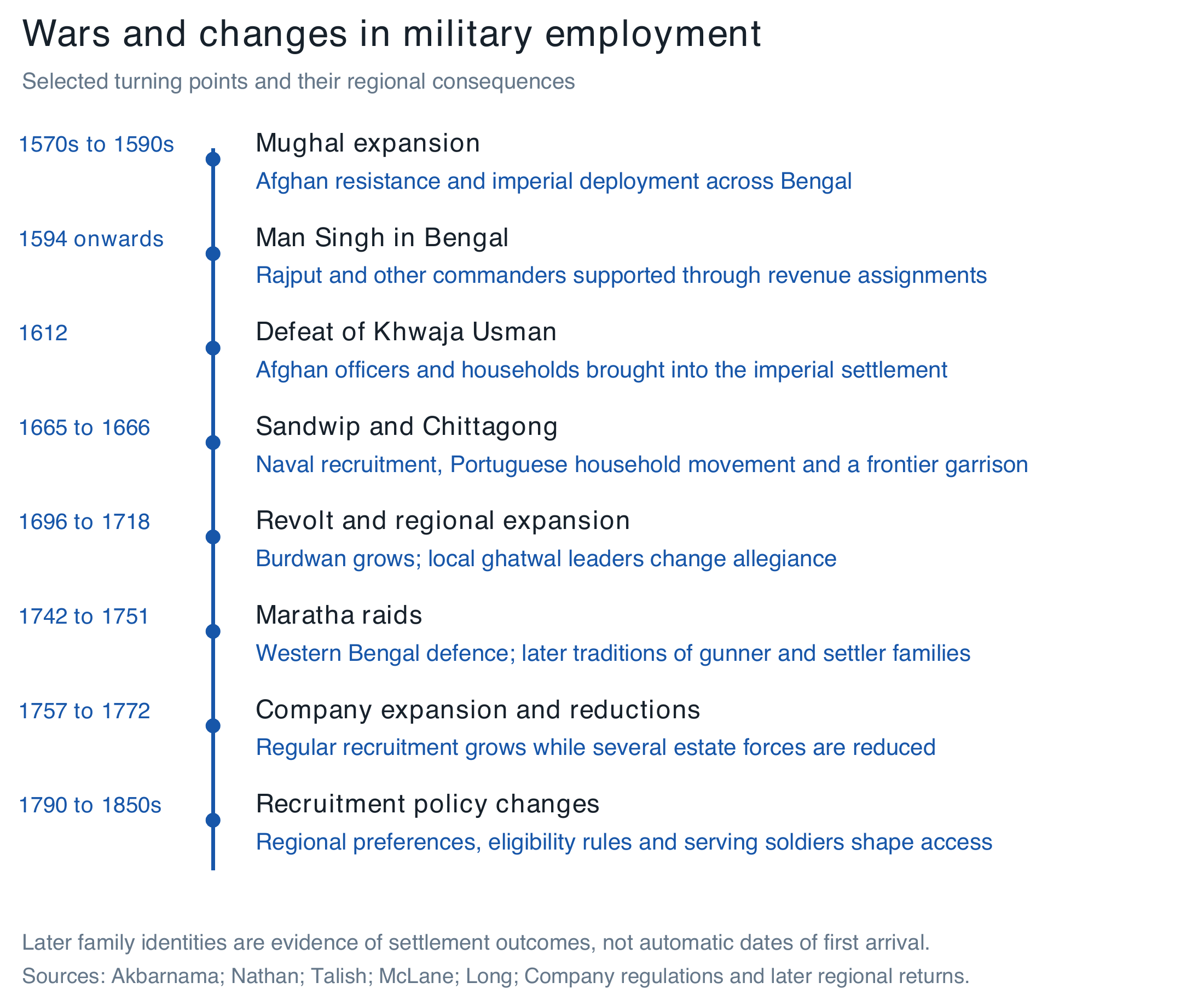
Regional evidence at a glance
District names are location guides, not timeless administrative boundaries. A family tradition establishes what a later account remembered; a contemporary service record establishes a particular act of employment or movement. Neither alone supplies a complete genealogy.
| Region or locality | People or family | Service or settlement evidence | Type and date of evidence |
|---|---|---|---|
| Dhaka and Sylhet | Afghan officers and households | Submission, imperial service and supervised household movement | Nathan's contemporary account, 1612 [14] |
| Pathantali near Dhamrai | Afghan descendants | Nineteenth-century report of a settled community | Hunter 1875 citing Taylor; no named 1612 pedigree [20] |
| Dhaka and Chittagong | Portuguese and Indo-Portuguese households | Transfer from Arakanese to Mughal employment with families | Talish and Bernier, 1665–1666 [15] |
| Chittagong and Noakhali | Garrison families and frontier officers | Military allotments, defence estates and later revenue farmers | Revenue records and Akhtar's study [4][19] |
| Hooghly and Bandel | Portuguese and Christian households | Maritime work, conversion, household labour and property | Bowrey, 1669–1679; archival household cases [16][25] |
| Mahishadal and Maslandpur | Christian families with Portuguese names | Claimed gunner descent from Maratha-period defence | Observed community; tradition in 1911 gazetteer [17] |
| Bankura and western tracts | Ghatwals, Bagdi, Dom and Bhumij service groups | Local guarding, policing, service lands and chiefly authority | Gazetteer and regional social history [4][24] |
| Kuch Behar and Jalpaiguri | Rajput service populations; Kuch Behar immigrants | Personal service, armed employment, guards and police | Hunter's 1870s district observations [18] |
| Nadia and Burdwan | Nakashipara and Chakdighi Singha Rays | Remembered Rajputana or Kalinjar origins and later service | Bangsha Parichay, 1923–1927 [5] |
| Tamluk and 24 Parganas | Birulia Jana and Bawali Mandal | Military service traditions; later Mahishya identification | Genealogies and Rao 1925; early episodes retrospective [5][6] |
| Hooghly | Itachuna Kundu | Competing Maratha–Tili and Ugra Kshatriya origin accounts | 1921 genealogy and 1972 gazetteer; no dated admission [5][7] |
| Burdwan | Ugrakshatriya families and estate personnel | Local families, military employment and regional concentration | Family histories, 1767 returns and 1872 census [5][9][11] |
| Comilla region | Govindapur Chauhan family | Ajmer origin, British service, retirement and settlement | Bangsha Parichay III, 1923 [5] |
What the numbers can establish
| Observation | Date | Recorded quantity | What is being counted |
|---|---|---|---|
| Imperial cavalry supported by Bengal assignments | 1594 | 5,000 | Cavalry establishment; not permanent settler families [1] |
| Afghan officers receiving gifts | 1612 | 400 | Officers in a specific accommodation episode [14] |
| Chittagong expedition | 1666 | About 6,500 | Land force; not a descendant population [2] |
| Burdwan establishment reduction | 1767 | 648 dismissed; 839 proposed retained | 1,487 positions including support roles; complementary returns [9] |
| Dinajpur establishment | 1770 | 343 cavalry plus 1,015 foot and peons | 1,358 positions in the cited official account [4] |
| Ugrakshatriya census concentration | 1872 | 59,887 of 70,606; 84.82% | Burdwan share of the specified Bengal-section Ugrakshatriya total [11] |
| Rajput or Kshattriya category in Kuch Behar | 1870s account | 299 adult males | Mixed occupations; not 299 soldiers [18] |
| Rajputs in Jalpaiguri's permanently settled parganas | 1870s account | 523 | Classified population with several service occupations [18] |
| Maslandpur Christian community | 1911 account | A little over 200 | Community population claiming gunner descent [17] |
These observations measure different things: cavalry supported by revenue assignments, an expeditionary force, estate employment, or people classified in a census. They cannot be added to produce a total of military settlers. The 1767 Burdwan dismissal and retention figures are complementary parts of one establishment; the 1760 allied force is a different category.
Notes & sources
Contemporary chronicles and published government records establish particular acts of service, movement and recruitment policy. Gazetteers and censuses describe later communities and classifications. Bangsha Parichay records family memory and public identity, with remote ancestry stories distinguished from contemporary documents. The source notes identify where an original printed page was checked and where an archival record is known through later scholarship. Colonial descriptions and caste rankings are treated as historical classifications, not as innate qualities of present communities.
- Abu'l-Fazl. Akbarnama, III, translated H. Beveridge, chapter CXIX, pp. 998–999, Man Singh's appointment and cavalry assignments; pp. 1042–1043, Akbarnagar and subsequent operations. Contemporary court chronicle, read in published English translation. Appointment passage; subsequent operations. ↩ ↩ ↩ ↩ ↩
- Eaton, Richard M. The Rise of Islam and the Bengal Frontier 1204–1760 (1993), chapter 6, The Early Mughal Experience in Bengal; chapter 9, Chittagong. Publisher edition. ↩ ↩ ↩ ↩ ↩ ↩
- McLane, John R. Land and Local Kingship in Eighteenth Century Bengal (1993), pp. 128–134, provincial setting and Khatri migration traditions; pp. 140–146, 1696 revolt and 1702 assassination; pp. 148–149, 1718 frontier incorporation; pp. 155–156, Arsa and the dispossessed heir; pp. 161–168, Maratha invasions, flight and fiscal crisis; pp. 168–170, Manikchandra and other officers; pp. 233, 249, Rupnarayan and Bakhtar Singh; pp. 118, 191–192, 263, service establishments. Library SRC-00095. Publisher record. ↩ ↩ ↩ ↩ ↩ ↩ ↩ ↩ ↩ ↩ ↩ ↩ ↩ ↩ ↩ ↩
- Akhtar, Shirin. The Role of the Zamindars in Bengal 1707–1772 (1982), pp. 31–32, 94, military and revenue settlement; pp. 96–98, naval and other forces; pp. 112–113, reductions; p. 145, lower police recruitment. Library SRC-00686. Tej Singh figures cite Sumner's 14 October 1779 account; Dinajpur figures cite Cottrell's correspondence of 1770 and 1772. Those underlying manuscripts were not separately inspected. ↩ ↩ ↩ ↩ ↩ ↩ ↩ ↩ ↩
- Kumar, Jnanendranath. Bangsha Parichay II (1921), pp. 213–217, Itachuna Kundu; III (1923), pp. 143–150, Chakdighi, and 610–619, Govindapur; VI (1927), pp. 44–48, Nakashipara; XII (1932), pp. 77–106, Sahana and Samanta, and 260–261, Bawali–Hili marriage; XIV (1934), pp. 94–95, Birulia Jana, and 390–391, Bilwagram Hazra. Original page images checked for these principal cases. Library SRC-00700, SRC-00701, SRC-00704, SRC-07641, SRC-00696. II; III; VI; XIV. ↩ ↩ ↩ ↩ ↩ ↩ ↩ ↩ ↩ ↩ ↩ ↩ ↩ ↩ ↩ ↩ ↩ ↩ ↩ ↩ ↩
- Rao, R. Venkoba. The Life and Work of Bengal Zemindars I (1925), pp. 76–77, Bawali's Mahishya identification. Printed account. Rajbari Bawali history preserves a current family origin tradition; its early commission or founding grant is not reproduced. ↩ ↩ ↩ ↩
- Banerji, A. K. West Bengal District Gazetteers Hooghly (1972), pp. 695–696, Itachuna admission legend; p. 697, Rupnarayan Chaudhuri. Gazetteer. The printed entry explicitly presents the early Kundu story as a legend. Itachuna Rajbari preserves the current Maratha-origin account. ↩ ↩ ↩ ↩
- Eastern Railway. Asansol Heritage Uncovered, p. 14, Nakari Roy and Ramkrishna Roy under Kashipur/Panchkot. Official retrospective heritage publication, not an original appointment or land grant. Publication. ↩
- Long, James, editor. Selections from Unpublished Records of Government 1748–1767, I (1869). Entry 468, p. 217; entries 504 and 507, pp. 238–239; entry 558, pp. 260–262, including Captain White's 29 December 1760 report; entry 954, pp. 507–509; entry 955, p. 509, dismissed troops; entry 958, p. 513, proposed retention. The latter returns were presented on 28 September 1767. Appendix C, pp. 547–548, memorandum on the Assam mission about 1792, is later material included in the volume despite the dates in its title. Published original-record transcriptions checked. Library SRC-10747. Volume. ↩ ↩ ↩ ↩ ↩ ↩
- Risley, H. H. The Tribes and Castes of Bengal, I (1891), pp. 12–13, community traditions and subdivisions. Used as a late nineteenth-century description, not as proof of a sixteenth-century etymology. Library SRC-00115. The population benchmark in this article is taken directly from Beverley, not from Risley's later statistical transcription. ↩
- Beverley, H. Report on the Census of Bengal, 1872 (1872), General Statement V.B, Bengal section, printed pp. cxviii–cxix, Ugrakshatriya row under Agricultural Castes; Orissa section p. cxxxii; chapter III, paragraphs 110–112, especially printed p. [40], enumeration timing. Library SRC-08149. Census volume; table location. The figures refer to the Bengal section of this return, not the whole historical Subah or a count of military descendants. ↩ ↩ ↩
- Porter, A. E. Census of India 1931, V, Bengal and Sikkim, part I (1933), p. 455, paragraph 486, Jana–Suta ritual negotiation and amalgamation. Library SRC-08136. Report. Thompson, W. H. Census of India 1921, V, Bengal, part I (1923), p. 350, Ugrakshatriya returns under Khatri; SRC-08135. A census designation is not proof of Punjabi ancestry. ↩
- Ugrakshatriya Samhita, preface signed Shitikantha Sharma, Sripur, 2 Shravan 1300 BS (1893), pp. 1–2, SRC-08132. Bhattacharya, J. N. Hindu Castes and Sects (1896), pp. 156–158. Vidyanidhi, Lalmohan. Sambandha Nirnaya, second edition (1896), pp. 187–188. These describe advocacy, ranking and boundaries within an existing community. Sambandha Nirnaya. ↩
- Mirza Nathan. Baharistan i Ghaybi, translated M. I. Borah (1936), I, pp. 196–198 and 208–209, Afghan accommodation, household movement, custody and the imperial summons; p. 209, Nathan's revenue assignment after his father's death. Contemporary chronicle read through the published translation. Volume I. ↩ ↩ ↩ ↩ ↩ ↩ ↩
- Talish, translated in Jadunath Sarkar, Studies in Mughal India, second edition (1919), pp. 129–143, Sandwip, Portuguese defection and the conquest of Chittagong. Bernier, François. Travels in the Mogul Empire, Constable edition (1891), pp. 174–182. Talish supplies the late 1665 and January 1666 sequence. Bernier reports negotiations and warfare without presenting them as his own eyewitness experiences. Talish translation. Bernier scan. ↩ ↩ ↩ ↩ ↩ ↩ ↩
- Bowrey, Thomas. A Geographical Account of Countries Round the Bay of Bengal 1669–1679, edited R. C. Temple (1905), pp. 191–194, Portuguese residents and household occupations around Hooghly and Bandel. Contemporary traveller's observations. University of Exeter transcription. ↩ ↩
- O'Malley, L. S. S. Bengal District Gazetteers Midnapore (1911), p. 207, Maslandpur Christian community and Portuguese-gunner tradition; p. 219, Sujamutha and other service grants. Original printed pages checked. The compiler's observed community and the retrospective ancestry traditions are distinguished. Gazetteer. ↩ ↩ ↩ ↩ ↩
- Hunter, W. W. A Statistical Account of Bengal X (1876), p. 257, Rajputs in Jalpaiguri's permanently settled parganas; pp. 342–343, adult-male basis and Rajput or Kshattriya category in Kuch Behar. Original pages checked. The 299 and 523 are different enumerations; neither is a troop return. Original volume. ↩ ↩ ↩ ↩ ↩
- Cotton, H. J. S. Memorandum on the Revenue History of Chittagong (1880), pp. 3–4, military allotments and later estates; Appendix B, p. 163, Chief to President in Council, 2 December 1772, Anthony Jose. The dated return is reproduced in this later revenue compilation. Text and printed-page markers checked in OCR; the original image of p. 163 was not verified. Available transcription. ↩
- Hunter, W. W. A Statistical Account of Bengal V (1875), pp. 44–45 and 72, Dhaka Firinghi and Christian communities; p. 73, Pathantali near Dhamrai, citing James Taylor. Original pages checked. The older account's early Portuguese chronology is not used in preference to Talish. Original volume. ↩ ↩ ↩ ↩
- Broome, Arthur. History of the Rise and Progress of the Bengal Army I (1850), pp. 92–93, the 1757 Calcutta battalion and early recruiting pool. Original page images checked. This is a retrospective Company-officer history, not a nominal muster. Its sweeping assertion about provincial natives' lack of military employment is not adopted. British Library IOR/L/MIL/17/2/474. Original volume. ↩ ↩
- Grace, Henry. The Code of Military Standing Regulations of the Bengal Establishment (Fort William compilation, 1 January 1791), pp. 183–184, Military Consultations, 18 February 1789, invalid land grants; Appendix section XXXIII, pp. 377–378, General Order, 29 June 1790, and Military Consultations, 16 June 1786, recruitment and obligations. Original page images checked. The scan's catalogue title/date are misleading; the printed Code and British Library IOR/L/MIL/17/2/438 identify the work. Recruitment orders; land grants. ↩ ↩ ↩
- Rand, Gavin, and Kim A. Wagner. Recruiting the “martial races”: identities and military service in colonial India, Patterns of Prejudice 46(3–4) (2012), pp. 232–254, especially notes 16–23. Discusses the parliamentary return East India (Castes of Hindoos), 1857–1858, paper 129, XLIII.123: 1828 despatch, p. 8; Fagan circular, 9 August 1830, p. 11; 1835 correspondence, p. 12; 1850 correspondence, pp. 14–15. These primary records are cited through the study; their original parliamentary printing was not separately inspected. Publisher article. ↩
- O'Malley, L. S. S. Bengal District Gazetteers Bankura (1908), pp. 28–29 and 35–37, Bishnupur under the raids and the later estate sale; pp. 64–65, 101, 125 and 129, ghatwal duties, tenures and settlement; library SRC-08153, original pages checked. Sanyal, Hitesranjan. Social Mobility in Bengal (1981), pp. 46–48, particularly p. 47, Bhumij landholding, service offices and status claims; SRC-10766. Curley, David. Battle and Self-sacrifice in a Bengali Warrior's Epic, in R. W. Nicholas, Rites of Spring (2008), p. 169, Dom service with explicit limits on generalization; SRC-10761. Curley's citations to Hunter IX p. 55 and VII p. 381 were not separately image-checked in this update. ↩ ↩ ↩ ↩ ↩
- Chakraborty, Titas. The Household Workers of the East India Company Ports of Pre-Colonial Bengal, International Review of Social History 64, special issue S27 (2019), pp. 71–93, especially pp. 76 and 78. Publisher pages checked. Nathalia Peres's 1740 case cites Dutch archive 1.11.06.11/1694, f. 124; the underlying manuscript was not separately inspected. Publisher article. ↩ ↩ ↩
- Shil, Partha Pratim. Orality, State Power, and the Labour of Policing in Colonial Bengal c 1850–1947, Past and Present 270 (2026), pp. 223–254, section I, especially notes 31 and 39; first published online 12 April 2025. Cites the New Police report for 1862 and subsequent police proceedings. This is evidence concerning the later constabulary, not Company-army enlistment. Publisher article.
- Alavi, Seema. The Company Army and Rural Society The Invalid Thanah 1780–1830, Modern Asian Studies 27 (1993), pp. 147–178, p. 159 n. 44. Chittagong references: Collector S. Pierard to Board of Revenue, 14 April 1800, Bengal Military Consultations, 29 May 1800, P/20/6; Collector to Board of Revenue Invalid Proceedings, 22 March 1805, vol. 3. The article was checked; the underlying letters were not separately inspected. Publisher record. ↩
- Gangaram. The Maharashta Purana An Eighteenth Century Bengali Historical Text, translated and annotated with an introduction by Edward C. Dimock Jr. and Pratul Chandra Gupta (Honolulu: East-West Center Press, 1965), pp. 26–32, flight and violence against civilians; introduction p. xi, manuscript dating and limits of authorship. Library SRC-00093. Original translated pages checked. The surviving narrative covers the early raids through Bhaskar Pandit's death in 1744; its manuscript date of 1751–1752 may be a composition or copying date. Publisher record ↩ ↩ ↩
- Yusuf Ali. Ahwal i Mahabat Jang, translated in Jadunath Sarkar, Bengal Nawabs (Calcutta: Asiatic Society, 1952), p. 96, conquest and chauth; p. 100, food shared during the retreat and burnt grain at Katwa; p. 102, flight by boat and Shahamat Jang's household. Library SRC-00123. Original translated pages checked. Yusuf Ali places himself in the retreat, but writes retrospectively; Sarkar's introduction, pp. 79–80, describes his resumption of writing in 1764. Published translation ↩ ↩
- National Army Museum. Battle of Plassey, sections The context, Regime change and Imperial power; Armies of the East India Company, Buxar. Used for the 1756–1765 sequence and the immediate political and military setting. The assessment of the raids' longer consequences draws on McLane, pp. 161 and 165–168 [3]. Plassey; Company armies ↩
- Banesvara Vidyalankara. Citra Campu (1744), verse translated in Edward C. Dimock Jr. and Pratul Chandra Gupta, introduction to Gangaram, The Maharashta Purana An Eighteenth Century Bengali Historical Text (Honolulu: East-West Center Press, 1965), pp. xiii–xiv, citing Ramcaran Cakravarti's edition (Benares, 1940), p. 13. The editors characterize the work as poetic and historically vague, while identifying this verse as evidence of the horsemen's methods and the terror they inspired. Published translation and source discussion checked. ↩
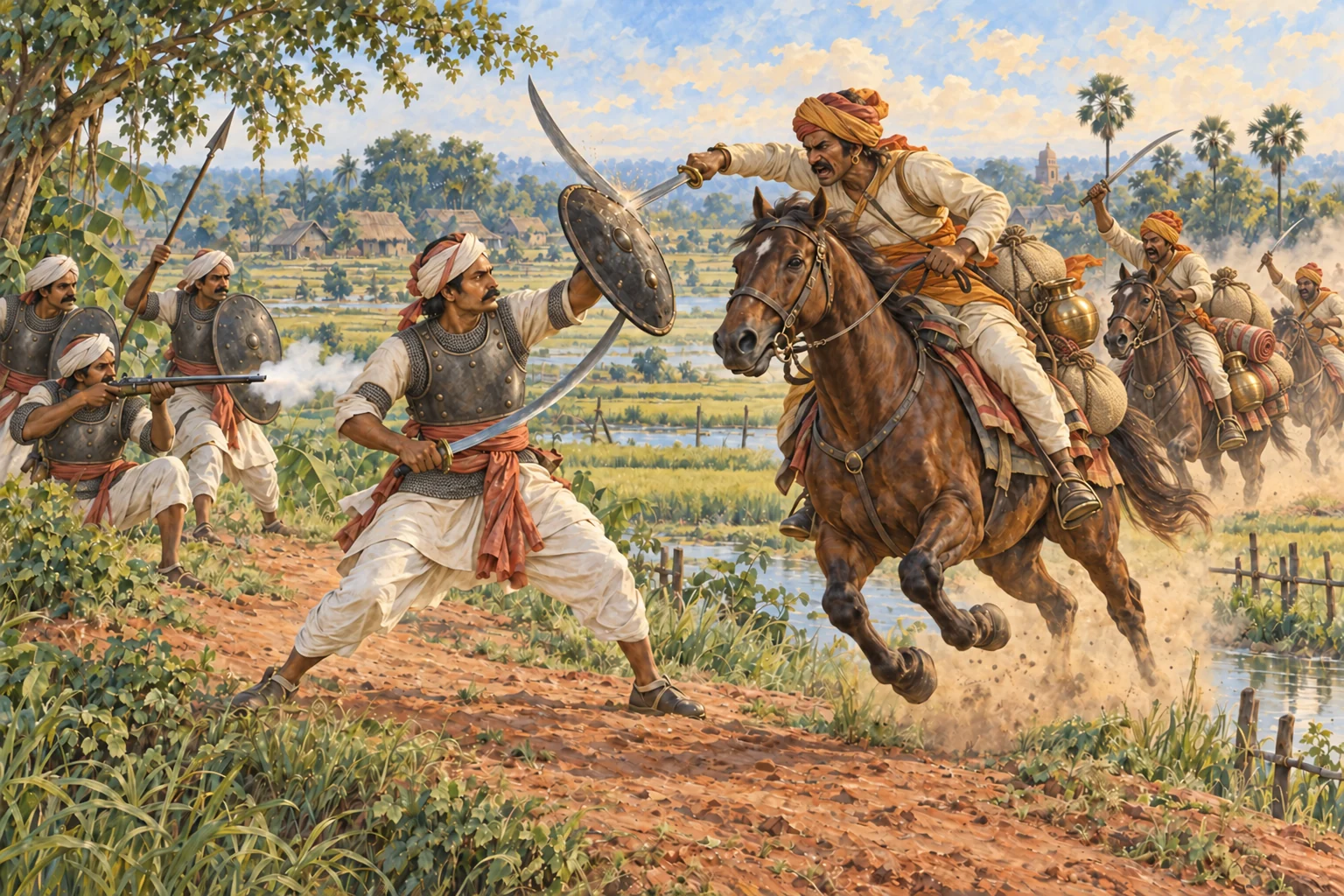
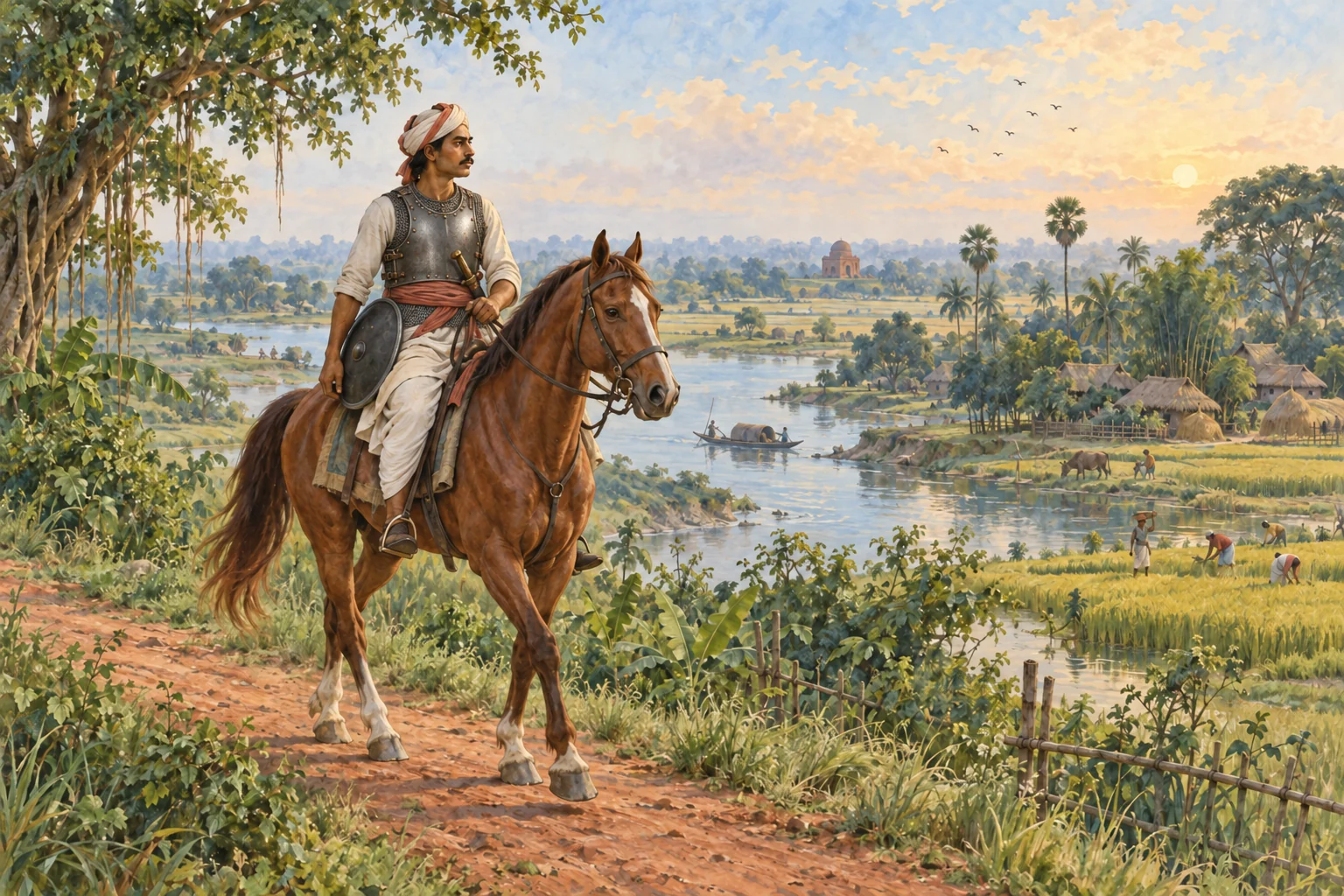
Illustration credit: Ugrakshatriya Heritage, two contemporary artworks from the original Origins article: A Rider in the Burdwan Landscape; Nagadees and the Bargi raids 1742–1751. They are artistic interpretations, not period images or evidence of dress, caste, ancestry or troop composition. Two diagrams and the opening table summarize the cited movements, institutions and chronology; they are explanatory reconstructions.
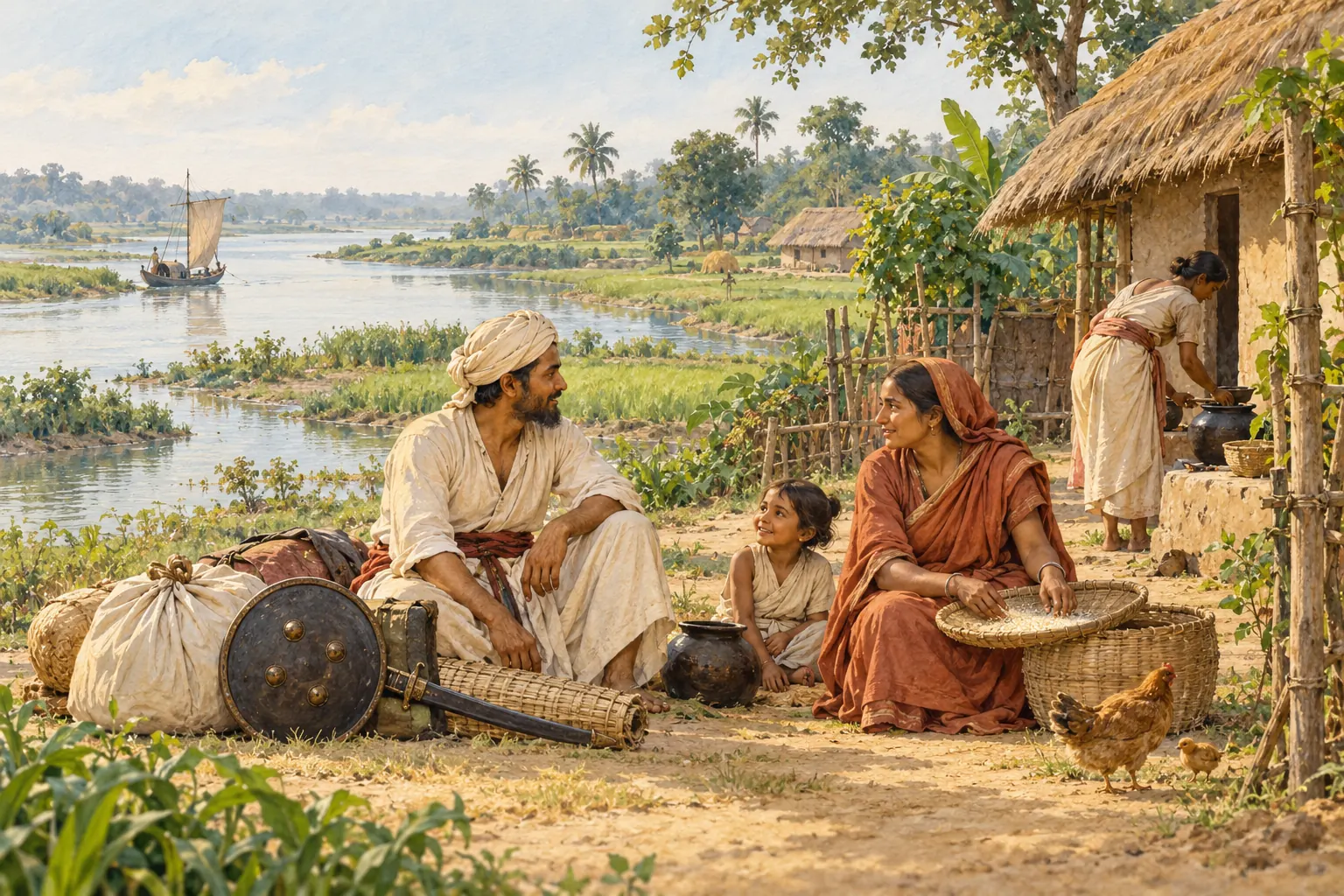
The header and carousel illustrations were created for this article. They evoke household migration and settlement without depicting a specific recorded event.
Page views: