The heritage projectHistoryFamily histories
Reading the Bangsha Parichay
Sourced from the Aguri Heritage project.
https://aguri-heritage.in/bangsha-parichay-aguri-origins
Original project material: all rights reserved. Other material retains its own rights. Copyright & reuse
What Bengal’s lineage books reveal about Aguri origins, family memory and belonging in Rarh.
Last updated:
Cite this page
Aguri Heritage. “Reading the Bangsha Parichay.” Last updated: . https://aguri-heritage.in/bangsha-parichay-aguri-origins.
Citing this page does not grant permission to republish it. Copyright & reuse.
The strongest historical explanation is that the Aguris took shape as a community in Rarh, especially the Burdwan region, through a long association with cultivation, landholding, armed service and local authority. Some families may also preserve memories of migration and service under Mughal commanders. The evidence does not establish one migrating army, one royal ancestor or one moment of origin for the entire community. It points more convincingly to several family histories becoming part of a shared regional identity. This is a historical reconstruction, with greater confidence in the regional setting and occupational history than in the earliest stages of formation. [1][2][3][4][5][6][7][8][10]
That conclusion gives family memory an important place. An ancestor remembered as a soldier may have served a local chief rather than the emperor personally. A story of a grant may preserve the establishment of a household even when the ruler's name has shifted. A pedigree may leave out generations without its keepers intending to deceive. The task is to understand what a tradition carries, and then determine which parts can be independently dated. A mistaken date in one Pal episode cannot discredit a Sahana tradition, a Kundu migration memory or the Hazras' village rituals.
Listening to the families
Bangsha Parichay volumes collected family histories, genealogies and biographies from materials supplied by families, within Bengal’s older tradition of preserving pedigrees through kulapanjikas and inherited memories. We regard them as a rich source of oral history, preserving family recollections, migration stories and local traditions that might otherwise have disappeared. Their accounts of marriages, occupations and public life are valuable, although they also reflect how families wished to be remembered. Claims of ancient ancestry or elevated status need independent corroboration, and not every entry derives from an old genealogical manuscript. Read critically, these volumes illuminate both the past and how families remembered it. [19]
The Bangsha Parichay brings together eight identified Aguri family accounts in five volumes published between 1921 and 1934. They concern landed, commercial and professional households. They are an unusually rich window into those families, although they cannot represent every Aguri household, especially poorer cultivators, labouring families or women's experiences beyond the roles the compilers chose to describe. This sample comes from searches across seventeen volumes; two gaps in the numbered sequence and the possibility of later volumes mean that other family accounts may remain to be identified. [1]
These accounts contain several kinds of knowledge. A recollection of a father's business is different from a tradition about a seventeenth-century founder; both differ from an argument linking a family to a medieval dynasty. They should be evaluated separately, even when they stand on the same page. The Pals' claim to descent from the Pala emperors requires a chain of evidence that has not been supplied. Their accounts of nineteenth-century marriages, businesses and village obligations pose different, more specific questions. [1]
The same distinction applies to sources outside the community. A census officer could accurately report a petition while repeating an untested explanation of origins. Risley and Bhattacharya recorded useful details, but also wrote through caste hierarchies, received classifications and stereotypes. Their printed authority does not turn speculation about parentage or character into population history. The community's traditions and the officials' descriptions both need to be read in context. [6][7][8]
| Family and home | Volume / pages | Main interests of the account |
|---|---|---|
| Kundu · Itachuna, Hooghly | II (1921) 213–217 | Bijaynarayan Kundu: landholding, contracting and a tradition of migration and military service. |
| Hati · Adhra, Burdwan | III (1923) 371–373 | Banwarilal Hati: legal practice, education and public service. |
| Hazra · Kurchi, Katwa | VI (1927) 360–361 | Paramsukh Hazra: commerce, genealogy and established ritual practice. |
| Sahana · Shuripushkarini, Bankura | XII (1932) 77–106 | Satya Kinkar Sahana: trading ancestry, settlement, mining, milling and legislative service. |
| Chaudhuri · Putsuri, Burdwan | XIV (1934) 107–115 | Bijaygobinda Chaudhuri: Suta identity, manuscript patronage and professional service. |
| Roy · Shanko, Burdwan | XIV (1934) 185–230 | Pratap Chandra Roy: a remembered fortified landscape and the publishing of the English Mahabharata. |
| Pal · Hitta and Burdwan | XIV (1934) 370–389 | Gangnarayan Pal’s family: royal descent claims, landholding, trade, ritual and litigation. |
| Hazra · Bilwagram, Galsi | XIV (1934) 390–399 | Rakhalchandra Hazra’s family: service, village establishment, inter-village ritual and commerce. |
Source: Bangsha Parichay [1]. This is an identified sample of family accounts, not a census of Aguri households.
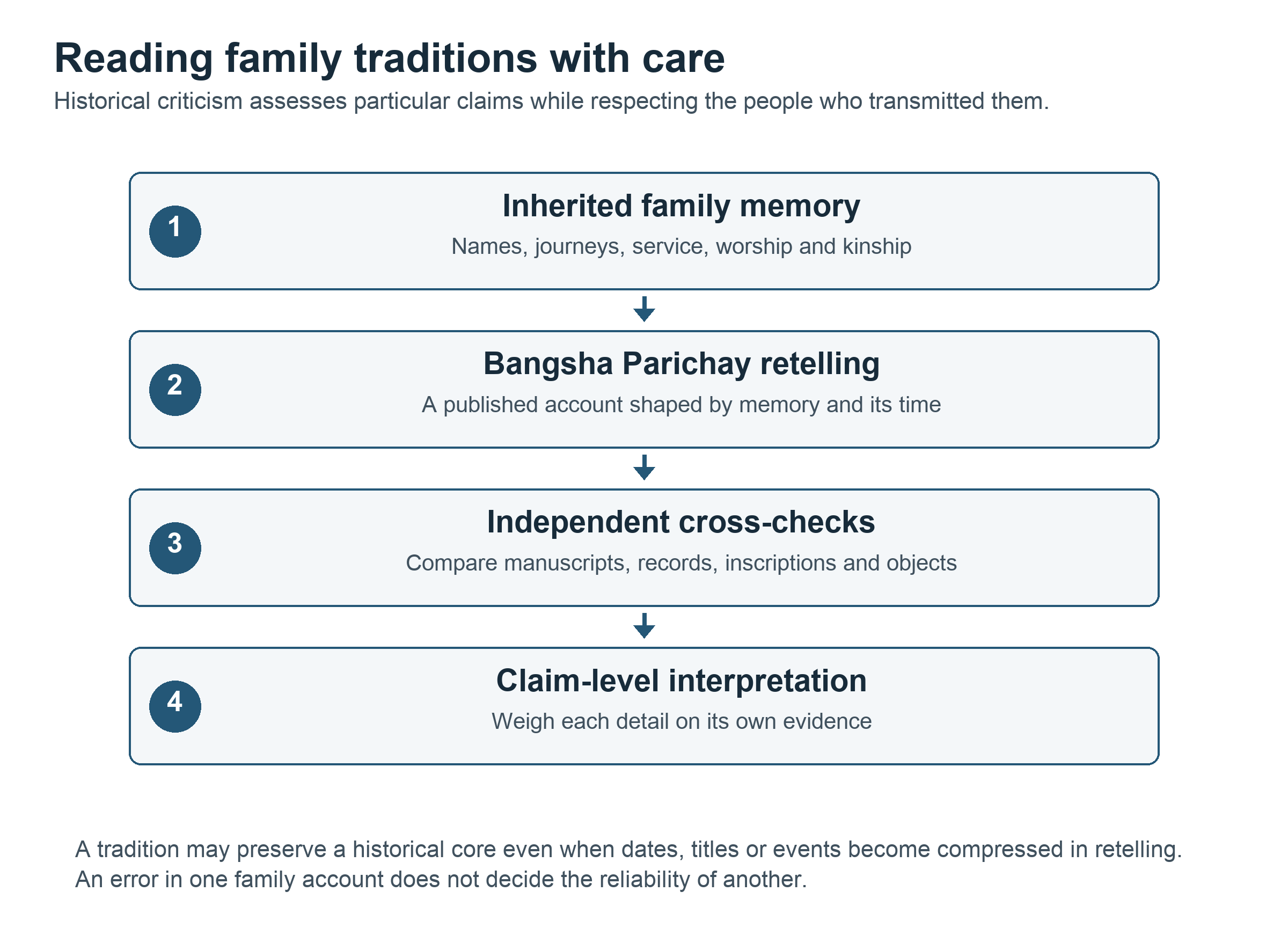
The most productive questions preserve the meaning of a tradition while testing its historical claims.
| Question | What it helps establish | Application |
|---|---|---|
| Independence | Whether an apparent match comes from a separate source. | Several books repeating one census account are one source chain, not several independent witnesses. |
| Closeness | How far the recorder stood from the event. | A near-contemporary professional biography and a seventeenth-century ancestry story require different levels of checking. |
| Specificity | Whether the claim points to a recoverable object. | A named grant, court, date and case number are stronger retrieval leads than a general assertion of royal descent. |
| Chronology | Whether named people and events could coincide. | Kirtichand’s death in 1740 conflicts with his personal rescue in 1743; it does not disprove every Pal tradition. [11][12] |
| Purpose | Why this version mattered when it was recorded. | Family prestige, ritual recognition and colonial classification may shape different sources. Purpose alone does not prove falsehood. |
These tests apply equally to community narratives, colonial ethnography and modern scholarship.
Agra and Rarh can belong to the same history
The family accounts offer several explanations of origin. Some remember arrival from the Agra region with Mughal forces. Others describe local houses entering imperial service. These explanations conflict if each is made the exclusive origin of every Aguri. They need not conflict as histories of different families, or as memories of different stages in the formation of one community. [1]
| Entry | Tradition recorded | Historical interpretation |
|---|---|---|
| Kundu (1921) | Agra; a commander sent by Man Singh. | A family migration and service tradition; no dated commission recovered. |
| Kurchi Hazra (1927) | Barman Kshatriyas from an unnamed homeland. | An identity claim with an admitted gap in the pedigree. |
| Sahana (1932) | Agra country; Mughal soldiers under Man Singh; Agari explained through Agra. | A remembered military origin alongside a detailed trading and settlement history. |
| Ray (1934) | Agra region and the Mughal army; Agari derived from Agra. | A migration explanation, not a demonstrated linguistic derivation. |
| Chaudhuri (1934) | Agra offered as something many people believe. | The qualifying language records a circulating view rather than certain family knowledge. |
| Pal (1934) | Local Rarh Kshatriyas; descent from the Pala emperors. | Local-rootedness and imperial genealogy are separate claims. The dynastic chain remains unproved. |
| Bilwagram Hazra (1934) | Local Rarh houses linked to Lausen; service in Man Singh’s Agari fauj. | A tradition of local recruitment. Joining an army need not mean arriving with it. |
Source: Bangsha Parichay [1], opening passages of the relevant family entries. Hati gives no comparable remote-origin explanation.
An imperial army could bring men into a region and recruit others already living there. Service, marriage, patronage and settlement could then connect households with different earlier backgrounds. The surviving evidence does not demonstrate that this exact sequence created the Aguris, but it offers a historically plausible way to read the traditions together without forcing every family into one pedigree.
The concentration of Aguris in Burdwan is strong evidence of regional rootedness by the census period. It is weaker evidence about where every ancestor came from centuries earlier. Soldiers settled in a particular estate could remain concentrated there. Surnames could also change as offices and local titles became hereditary. Geography and surnames make a single, community-wide Agra migration harder to establish; they do not rule out migrant ancestry in particular households. [2][6][7][8]
The derivation of Agari from Agra should therefore remain an explanation preserved by the community, rather than a demonstrated linguistic fact. Similarly, connecting Agari to agrahara, a type of land grant, requires dated intermediate forms and identifiable holders. Neither a resemblance between words nor an ancient grant to people with later-familiar surnames supplies the missing genealogical link.
A third explanation identifies Aguris with the Ugra category in Sanskrit accounts of social rank and parentage. Such classifications tell us how authors arranged society within a normative scheme; they do not by themselves document the marriages from which a particular historical community arose. Later writers also invoke the Brihaddharma Purana, but a passage there naming the historically specific Aguri community has not been independently verified for this account. The connection remains a textual question to investigate, not a biological conclusion to inherit from older scholarship. [6][7][17]
The traditions concerning Man Singh also depend on careful identification of places. The Pal account specifically describes a second battle of Mogalmari. Blochmann's historical note distinguishes the famous battlefield associated with Tukaroi in 1575 from another Mughulmari in Burdwan on the route towards Jahanabad and Mandaran. The family narrative cannot be identified with the 1575 battle solely because the place names resemble one another. No independent record of the family's particular second battle has been identified. A chronological objection based solely on the 1575 battle would therefore be premature. [1][9]
Land and armed service were closely connected
Across these families, landholding and armed service repeatedly appear together. The Ray account remembers a fortified settlement, guards and named military places. The Bilwagram Hazras connect a founder to service and village establishment. The Sahana narrative links movement and settlement to regional rulers, while later generations prosper through trade. These recurrences deserve attention, although shared editorial language must not be counted as independent corroboration. [1]
The best-supported interpretation is that martial and agrarian roles could coexist. A family might cultivate, collect revenue, maintain retainers, protect routes and serve a larger power at different moments. “Warrior” and “cultivator” are not mutually exclusive descriptions of a household's past. Nor does later commercial success require that every family began as a dispossessed ruler.
Modern research places Aguris among the Burdwan Raj's cash-paid troops, the nagdees or naqdis. This supports the importance of military service in the community's history. It does not establish that the army created the whole caste. Achintya Kumar Dutta explicitly rejects an exclusively eighteenth-century origin and argues for earlier presence. McLane likewise treats Aguris as an existing regional element in the Raj's success. The army is best understood as one institution through which some Aguris served and advanced, rather than a proven common ancestor of all Aguris. [2][10]
This military interpretation follows Dutta and McLane. Dutta's supporting sources include Ajit Halder's essay and the 1940 Burdwan settlement report, whose relevant passages have not been independently examined for this account. Exact troop totals, recruitment patterns and the proportion of Aguris in the force therefore require further verification. [15][16]
What each family can tell us
The Sahanas and a remembered trading world
Durlabh Konar's story centres on pack animals, commodities, routes and water. Even if ten thousand cattle is a conventional expression of great wealth, the occupational world described is specific: trade between the Bengal coast and the interior required animals, places to halt, access to water and negotiation with authority. The remembered request for rights to tanks and camping places fits that world. It may preserve an economic relationship more reliably than the name or date of the governor. [1]
The story also combines enterprise with privilege. Refusing one jagir while receiving rent-free tank land does not mean that the fortune was independent of land rights. Kuraram's later settlement on land granted by the Malla ruler adds another connection between commerce and local authority. The Sahana history is better read as the interaction of trading resources, settlement and patronage than as a simple choice between merchant and landlord origins.
The reported panja patta would be exceptionally valuable if it survives. The 1932 entry says that the sanad was then still preserved; its present location and authenticity remain unverified. Its date, seal, language, place names and terms could test the tradition directly. An unspecified gap between Durlabh and Kuraram cannot date the grant to one Mughal campaign. For the later family, the National Library's catalogue confirms thirty-six diaries by Satya Kinkar Sahana, covering selected years between 1915 and 1960. The volumes for 1932 and 1934 are particularly relevant to the world in which the lineage histories were published. This establishes the diaries as a catalogued collection; their contents have not been examined for this account. [1][13]
The Kundus and two memories of the Maratha years
The 1921 Kundu account remembers a family defending the Burdwan Raj's interests during Maratha incursions; the modern heritage narrative remembers Maratha incomers who settled and prospered. Both connect the household to the same disruptive period, but assign it different roles. Their disagreement calls for inquiry into how the accounts were transmitted, rather than an immediate choice of the more attractive story. [1][18]
The pedigree produces a chronological tension with a foundation in the 1740s if all the stated links and the assumed generation lengths are accepted. It does not independently establish an arrival date. A temple inscription or rent-free grant could identify a patron and a dated act of establishment, but even a securely dated building would not necessarily date the family's first arrival. Later marriage links with other Aguri households are relevant to the family's community position by the period recorded; they do not settle its distant ancestry.
The Hazras of Bilwagram and relationships preserved in ritual
The exchange of lamps and festival visits between Bilwagram and Satinandi is a different kind of evidence from a royal pedigree. If its continuity is independently documented, it may preserve a durable relationship between settlements even when the explanatory genealogy has become compressed. The remembered tanks, deities and branches of the Sen house offer several connected lines of inquiry. [1]
The assertion that Hemanta Sen held an imperial mansab of ten thousand is much harder to accept literally. Such a rank was extraordinary in the period claimed. Yet replacing it with a supposedly proven rank of one thousand merely because Hazra is associated with hazari creates another unsupported assertion. The reasonable interpretation is that the title may preserve a memory of office or service; the precise rank awaits contemporary evidence. The difficulty with this number does not invalidate the village relationship or the family's later commercial history. [9]
The Hazras of Kurchi and the value of an admitted gap
The Kurchi genealogy explicitly leaves several generations unknown. This admission should be treated as useful information about the limits of the family's knowledge. Its description of established thread-wearing and ritual names is evidence of how the household understood its practice in 1927. Whether the practice began much earlier requires other evidence, but the account need not be reduced to an imitation of a recent movement. [1]
The Pals and the need to separate royal ancestry from local history
The connection to the Pala emperors remains unproved. A shared surname, an interpretation of Buddhist worship or a citation to an ancient ruler does not bridge the intervening centuries. The episode in which Radhakanta Pal rescues Kirtichand in 1743 also fails as literal biography if it refers to the Burdwan ruler who died in 1740. A remembered act of assistance may have acquired the wrong ruler's name, but that possible explanation is not itself corroboration. [1][11][12]
These problems are specific. They do not make every Pal detail false. The family text preserves named reservoirs, a shared sacrificial arrangement with Kesh households, businesses, marriages and numbered lawsuits. Each is capable of a different kind of verification. The Dharmamangal reading and the precise “second battle” wording also show why criticism of this account must attend closely to its sources. Even where a claim serves family prestige, deliberate invention must be demonstrated rather than presumed.
The Roys and the material landscape of Shanko
The Shanko narrative connects family memory to a fort, moats, tanks, sacred images and neighbouring settlements. These features could help distinguish successive phases of settlement and power. The account of human remains in a tank is not sufficient to identify a battle, but neither is it the only archaeologically testable claim: earthworks, buildings and water systems can also preserve evidence. Pratap Chandra Roy's publishing career belongs to a much better documented period and should be evaluated through its own records. [1]
The Chaudhuris and Hatis in a wider community
The Putsuri Chaudhuris' account is valuable for Suta identity, marriage, education and public service. Its manuscript story requires careful distinction between the copies and people involved. Sukumar Sen describes two extended Chaitanya Bhagavata witnesses associated with Denur and Kaigram. The presence of three additional chapters alone does not identify the Putsuri copy with either of them. Ambikacharan Chaudhuri, the family owner, must also be distinguished from Ambikacharan Brahmachari, the scholar who published additional chapters. The lineage entry is a lead to a manuscript, not proof of its present location. [1][14]
The Hati account offers comparatively little about remote origins and much about legal practice, education and public works. That is a strength for those questions, not a deficiency to be filled with someone else's ancestry. Read together, the Hati and Chaudhuri entries show how professional service and intermarriage helped sustain community connections alongside landholding and commerce. [1]
Tanks and temples record a claim to belonging
The repeated attention to water is one of the most persuasive patterns in the family histories. A tank served practical needs, but its patronage also placed a family within the village's memory. A reservoir associated with a wife or mother connected household remembrance to a public resource. A temple, a festival obligation or a lamp carried between villages could similarly make belonging visible and repeat it across generations. [1]
These acts help explain why family histories describe authority through things built, repaired and endowed. They record how a household expected its position to be remembered. The practical service and the claim to status could be present together. Recognising this does not require treating every number of tanks or every founding attribution as exact.
This evidence also has a social limit. The surviving narratives usually speak from the patron's side. The people who dug tanks, maintained fields or supplied unpaid labour seldom speak for themselves. A fuller community history would place those experiences beside the benefactor's account. The Sahana story of Ambika Devi insisting that tenants be well fed, for example, preserves both a remembered ethic of care and the unequal labour relationship within which that care operated. [1]
What the family trees can and cannot date
Generation counts can test whether a chronology is comfortable or strained. They cannot turn an undated pedigree into a series of established birth dates. The calculations below use starting years and father-to-son counts drawn from the family chronologies, conditionally, and make the assumptions explicit. The links themselves have not all been independently authenticated. [1]
| Founder / family | Anchor year; steps | Modelled birth window | Modelled adult window |
|---|---|---|---|
| Hemanta Sen · Bilwagram | Rakhalchandra 1850; 9 | 1535–1598 | 1560–1653 |
| Chaitanyacharan · Kundu | Bijaynarayan 1860; 8 | 1580–1636 | 1605–1691 |
| Haripal · Pal | Gangnarayan c. 1855; 7 | 1610–1659 | 1635–1714 |
| Kuraram · Sahana | Gosaidas c. 1822; 5 | 1647–1682 | 1672–1737 |
| Bhagabat · Kurchi | Paramsukh 1886; 4 | 1746–1774 | 1771–1829 |
Conditional on the stated birth-year anchors and generation counts from the family chronologies [1]. Birth window = anchor − 35 × steps to anchor − 28 × steps. Adult window adds ages 25–55. Approximate anchors remain approximate. Ray, Chaudhuri and Hati supply no comparable continuous chain.
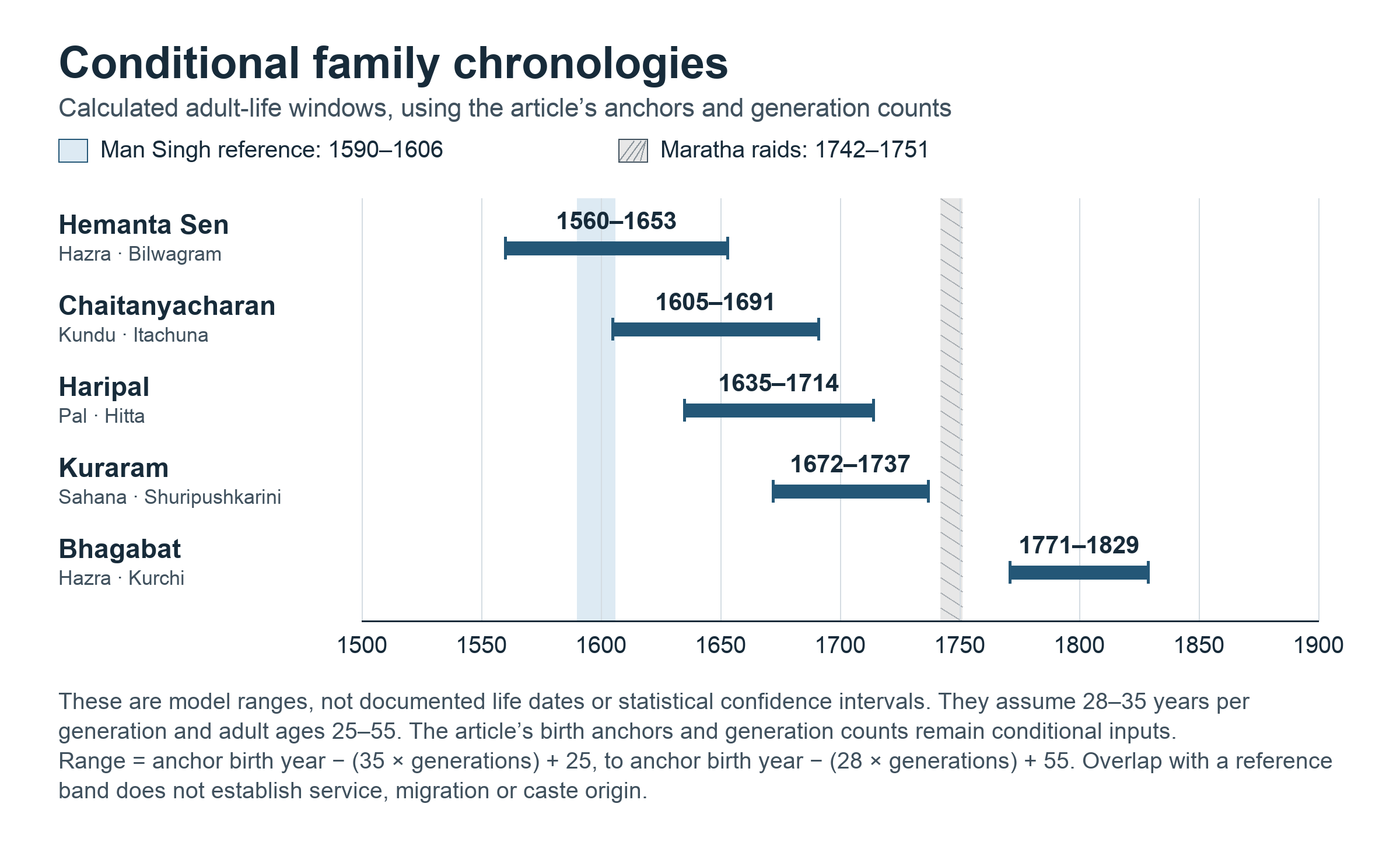
The calculation assumes an average of 28–35 years for each generation. Its adult window then adds ages 25–55. These are illustrative choices, not statistical confidence limits or universal rules about fatherhood and service. Late-born children, collateral succession, adoption and omitted generations can change the result without implying dishonesty.
Under these assumptions, Hemanta's earliest modelled adult year is 1560, Haripal's is 1635 and Kuraram's is 1672. The figure is useful for identifying questions, especially the strain between Haripal's modelled chronology and the 1624 episode. It cannot decide whether an ancestor existed, arrived from elsewhere or held a particular caste name. An ancestral line and a community's formation are related questions, but they are not the same question.
Ritual differences and a changing public identity
The Jana and Suta distinctions show that a shared community name did not mean uniform practice. Risley in 1891 records sacred-thread practice among Janas, but does not give the Jana twelve-day and Suta thirty-day mourning contrast. Vidyanidhi's 1896 discussion provides earlier testimony to Jana ritual claims, and the 1931 census explicitly records the twelve-day and thirty-day distinction. These sources locate debates about status and practice before, as well as during, the twentieth-century campaigns. They do not establish biological differences between the branches. [6][8][17]
The census also shows identity being negotiated in public. In 1921, some households returned themselves as Khatri; the reported decline in Aguri numbers therefore cannot be read simply as population loss. In 1931, the designation Ugra Kshattriya (Aguri) was accepted, and the report describes efforts to bring Jana and Suta practices together. It notes some shared dining among educated people but says that no instance of intermarriage had been reported before the census. This records a movement towards unity, not proof that a merger was already complete. The report did not separately tabulate the caste that year. [8]
The conclusion the evidence supports
The Aguris' clearest historical homeland is Rarh. Their recorded history joins cultivation and landholding with military service, trade and public life. The literary evidence, especially when early editions and manuscript variants are considered, favours an interpretation in which their regional history predates the eighteenth-century expansion of the Burdwan Raj. The 1903 Ramayana edition strengthens the possibility of a considerably earlier presence, while leaving the precise dating of its Agari passage to manuscript verification. [2][3][4][5][6][7][8][10]
The most convincing reconstruction is therefore a community with deep regional roots whose families did not necessarily share one origin. Mughal service may have introduced or strengthened some lineages; local houses may have joined larger military and revenue structures; marriage and ritual relationships could connect them over time. The Burdwan Raj gave important opportunities to an existing regional population and helped reshape its fortunes. This interpretation accommodates the strongest parts of the family traditions without making every remembered commander, number or royal descent literal history.
The name Ugra Kshatriya also has a history. It should not be treated simply as a label invented during the twentieth-century census campaigns: earlier printed sources and the literary passages discussed here already place Agari identity in relation to Kshatriya status. What became especially visible in the census era was organised debate over recognition, naming and relations between branches. The strength and spread of particular practices varied; an old household custom and a newer movement to extend it could exist together. [3][6][7][8][17]
What remains unestablished is a single biological ancestry: descent of all Aguris from Agra Rajputs, the Pala emperors, one named founder or one regiment. The absence of that proof does not leave the community without a history. Its history is already substantial in the landscapes it inhabited, the services its families performed, the relationships they maintained and the memories they passed on. A responsible community history can state that conclusion firmly while keeping particular ancestral questions open.
Read the family accounts
Explore the Bengali text alongside its English translation in these downloadable PDFs. They are working transcriptions and translations: uncertain readings are marked, and a second-reader proofread remains pending.
- Seven Aguri family entries — Bengali and English (PDF · 1.03 MB): Kundu, Hati, Kurchi Hazra, Chaudhuri, Ray, Pal and Bilwagram Hazra.
- The Sahana lineage — Bengali and English (PDF · 1.41 MB): the complete volume XII chapter, with photographs and the family tree.
Find both documents on the Resources page. The original volume and page references are recorded in the documents and the references below.
References
- Jnanendranath Kumar (compiler), Bangsha Parichay: II (1921), Kundu, pp. 213–217; III (1923), Hati, pp. 371–373; VI (1927), Kurchi Hazra, pp. 360–361; XII (1932), Sahana, pp. 77–106; XIV (1934), Chaudhuri, pp. 107–115, Ray, pp. 185–230, Pal, pp. 370–389, and Bilwagram Hazra, pp. 390–399. The family narratives are read as distinct claims and traditions, not as authenticated continuous pedigrees. Volume II · Volume III · Volume VI · Volume XII, sanad page · Volume XIV ↩ ↩ ↩ ↩ ↩ ↩ ↩ ↩ ↩ ↩ ↩ ↩ ↩ ↩ ↩ ↩ ↩ ↩ ↩ ↩ ↩ ↩
- Achintya Kumar Dutta, “Prosperity, Dominance, and Social Mobility: Emergence of a Mobile Caste in Colonial Southwest Bengal,” in Dutta (ed.), Explorations in Colonial Bengal: Essays on Religion, Society, and Culture (Orient BlackSwan, 2023), pp. 297–324, especially pp. 299–303 and 322–323. Publisher ↩ ↩ ↩ ↩
- Krittibasi Ramayana, Uttarakanda, edited by Hirendranath Datta (Bangiya Sahitya Parishat, 1310 BS; conventionally dated 1903). Preface, PDF pp. 3–4; printed pp. 194–197, PDF pp. 206–209. The preface distinguishes the 1009 sal Patrasayer copy from the 1502 Shaka witness. These are the editor’s manuscript descriptions; the original witnesses have not been independently authenticated here. Full edition ↩ ↩ ↩
- Mukunda Chakravarti, Chandimangal, edited by Sukumar Sen (Sahitya Akademi, 1955; Baishakh 1362 BS). Introduction p. 4; text p. 80, stanza 135; variant apparatus p. 331. The Aguri variant belongs to manuscript Ma, not automatically to the principal witness dated 1717. Edition scan ↩ ↩
- Ghanaram Chakravarti, Dharmamangal: Bangabasi printing, 1290 BS (1883), pp. 47, verse 79, and 737, verse 163; third edition, Bangabasi Electro-Machine Press, 1318 BS (1911–12), pp. 15 and 226; edition by Piyush Kanti Mahapatra (University of Calcutta, 1962), pp. 34 and 584. The 1883 army verse reads twenty-two; the 1911 and 1962 editions print a different reading. 1883 edition · 1911 edition · 1962 edition ↩ ↩
- H. H. Risley, The Tribes and Castes of Bengal, vol. I (Calcutta: Bengal Secretariat Press, 1891), “Aguri,” pp. 12–13. Read critically for the author’s caste classifications and stereotypes. Digitised work ↩ ↩ ↩ ↩ ↩ ↩ ↩
- Jogendra Nath Bhattacharya, Hindu Castes and Sects (Calcutta: Thacker, Spink & Co., 1896), pp. 156–158. His Aghari conjecture and the Reis and Rayyet criticism of Oldham quoted on these pages require independent corroboration. GIPE scan ↩ ↩ ↩ ↩ ↩ ↩
- W. H. Thompson, Census of India 1921, vol. V, Bengal, part I: Report (1923), p. 350; A. E. Porter, Census of India 1931, vol. V, Bengal and Sikkim, part I: Report (1933), p. 455, paragraph 486. These document reported population returns, recognition and ritual practices; they do not adjudicate ancient ancestry. 1921 report · 1931 report ↩ ↩ ↩ ↩ ↩ ↩ ↩
- H. Blochmann’s historical annotations to Abu’l-Fazl’s Ain-i-Akbari, vol. I: mansabs, pp. 238 ff.; Man Singh, approximately pp. 339–342; Tukaroi/Mughulmari, pp. 375–376. The note identifies another Mughulmari in Burdwan. Blochmann’s annotations are distinguished from Abu’l-Fazl’s original text. Mansab note · Man Singh · Mughulmari note ↩ ↩ ↩
- John R. McLane, Land and Local Kingship in Eighteenth-Century Bengal (Cambridge University Press, 1993), pp. 157–158. The longer martial quotation is mediated through Edward C. Dimock and Ronald B. Inden; its relationship to Sen’s Bengali edition remains to be established. Publisher DOI ↩ ↩ ↩
- J. C. K. Peterson, Bengal District Gazetteers: Burdwan (1910), p. 31, for Kirtichand’s death in 1740. Digitised gazetteer ↩ ↩
- K. K. Datta, Alivardi and His Times (Calcutta, 1939), pp. 65–66, for Alivardi at Burdwan in April 1742 and the Maratha incursions. This chronology does not corroborate the particular Pal rescue story. Catalogue ↩ ↩
- National Library of India, manuscript catalogue, PDF pp. 257–264: Satya Kinkar Sahana’s 36 personal diaries, selected years 1915–1960, R30/1–36, accessions G24962–G24997. A catalogue of the collection, not a reading of its contents. Official catalogue ↩
- Sukumar Sen, Bangala Sahityer Itihas (1940), pp. 282 and 296–297. Describes the Denur and Kaigram extended Chaitanya Bhagavata witnesses. The Kaigram colophon is dated 18 Shraban 1143 BS / 1658 Shaka, approximately 1736 CE. Neither witness has been securely identified with the Putsuri family’s copy. Book scan · Printed p. 282 · Printed p. 296 · Printed p. 297 ↩
- K. A. L. Hill and P. K. Banerjee, Final Report on the Survey and Settlement Operations in the District of Burdwan, 1927–34 (Alipore, 1940). Volume I, pp. 22–23, cited through Dutta. British Library catalogue IOR/V/27/314/35. The relevant passages were not independently examined for this article. British Library record ↩
- Ajit Halder, “Darpane Anya Mukh,” Bardhaman Raj College Satabarsa 1881–1981 (1982), pp. 51–55, especially 52–53, cited through Dutta. University of Calcutta Central Library catalogue, printed p. 960, confirms the volume. The essay itself was not independently examined for this article. University of Calcutta holding ↩
- Lalmohan Vidyanidhi, Sambandha Nirnaya, Samanya-kanda, second edition (Calcutta, 1896), pp. 187–188, footnote. Reports Jana/Suta ritual and textual claims; its appeal to the Brihaddharma Purana is not independent verification of a medieval Aguri passage. Digitised book ↩ ↩ ↩
- Itachuna Rajbari, “A Taste of Royalty,” heritage website. The modern Maratha-origin narrative is considered alongside the 1921 Kundu entry. The website text has not been independently rechecked. Itachuna Rajbari website ↩
- Jnanendranath Kumar (compiler), Bangsha Parichay, vol. I (1328 BS / 1921), Haraprasad Shastri’s “Bhumika” and the compiler’s “Abataranika,” opening matter, viewer pp. 3–5. Shastri describes the use of materials supplied by families and calls for comparing them with Bengal’s history. Volume I introduction ↩
Page views: