The heritage projectHistoryFreedom struggle
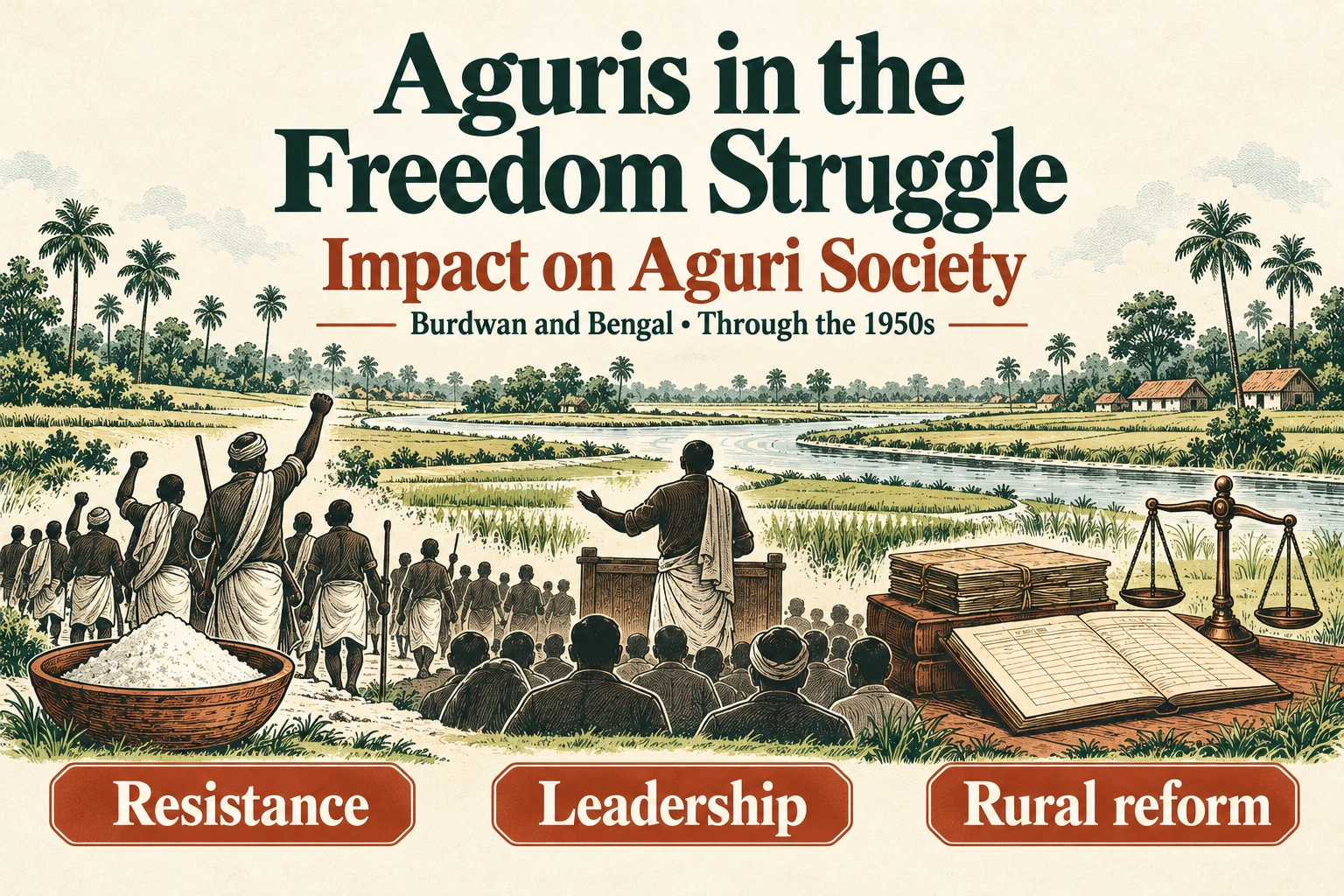
Aguris in the Freedom Struggle and Its Impact on Aguri Society
Sourced from the Aguri Heritage project.
https://aguri-heritage.in/aguris-freedom-struggle
Original project material: all rights reserved. Other material retains its own rights. Copyright & reuse
Burdwan and Bengal from the nationalist movement to the 1950s
Last updated:
Cite this page
Aguri Heritage. “Aguris in the Freedom Struggle and Its Impact on Aguri Society.” Last updated: . https://aguri-heritage.in/aguris-freedom-struggle.
Citing this page does not grant permission to republish it. Copyright & reuse.
Burdwan in Bengal’s freedom struggle
In 1930, Burdwan’s struggle against British rule reached across Bengal. Jadabendra Nath Panja led twenty-five volunteers to Mahishbathan in the 24 Parganas to make salt in defiance of colonial law. Shib Shankar Chowdhury led another contingent to Pichhabani in Midnapore. In Burdwan itself, Benoy Choudhury organised public sales of illicit salt at Curzon Gate, with Hare Krishna Konar and Dasarathi Tah participating. These journeys and demonstrations placed local activists within the movement set in motion by Gandhi’s challenge to the salt laws. [1]
Aguri leaders such as Panja, Tah, Choudhury, Konar, Shib Shankar Chowdhury and Ananda Prasad Mondal connected Burdwan’s political life with Bengal’s provincial campaigns and national leadership. Also known as Ugra Kshatriyas, the Aguris participated in several currents of the freedom movement. These leaders’ choices reflected Bengal’s wider arguments over non-cooperation, revolutionary action, socialism and the organisation of rural society. Their political advance coincided with changes in rural property and credit that reshaped the lives of Aguri landholders, lenders and cultivators. [2]
Congress campaigns and revolutionary politics
The first major connection was with the transformation of Congress politics under Gandhi and Deshbandhu Chittaranjan Das. Non-Cooperation asked people to withdraw their support from colonial institutions. In Bengal, Das’s abandonment of his legal practice gave that demand a prominent public example. Panja, who had qualified in law in 1911, also gave up practice during the movement. He joined the movement after the special Calcutta Congress session of 1920. His decision belonged to a province-wide change in political conduct, as professional men turned towards organising people beyond the courtroom. [2][3][4]
Village legal practitioners also helped sustain the movement. Ekkari Chattopadhyay names Jagabandhu Hazra, a mukhtar (legal practitioner) of Mandalgram, among local Non-Cooperation leaders. His account of the 1930 Civil Disobedience movement records Jagabandhu Hazra Chowdhury of Mandalgram and advocate Panchanan Chowdhury as interned in Burdwan. These references place Jagabandhu within the village networks and professional circles through which nationalist politics developed in the district. [1, pp. 435, 443]
Participation did not remove disagreement. When C. R. Das promoted entry into the legislatures through the Swaraj Party after Non-Cooperation, Panja remained with Gandhi’s “No-changer” position. The division reached Burdwan’s own Congress circles. A later district political conference chaired by Deshapriya Jatindra Mohan Sengupta debated the Gandhi–Irwin Pact of 1931: Panja and Bijoy Bhattacharya supported approval, while younger leaders including Benoy Choudhury and Saroj Mukherjee opposed it. The opposing resolution gained support at the conference. Bengal’s arguments about compromise and renewed struggle were being worked out in local meetings as well as at national Congress sessions. [1][5]
Panja’s commitment carried a substantial personal cost. On 27 January 1932, he was convicted for promoting a meeting of the Burdwan Congress Committee after it had been declared unlawful. His sentence was two and a half years’ rigorous imprisonment and a Rs 500 fine, with another six months in default. Movable possessions were seized and sold. In 1936 the High Court quashed a later warrant for recovery of the fine. District leadership meant accepting the consequences of maintaining an organisation the colonial state had prohibited. [6]
The younger activists also belonged to Bengal’s revolutionary and socialist networks. Choudhury recalled joining Jugantar in 1928, when he entered Serampore College with Saroj Mukherjee, and meeting Bhupendranath Datta, Vivekananda’s brother, that year. Datta’s political teaching helped connect nationalist commitment with the conditions of workers and peasants. Choudhury’s arrest during Civil Disobedience in 1930 and imprisonment in the Birbhum conspiracy case in 1933 subsequently became part of that political education. [7][8]
Konar’s route also passed through prison. He participated in the 1930 satyagraha as a schoolboy and was arrested in 1932 and transported to the Andamans. There he entered Communist Consolidation. After release in 1938, labour and peasant organisation became central to his life. His experience formed part of Bengal’s wider movement from revolutionary nationalism towards Marxism and mass politics. [9][5]
Choudhury recalled meeting Muzaffar Ahmad after his release in October 1938, obtaining party membership and discussing work in the Asansol industrial region. Ahmad agreed and explained the work already under way. The network included Bankim Mukherjee and organisers of the Raniganj paper-mill workers. Choudhury’s movement from prison to the coalfield and factory districts thus took place through provincial relationships. The interests of workers and cultivators increasingly shaped what independence was expected to accomplish. [10]
Subhas Chandra Bose’s involvement in Burdwan’s canal-tax dispute shows another connection with top-level nationalist leadership. Bose visited on 28 May 1938 and, on 5 February 1939, issued a message supporting the Damodar canal farmers’ demands and the possibility of renewed struggle. Bose was then Congress president. The campaign in which Choudhury and Konar became important organisers therefore attracted attention at the head of the national organisation. Irrigation charges had become a question of political mobilisation, linking village grievances with national strategy. [1][8][9]
Quit India and local organisation
Wartime politics divided these currents. The Communist Party’s change of policy after Germany attacked the Soviet Union in 1941 brought tensions with the Congress-led Quit India mobilisation of August 1942. Konar and Choudhury followed the communist course, while Tah and the Kalna activists became prominent in the local Quit India resistance. [9]
The Quit India resolution of August 1942 and the arrest of national Congress leaders gave local initiative new importance. Across Bengal, resistance could involve demonstrations, strikes and attacks on the institutions through which colonial government operated. Burdwan formed part of this wider upheaval. Tah issued a student leaflet on 26 August, printed at Raina Bazar, and hartals followed at Jamalpur and Kalna on 1 September. Colonial reports linked Tah to leadership of the Jamalpur raid on 19 September. [11][12]
Ananda Prasad Mondal brings Kalna into this provincial story. His arrest in 1942 prompted a procession demanding his release. The protesters moved against the jail gate and other government premises. The mobilisation around his detention shows how local political loyalties could turn the arrest of a district activist into a wider challenge to colonial authority. [2][11]
Kalna’s resistance had developed through earlier Gandhian campaigns. Annada Prasad Mondal, possibly the same activist, appears in accounts of Non-Cooperation, liquor-shop picketing during Civil Disobedience and individual satyagraha. Alongside Abdus Sattar and other Congress workers, he helped sustain the town’s nationalist activity. The protest at Kalna’s Town Hall in September 1942 belonged to this longer history of local organisation. [11][1][13]
Local organisation also depended on the circulation of political news. Tah founded the weekly Damodar in 1936, and it carried anti-British writing. Roma Tah kept the paper running while he was underground. Her editorial work belongs to the story as a contribution of its own. It helped sustain a means of communication when political workers could not act openly. [14]
Peasant mobilisation and provincial leadership
Burdwan could also host Bengal’s wider leadership. Konar played an important organisational role in the 1945 Hatgobindapur provincial peasant conference, attended by Muzaffar Ahmad, Bankim Mukherjee and P. C. Joshi. Such meetings connected village organisers with leaders operating at provincial and all-India levels. They help explain how the peasant movement became an important arena of politics in the last years of colonial rule and how district experience could acquire influence beyond the district. [9][15]
Maintaining relations across religious boundaries was another part of that work. Shib Shankar Chowdhury, also known as Kaloda, was among the leaders and officials whose intervention helped avert communal violence around Mandalgram in May 1942. Kaloda and Panja also participated in joint communist and Congress peace work after the Calcutta violence of August 1946. This work connected them with colleagues such as Shahedullah and Abdus Sattar. As Bengal moved towards independence and partition, political responsibility included the difficult task of keeping local society from breaking apart. [1]
Panja’s leadership extended from district organisation into the debates over Bengal’s future. He served for roughly twenty years as president of the undivided Burdwan District Congress. In 1947, he was president of the Jatiya Banga Sangathan Samiti, with Atulya Ghosh as secretary. The group argued for a compact West Bengal in the dispute over partition boundaries. Its preferred territory did not become the final settlement. This episode places Panja among the organisers advancing provincial proposals, alongside figures who would become central to West Bengal Congress politics. [14][16]
In 1958, Panja became president of the West Bengal Pradesh Congress Committee. The former district organiser and imprisoned nationalist now led the state Congress organisation, with responsibility for party affairs across West Bengal. His rise linked the experience of the freedom struggle with the exercise of political authority in independent India. [3]
Panja’s presidencies marked a progression from organising resistance to exercising authority within a governing party. Choudhury and Konar continued to organise workers and peasants within the communist movement. These different political paths carried the debates of the freedom struggle into independent Bengal. Political representation and the distribution of rural power remained closely connected questions during the 1950s. [3][8][9]
Land, lending and the social impact of freedom
The social meaning of independence also depended on the changing distribution of land and rural credit. Prosperous Aguris included landholders, substantial cultivators, grain traders and moneylenders; some acquired patni and darpatni tenures through which they collected rent. These overlapping sources of income helped sustain local influence. Yet the community also included middle and poor peasants. Reforms affecting creditors, rent receivers and cultivating owners therefore reached different sections of Aguri society in different ways. A household combining several of these roles could face several pressures at once. [2]
Debt reform had begun before independence. Bengal’s agricultural-debt legislation, enacted in 1936 and brought into force in Burdwan in July 1937, established Debt Settlement Boards to address cultivators’ indebtedness. The boards allowed settlements and, in specified circumstances, reduction and discharge of debts. Amendments also required certain receipts from property held as security to be credited against interest and principal. For an Aguri lender whose claims fell within these provisions, the consequences could include smaller recoveries, delayed payments and loss of outstanding claims. For an eligible Aguri debtor, the same provisions offered relief from obligations that could threaten the household’s livelihood. [17]
The Bengal Money-Lenders Act of 1940 further restricted recovery on covered loans. Among its safeguards, total recoverable principal and interest, including sums already paid, could not exceed twice the original principal. Courts could reopen transactions and reduce excessive liabilities. A balance still described as principal in a lender’s accounts could consequently cease to be recoverable once earlier collections were counted. This was different from losing an advance from which nothing had ever been recovered, although debt settlements could also entail genuine losses on unpaid advances. Either outcome could reduce the future income expected from an established lending business. [18][17]
A contemporary assessment records the wider disruption. The 1951 Census report for West Bengal associated the contraction of rural credit during 1941–50 with the moneylending and agricultural-debt laws and described damage to traditional financial agencies. It also recorded debtors selling land and possessions to creditors during the wartime crisis. The transition thus included both pressure on lenders and continuing distress among borrowers. Independence arrived amid a restructuring of rural credit that had begun under colonial rule and continued into the new political era. [19][17][18]
During the 1950s, land reform changed another foundation of rural wealth. The West Bengal Estates Acquisition Act of 1953 transferred intermediary rights to the state in 1955–56 and limited land retention, while providing statutory compensation. Aguris who held patni, darpatni or other rent-receiving tenures stood to lose rental income and the authority attached to those rights. Larger holders also faced the loss of land beyond the permitted limits. Cultivators retaining land under the Act held it directly under the state, changing their relationship with the old hierarchy of rent receivers. [2][20]
The effects depended on a household’s place in the agrarian economy. For prosperous Aguris combining lending with rent collection, restrictions on debt recovery and the abolition of intermediary rights could bear on several sources of income at once. Statutory compensation and rights to retain land moderated the change, but did not preserve the previous system of rent collection. Eligible indebted cultivators stood to gain from debt relief, while cultivating owners within the retention limits faced a different transition from that of large rent receivers. The community’s experience therefore included both economic losses and opportunities for greater independence as cultivators. [2][17][18][20]
By the close of the 1950s, Aguri participation in the freedom struggle had left a political legacy within a changing rural society. Panja’s leadership, the worker and peasant organisation of Konar and Choudhury, Tah’s political and journalistic activity, and Mondal’s role in Kalna had linked Burdwan with Bengal’s wider movements. Former activists now exercised public responsibilities, while debt regulation and early land reform altered the economic foundations of village influence. Political advance coexisted with losses for some lending and rent-receiving households and new possibilities for eligible indebted cultivators. These unequal experiences shaped what independence meant within Aguri society. [2][3][17][18][19][20]
Notes & sources
- Ekkari Chattopadhyay, Bardhaman Jelar Itihas O Lokosanskriti [History and folk culture of Burdwan district], vol. 1 (Calcutta: Radical Impression, 2000), especially pp. 435–437, 441–444, 449–450, 456, 460 and 462. Original scans checked in the local library. The 1939 Bose message is reproduced through an earlier local collection and memoir; the separate original leaflet was not inspected. Read the digitised volume Jagabandhu passages: p. 435 and p. 443. ↩ ↩ ↩ ↩ ↩ ↩
- Achintya Kumar Dutta, ‘Prosperity, Dominance, and Social Mobility: Emergence of a Mobile Caste in Colonial Southwest Bengal’, in Explorations in Colonial Bengal, edited by Dutta (Orient BlackSwan, 2023), pp. 297–324, especially 299, 306–310 and 314. Chapter consulted in the research library. The link is the publisher’s record. Publisher’s book record ↩ ↩ ↩ ↩ ↩ ↩ ↩
- The Nehru Archive, biographical entry for Jadabendra Nath Panja (1886–1961). Read the archival biography ↩ ↩ ↩ ↩
- Sukumar Ranjan Das, Chitta Ranjan (Calcutta: Metcalfe Press, 1921), chapter VIII. Contemporary sympathetic biography; used for C. R. Das and Non-Cooperation. Read the contemporary biography ↩
- Sabyasachi Bhattacharya, The Defining Moments in Bengal 1920–1947 (Oxford University Press, 2014), chapter 5, ‘Gandhian Politics and its Alternatives’, pp. 146–217. The publisher’s chapter abstract was consulted for the broad relationship between Gandhian, revolutionary and socialist politics; no full-chapter access is claimed. Read the chapter abstract ↩ ↩
- Jadabendranath Panja v. Emperor, Calcutta High Court, 14 January 1936, AIR 1936 Cal 149, especially paragraphs 2 and 8. Contemporary judgment reproduced by Indian Kanoon. Read the judgment ↩
- Benoy Choudhury, ‘Amar Biplabi Jibane Vivekananda’ [Vivekananda in my revolutionary life], recollection reproduced by CPI(M) West Bengal, 12 January 2021. The original interview date is not established. Read Choudhury’s recollection ↩
- CPI(M) Polit Bureau, memorial statement for Benoy Krishna Chaudhury, concerning his death in 2000. A partisan retrospective. The displayed webpage date of 2009 is not used as the statement’s original date. Read the memorial statement ↩ ↩ ↩
- Syed Shahedullah, ‘Harekrishna Konar’, memoir originally published in Nandan, Shraban 1381 (1974), subsequently collected and reproduced by Marxbadi Path, 23 July 2023. A political colleague’s retrospective account. Read Shahedullah’s memoir ↩ ↩ ↩ ↩ ↩
- Benoy Choudhury, ‘Kakababu Smarane’ [Remembering Kakababu], first-person recollection of Muzaffar Ahmad, republished by CPI(M) West Bengal, 5 August 2021. Used for the meeting after his October 1938 release and his move towards Asansol labour work. Read Choudhury’s memoir ↩
- Sukanta Pramanik, ‘Spontaneity, Resistance and Radicalism: Revisiting the Quit India Movement in Burdwan and Birbhum’, Journal of Historical Studies and Research 5, no. 3 (2025), pp. 221–229, especially 223–224 and notes 4–6 on p. 229. The underlying colonial records were not independently inspected. The attribution of the Jamalpur raid to Tah is transmitted through colonial reporting and a reported judicial confession. The Kalna account does not identify Mondal as the organiser of the crowd’s attacks. Read the article ↩ ↩ ↩
- Government of India, Publications Division, ‘Quit India Movement’, Gandhi timeline. Used for the national resolution, arrests and spread of resistance, including Bengal. Read the historical overview ↩
- Samim Rahaman Molla, ‘Bharat Chharo Andolane Bardhaman Jela Ebong Muslim Samaj’ [The Quit India Movement in Burdwan district and Muslim society], Journal of Emerging Technologies and Innovative Research 6, no. 3 (March 2019), pp. 501–510, especially 503 and notes 8–12 on p. 510. Original Bengali account; its earlier underlying sources were not independently inspected. The identification of Annada or Annada Prasad Mondal with Ananda Prasad Mondal remains provisional. Molla dates the Town Hall protest to 13 September 1942 and gives 3,000–4,000 participants, whereas Pramanik gives 250; these accounts have not been combined into one precise chronology. Read the Bengali article ↩
- Pradip Kumar Chattopadhyay, Bengali feature on Burdwan’s freedom fighters, Indian Express Bengali, 15 August 2026. Used selectively for Damodar, Roma Tah and the approximate length of Panja’s district Congress presidency. Read the newspaper feature ↩ ↩
- Badruddin Umar, recollection of Muzaffar Ahmad, Marxbadi Path, 5 August 2023, passage concerning the 1945 Hatgobindapur conference. A retrospective account by an attendee. Read Umar’s recollection ↩
- Joya Chatterji, ‘The Fashioning of a Frontier: The Radcliffe Line and Bengal’s Border Landscape, 1947–52’, Modern Asian Studies 33, no. 1 (1999), pp. 185–242, especially p. 207 and notes 64–66. Scholarly reconstruction drawing on a May 1947 pamphlet. Read the scholarly article ↩
- Bengal Agricultural Debtors Act, 1936 (Bengal Act VII of 1936), commencement notes and sections 18, 19 and 22, with amendment annotations. Originally styled the Act of 1935; its short-title year was corrected in 1948. The commencement note dates its application in Burdwan to 2 July 1937. Read the statute ↩ ↩ ↩ ↩ ↩
- Bengal Money-Lenders Act, 1940 (Bengal Act X of 1940), especially sections 30 and 36. Consolidated text hosted by the West Bengal Judicial Academy; later amendments are identified in its notes. The narrative concerns the recovery ceiling and reopening of transactions already provided by the 1940 legislation. Read the statute ↩ ↩ ↩ ↩
- A. Mitra, Census of India 1951, vol. VI, West Bengal, Sikkim and Chandernagore, part I-A, Report (1953), p. 105, paragraphs 217–218. Contemporary assessment of debt, asset sales and contraction of rural credit during the 1940s; it does not quantify Aguri losses. The debt statutes and evidence examined do not establish a blanket cancellation of all private principal and interest in 1947. Read the Census report ↩ ↩
- West Bengal Estates Acquisition Act, 1953 (West Bengal Act I of 1954), especially sections 4–6 and the compensation provisions. For vesting on 15 April 1955 and its extension to raiyats and under-raiyats from 14 April 1956, see Bhutnath Das and Others v. State of West Bengal and Others, Calcutta High Court, 4 June 1964, AIR 1964 Cal 552, paragraph 2. Read the Act · Read the vesting judgment ↩ ↩ ↩
Page views: